

34
an integrated analytical framework on network analysis of SDG interconnections
between goals that are then applied to the analysis and visualization of inter-links
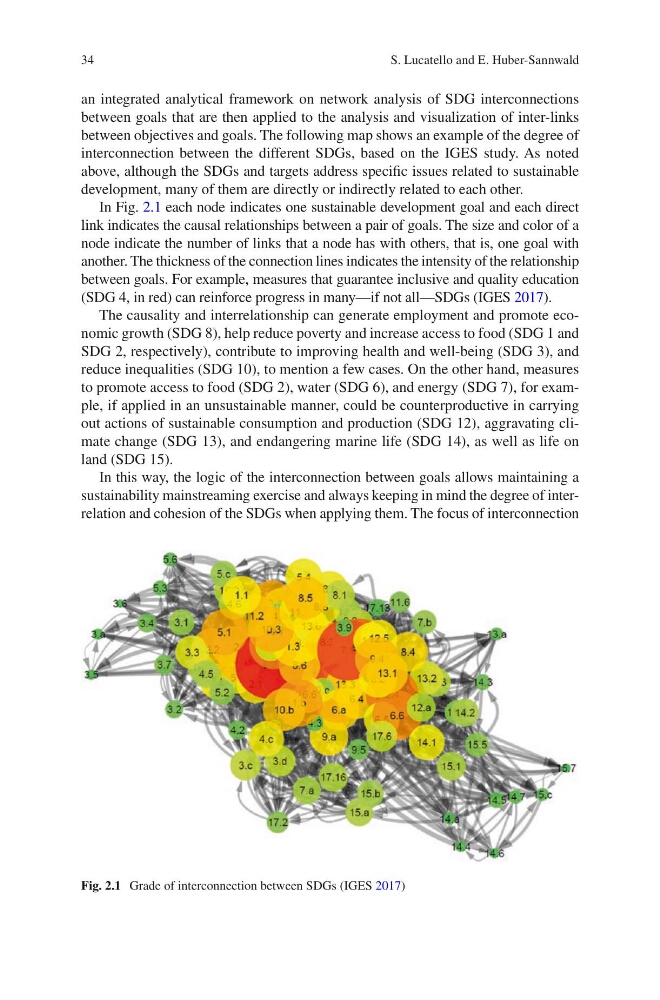
between objectives and goals. The following map shows an example of the degree of
interconnection between the different SDGs, based on the IGES study. As noted
above, although the SDGs and targets address specific issues related to sustainable
development, many of them are directly or indirectly related to each other.
In Fig. 2.1 each node indicates one sustainable development goal and each direct
link indicates the causal relationships between a pair of goals. The size and color of a
node indicate the number of links that a node has with others, that is, one goal with
another. The thickness of the connection lines indicates the intensity of the relationship
between goals. For example, measures that guarantee inclusive and quality education
(SDG 4, in red) can reinforce progress in many—if not all—SDGs (IGES 2017).
The causality and interrelationship can generate employment and promote economic growth (SDG 8), help reduce poverty and increase access to food (SDG 1 and
SDG 2, respectively), contribute to improving health and well-being (SDG 3), and
reduce inequalities (SDG 10), to mention a few cases. On the other hand, measures
to promote access to food (SDG 2), water (SDG 6), and energy (SDG 7), for example, if applied in an unsustainable manner, could be counterproductive in carrying
out actions of sustainable consumption and production (SDG 12), aggravating climate change (SDG 13), and endangering marine life (SDG 14), as well as life on
land (SDG 15).
In this way, the logic of the interconnection between goals allows maintaining a
sustainability mainstreaming exercise and always keeping in mind the degree of interrelation and cohesion of the SDGs when applying them. The focus of interconnection
Fig. 2.1 Grade of interconnection between SDGs (IGES 2017)
S. Lucatello and E. Huber-Sannwald
an integrated analytical framework on network analysis of SDG interconnections
between goals that are then applied to the analysis and visualization of inter-links
between objectives and goals. The following map shows an example of the degree of
interconnection between the different SDGs, based on the IGES study. As noted
above, although the SDGs and targets address specific issues related to sustainable
development, many of them are directly or indirectly related to each other.
In Fig. 2.1 each node indicates one sustainable development goal and each direct
link indicates the causal relationships between a pair of goals. The size and color of a
node indicate the number of links that a node has with others, that is, one goal with
another. The thickness of the connection lines indicates the intensity of the relationship
between goals. For example, measures that guarantee inclusive and quality education
(SDG 4, in red) can reinforce progress in many—if not all—SDGs (IGES 2017).
The causality and interrelationship can generate employment and promote economic growth (SDG 8), help reduce poverty and increase access to food (SDG 1 and
SDG 2, respectively), contribute to improving health and well-being (SDG 3), and
reduce inequalities (SDG 10), to mention a few cases. On the other hand, measures
to promote access to food (SDG 2), water (SDG 6), and energy (SDG 7), for example, if applied in an unsustainable manner, could be counterproductive in carrying
out actions of sustainable consumption and production (SDG 12), aggravating climate change (SDG 13), and endangering marine life (SDG 14), as well as life on
land (SDG 15).
In this way, the logic of the interconnection between goals allows maintaining a
sustainability mainstreaming exercise and always keeping in mind the degree of interrelation and cohesion of the SDGs when applying them. The focus of interconnection
Fig. 2.1 Grade of interconnection between SDGs (IGES 2017)
S. Lucatello and E. Huber-Sannwald