

322
Introduction
As established in the introduction of this book, the successful governance of coupled social-environmental systems is at the heart of the conceptual considerations
articulated in the 2030 Sustainable Development Agenda. The creation of stable
governance institutions with clearly defined equitable rules, and openness for shared
learning as a basis for collective action related to sustainable resource use is essential for the conservation of the biotic and cultural diversity (Ostrom 2000). Thus,
documenting and understanding the specific historical, cultural, economic, and
political unfolding of local communities can allow us to conduct interregional,
intercultural, and inter-policy comparisons among similar dryland socio-ecological
systems and their divergent responses to global environmental change drivers
(Chap. 1). In this context, the present chapter contributes to the advances on this
burgeoning literature by articulating the connection between transitional forms of
social cohesion and concomitant forms of environmental governance in a dry setting context among the Comcaac, an indigenous community of the coastal desert of
Northern Mexico.
The Comcaac are a small indigenous society of former hunter-gatherers living
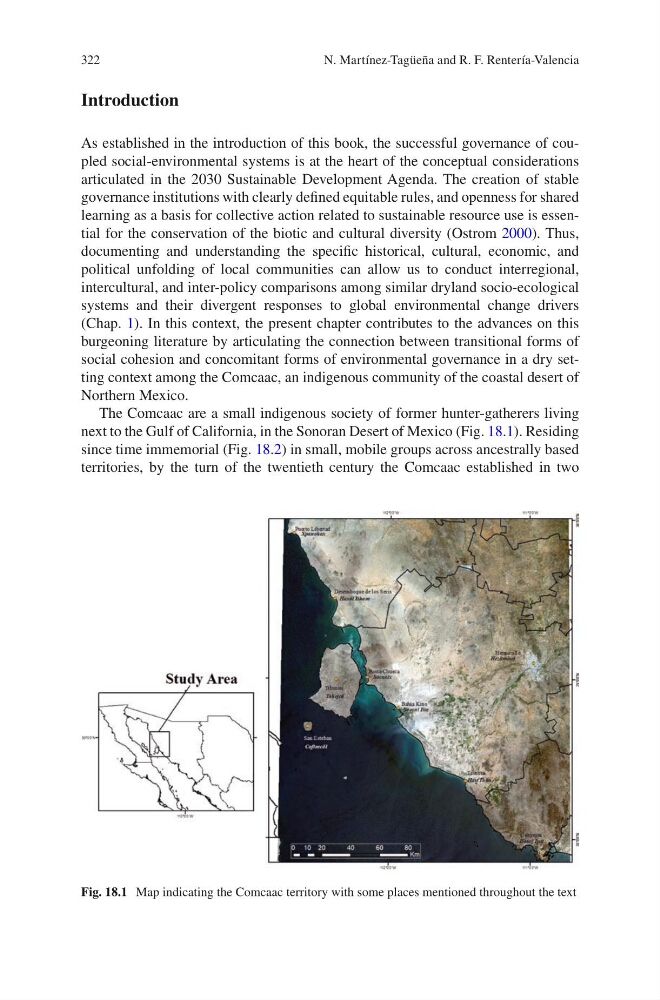
next to the Gulf of California, in the Sonoran Desert of Mexico (Fig. 18.1). Residing
since time immemorial (Fig. 18.2) in small, mobile groups across ancestrally based
territories, by the turn of the twentieth century the Comcaac established in two
Fig. 18.1 Map indicating the Comcaac territory with some places mentioned throughout the text
N. Martínez-Tagüeña and R. F. Rentería-Valencia
Introduction
As established in the introduction of this book, the successful governance of coupled social-environmental systems is at the heart of the conceptual considerations
articulated in the 2030 Sustainable Development Agenda. The creation of stable
governance institutions with clearly defined equitable rules, and openness for shared
learning as a basis for collective action related to sustainable resource use is essential for the conservation of the biotic and cultural diversity (Ostrom 2000). Thus,
documenting and understanding the specific historical, cultural, economic, and
political unfolding of local communities can allow us to conduct interregional,
intercultural, and inter-policy comparisons among similar dryland socio-ecological
systems and their divergent responses to global environmental change drivers
(Chap. 1). In this context, the present chapter contributes to the advances on this
burgeoning literature by articulating the connection between transitional forms of
social cohesion and concomitant forms of environmental governance in a dry setting context among the Comcaac, an indigenous community of the coastal desert of
Northern Mexico.
The Comcaac are a small indigenous society of former hunter-gatherers living
next to the Gulf of California, in the Sonoran Desert of Mexico (Fig. 18.1). Residing
since time immemorial (Fig. 18.2) in small, mobile groups across ancestrally based
territories, by the turn of the twentieth century the Comcaac established in two
Fig. 18.1 Map indicating the Comcaac territory with some places mentioned throughout the text
N. Martínez-Tagüeña and R. F. Rentería-Valencia