

256
A Brief Introduction to Amazigh History
The Imazighen [singular: Amazigh] or Berbers are the indigenous people of a region
called Tamazgha, which encompasses Morocco, Algeria, Tunisia, Libya, Northern
Mali, the Canary Islands, and large parts of Mauritania, Niger, and Egypt (Almasude
2014). The Amazigh languages belong to the Afro-Asiatic language family and are
spoken by about 40 million people (Lafkioui 2018), of which about 11 million live
in Morocco (Ennaji 1997). They can be grouped in several sub-groups or varieties,
among them the “Tamazight,” which is spoken in the Middle Atlas and east of High
Atlas (Ennaji 1997).
The origin of the Imazighen has been controversially discussed which, among
other things, is probably due to their very large settlement area and their ethnic
diversity. From an archeological perspective, prehistoric Amazigh colonization in
the Maghreb region can be traced back to at least 10,000 years ago (known as
Neolithic Capsian culture; Ilahiane 2006). In historical times, first references to
people known as Berbers are found in Egyptian, Greek, and Roman records (Shoup
2011). For many centuries, Amazigh groups settled along the Mediterranean coast
from Egypt to the Atlantic Ocean, where the semi-nomadic tribes have experienced
several conflicts with invaders and colonists such as Phoenicians, Greeks, Romans,
Vandals, and Byzantines, before the Arabs conquered the Maghreb. The various preArabic invasions left some imprint on the Amazigh culture as well as it vice versa
influenced other cultures.
The Islamization of the Maghreb by the Arabs started in 647 when Rome/
Byzantium lost Libya and Tunisia and was concluded in 709 when all of North
Africa was under control of the Arab caliphate. Unlike previous conquests, the
Islamization and Arabization of the region had fundamental and lasting effects on
the Amazigh society, and in large parts replaced former social norms and political
idioms (Maddy-Weitzman 2011). However, the ruling Arabs treated converts as
“second-class Muslims,” taxed them heavily, and even enslaved them, which finally
led to the Great Berber Revolt of 740 (Elfasi and Hrbek 1988). After the revolt,
several tribal kingdoms and later larger Berber dynasties (from 1060 to 1549)
emerged in the Maghreb and in Al-Andalus.
In Morocco, from 1549 onward, the Berber dynasties were replaced by the
descendant Arab dynasties that claimed descent from the prophet Muhammad. The
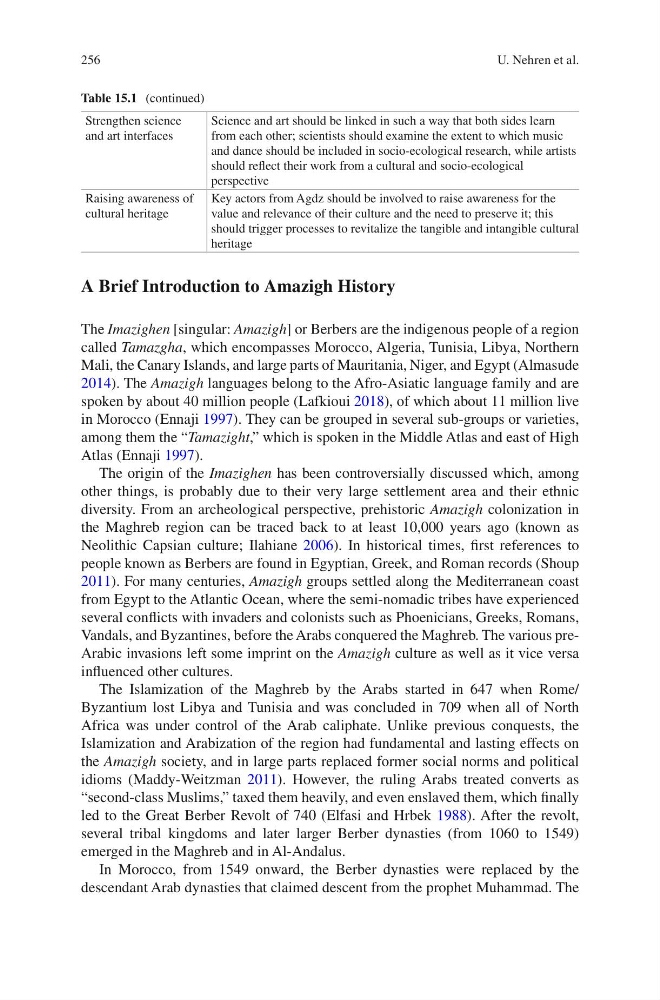
Table 15.1 (continued)
Strengthen science
and art interfaces
Science and art should be linked in such a way that both sides learn
from each other; scientists should examine the extent to which music
and dance should be included in socio-ecological research, while artists
should reflect their work from a cultural and socio-ecological
perspective
Raising awareness of
cultural heritage
Key actors from Agdz should be involved to raise awareness for the
value and relevance of their culture and the need to preserve it; this
should trigger processes to revitalize the tangible and intangible cultural
heritage
U. Nehren et al.
A Brief Introduction to Amazigh History
The Imazighen [singular: Amazigh] or Berbers are the indigenous people of a region
called Tamazgha, which encompasses Morocco, Algeria, Tunisia, Libya, Northern
Mali, the Canary Islands, and large parts of Mauritania, Niger, and Egypt (Almasude
2014). The Amazigh languages belong to the Afro-Asiatic language family and are
spoken by about 40 million people (Lafkioui 2018), of which about 11 million live
in Morocco (Ennaji 1997). They can be grouped in several sub-groups or varieties,
among them the “Tamazight,” which is spoken in the Middle Atlas and east of High
Atlas (Ennaji 1997).
The origin of the Imazighen has been controversially discussed which, among
other things, is probably due to their very large settlement area and their ethnic
diversity. From an archeological perspective, prehistoric Amazigh colonization in
the Maghreb region can be traced back to at least 10,000 years ago (known as
Neolithic Capsian culture; Ilahiane 2006). In historical times, first references to
people known as Berbers are found in Egyptian, Greek, and Roman records (Shoup
2011). For many centuries, Amazigh groups settled along the Mediterranean coast
from Egypt to the Atlantic Ocean, where the semi-nomadic tribes have experienced
several conflicts with invaders and colonists such as Phoenicians, Greeks, Romans,
Vandals, and Byzantines, before the Arabs conquered the Maghreb. The various preArabic invasions left some imprint on the Amazigh culture as well as it vice versa
influenced other cultures.
The Islamization of the Maghreb by the Arabs started in 647 when Rome/
Byzantium lost Libya and Tunisia and was concluded in 709 when all of North
Africa was under control of the Arab caliphate. Unlike previous conquests, the
Islamization and Arabization of the region had fundamental and lasting effects on
the Amazigh society, and in large parts replaced former social norms and political
idioms (Maddy-Weitzman 2011). However, the ruling Arabs treated converts as
“second-class Muslims,” taxed them heavily, and even enslaved them, which finally
led to the Great Berber Revolt of 740 (Elfasi and Hrbek 1988). After the revolt,
several tribal kingdoms and later larger Berber dynasties (from 1060 to 1549)
emerged in the Maghreb and in Al-Andalus.
In Morocco, from 1549 onward, the Berber dynasties were replaced by the
descendant Arab dynasties that claimed descent from the prophet Muhammad. The
Table 15.1 (continued)
Strengthen science
and art interfaces
Science and art should be linked in such a way that both sides learn
from each other; scientists should examine the extent to which music
and dance should be included in socio-ecological research, while artists
should reflect their work from a cultural and socio-ecological
perspective
Raising awareness of
cultural heritage
Key actors from Agdz should be involved to raise awareness for the
value and relevance of their culture and the need to preserve it; this
should trigger processes to revitalize the tangible and intangible cultural
heritage
U. Nehren et al.