

255
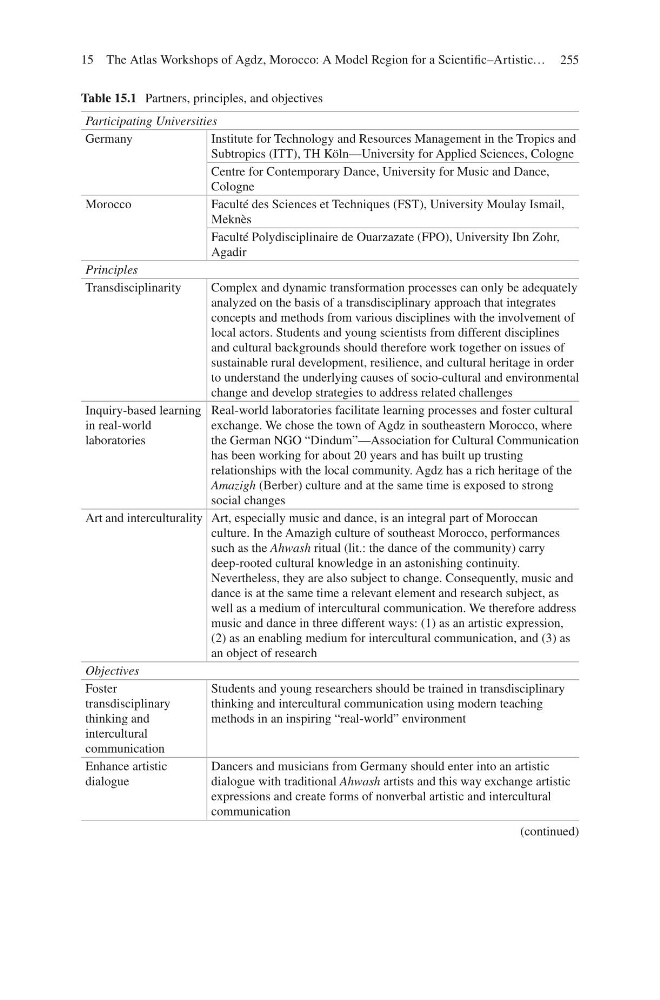
Table 15.1 Partners, principles, and objectives
Participating Universities
Germany
Institute for Technology and Resources Management in the Tropics and
Subtropics (ITT), TH Köln—University for Applied Sciences, Cologne
Centre for Contemporary Dance, University for Music and Dance,
Cologne
Morocco
Faculté des Sciences et Techniques (FST), University Moulay Ismail,
Meknès
Faculté Polydisciplinaire de Ouarzazate (FPO), University Ibn Zohr,
Agadir
Principles
Transdisciplinarity
Complex and dynamic transformation processes can only be adequately
analyzed on the basis of a transdisciplinary approach that integrates
concepts and methods from various disciplines with the involvement of
local actors. Students and young scientists from different disciplines
and cultural backgrounds should therefore work together on issues of
sustainable rural development, resilience, and cultural heritage in order
to understand the underlying causes of socio-cultural and environmental
change and develop strategies to address related challenges
Inquiry-based learning
in real-world
laboratories
Real-world laboratories facilitate learning processes and foster cultural
exchange. We chose the town of Agdz in southeastern Morocco, where
the German NGO “Dindum”—Association for Cultural Communication
has been working for about 20 years and has built up trusting
relationships with the local community. Agdz has a rich heritage of the
Amazigh (Berber) culture and at the same time is exposed to strong
social changes
Art and interculturality Art, especially music and dance, is an integral part of Moroccan
culture. In the Amazigh culture of southeast Morocco, performances
such as the Ahwash ritual (lit.: the dance of the community) carry
deep-rooted cultural knowledge in an astonishing continuity.
Nevertheless, they are also subject to change. Consequently, music and
dance is at the same time a relevant element and research subject, as
well as a medium of intercultural communication. We therefore address
music and dance in three different ways: (1) as an artistic expression,
(2) as an enabling medium for intercultural communication, and (3) as
an object of research
Objectives
Foster
transdisciplinary
thinking and
intercultural
communication
Students and young researchers should be trained in transdisciplinary
thinking and intercultural communication using modern teaching
methods in an inspiring “real-world” environment
Enhance artistic
dialogue
Dancers and musicians from Germany should enter into an artistic
dialogue with traditional Ahwash artists and this way exchange artistic
expressions and create forms of nonverbal artistic and intercultural
communication
(continued)
15 The Atlas Workshops of Agdz, Morocco: A Model Region for a Scientific–Artistic…
Table 15.1 Partners, principles, and objectives
Participating Universities
Germany
Institute for Technology and Resources Management in the Tropics and
Subtropics (ITT), TH Köln—University for Applied Sciences, Cologne
Centre for Contemporary Dance, University for Music and Dance,
Cologne
Morocco
Faculté des Sciences et Techniques (FST), University Moulay Ismail,
Meknès
Faculté Polydisciplinaire de Ouarzazate (FPO), University Ibn Zohr,
Agadir
Principles
Transdisciplinarity
Complex and dynamic transformation processes can only be adequately
analyzed on the basis of a transdisciplinary approach that integrates
concepts and methods from various disciplines with the involvement of
local actors. Students and young scientists from different disciplines
and cultural backgrounds should therefore work together on issues of
sustainable rural development, resilience, and cultural heritage in order
to understand the underlying causes of socio-cultural and environmental
change and develop strategies to address related challenges
Inquiry-based learning
in real-world
laboratories
Real-world laboratories facilitate learning processes and foster cultural
exchange. We chose the town of Agdz in southeastern Morocco, where
the German NGO “Dindum”—Association for Cultural Communication
has been working for about 20 years and has built up trusting
relationships with the local community. Agdz has a rich heritage of the
Amazigh (Berber) culture and at the same time is exposed to strong
social changes
Art and interculturality Art, especially music and dance, is an integral part of Moroccan
culture. In the Amazigh culture of southeast Morocco, performances
such as the Ahwash ritual (lit.: the dance of the community) carry
deep-rooted cultural knowledge in an astonishing continuity.
Nevertheless, they are also subject to change. Consequently, music and
dance is at the same time a relevant element and research subject, as
well as a medium of intercultural communication. We therefore address
music and dance in three different ways: (1) as an artistic expression,
(2) as an enabling medium for intercultural communication, and (3) as
an object of research
Objectives
Foster
transdisciplinary
thinking and
intercultural
communication
Students and young researchers should be trained in transdisciplinary
thinking and intercultural communication using modern teaching
methods in an inspiring “real-world” environment
Enhance artistic
dialogue
Dancers and musicians from Germany should enter into an artistic
dialogue with traditional Ahwash artists and this way exchange artistic
expressions and create forms of nonverbal artistic and intercultural
communication
(continued)
15 The Atlas Workshops of Agdz, Morocco: A Model Region for a Scientific–Artistic…