

119
of PRA is to identify the key, solvable problems in a community and then devise a
community action plan (CAP) to pursue sustainable solutions. The CAP lays out the
pathway for change and identifies the human, technical, and financial resources
needed to move forward.
While the PRA approach has been adapted to fit a variety of circumstances, the
core toolkit involves about a dozen elements. A thorough PRA can be typically
conducted in about five days. The toolkit elements include analyzing: (1) Maps of
local landscapes and key resources; (2) timelines of important historical events; (3)
seasonal activity calendars; (4) wealth class dynamics; (5) gendered activities; (6)
sustainability of livelihoods; and (7) institutions (formal and informal) that affect
community well-being. The cornerstone of the process is a community-based ranking of priority, solvable problems using matrices. Matrices compare each major
problem with every other major problem in terms of perceived costs and benefits.
16
The time needed for problem identification through solution implementation can
take months or years (Coppock 2016).
Group dynamics are diverse and can be tailored to each PRA situation. Methods
include the use of plenary opening and closing gatherings that involve as many
community members as possible; this helps ensure that awareness is raised and
surprises are avoided. Smaller breakout groups can be used to focus on details of
problems or solutions; they can also be conduits for input from marginalized people
unwilling to speak in larger assemblies (Fig. 7.4). In-depth interviews of key informants can also supplement the process, as needed. In general, change agents—
whether they be researchers, outreach staff, policy makers, or planners—are only
observers. They can provide expert feedback when the priority problems or CAP
16 While any solvable problem can emerge as a priority from a PRA, recent experiences in Africa
and Asia regarding community adaptation to climate change often end up focused on water issues
(D. L. Coppock, personal observations).
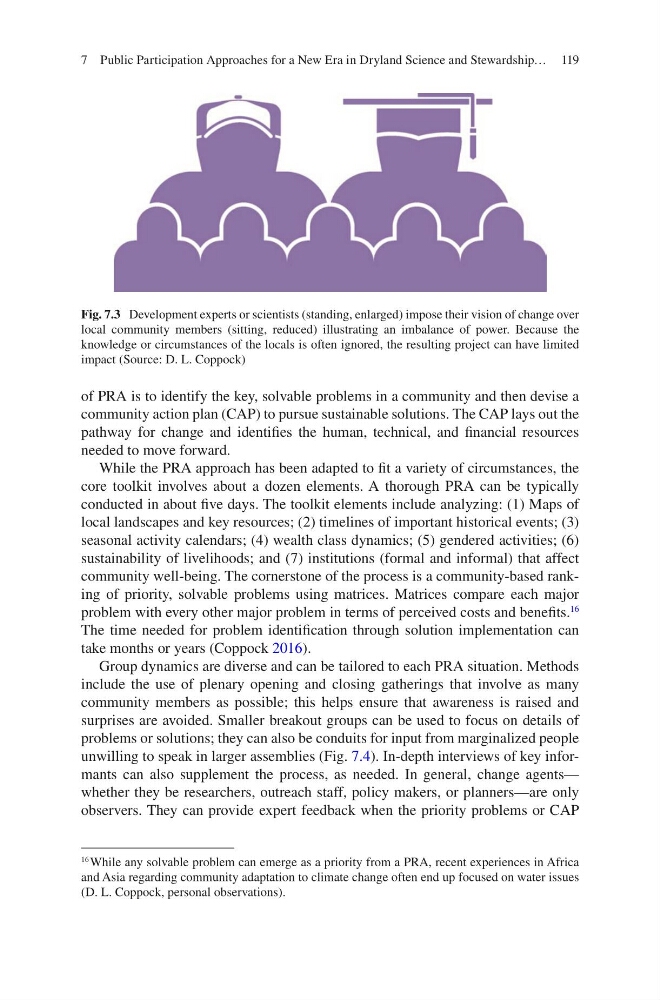
Fig. 7.3 Development experts or scientists (standing, enlarged) impose their vision of change over
local community members (sitting, reduced) illustrating an imbalance of power. Because the
knowledge or circumstances of the locals is often ignored, the resulting project can have limited
impact (Source: D. L. Coppock)
7 Public Participation Approaches for a New Era in Dryland Science and Stewardship…
of PRA is to identify the key, solvable problems in a community and then devise a
community action plan (CAP) to pursue sustainable solutions. The CAP lays out the
pathway for change and identifies the human, technical, and financial resources
needed to move forward.
While the PRA approach has been adapted to fit a variety of circumstances, the
core toolkit involves about a dozen elements. A thorough PRA can be typically
conducted in about five days. The toolkit elements include analyzing: (1) Maps of
local landscapes and key resources; (2) timelines of important historical events; (3)
seasonal activity calendars; (4) wealth class dynamics; (5) gendered activities; (6)
sustainability of livelihoods; and (7) institutions (formal and informal) that affect
community well-being. The cornerstone of the process is a community-based ranking of priority, solvable problems using matrices. Matrices compare each major
problem with every other major problem in terms of perceived costs and benefits.
16
The time needed for problem identification through solution implementation can
take months or years (Coppock 2016).
Group dynamics are diverse and can be tailored to each PRA situation. Methods
include the use of plenary opening and closing gatherings that involve as many
community members as possible; this helps ensure that awareness is raised and
surprises are avoided. Smaller breakout groups can be used to focus on details of
problems or solutions; they can also be conduits for input from marginalized people
unwilling to speak in larger assemblies (Fig. 7.4). In-depth interviews of key informants can also supplement the process, as needed. In general, change agents—
whether they be researchers, outreach staff, policy makers, or planners—are only
observers. They can provide expert feedback when the priority problems or CAP
16 While any solvable problem can emerge as a priority from a PRA, recent experiences in Africa
and Asia regarding community adaptation to climate change often end up focused on water issues
(D. L. Coppock, personal observations).
Fig. 7.3 Development experts or scientists (standing, enlarged) impose their vision of change over
local community members (sitting, reduced) illustrating an imbalance of power. Because the
knowledge or circumstances of the locals is often ignored, the resulting project can have limited
impact (Source: D. L. Coppock)
7 Public Participation Approaches for a New Era in Dryland Science and Stewardship…