

116
New Approaches Linking Research with the Public in the USA
There is growing awareness at American colleges and universities that public engagement matters in ways that go beyond the traditional roles of teaching or extension. In
essence, academic leadership is questioning how universities can regain public trust
that has been eroded due to perceptions that campuses have become insular environments. As a case in point, schools across the US have recently embraced the concept
of the “engaged university,” whereby researchers and educators partner with local
communities in processes of mutual learning and problem-solving. The emergence
of engaged scholarship recognizes that academic expertise can be valuable for societal problem-solving (Whitmer et al. 2010). As an offshoot of this momentum,
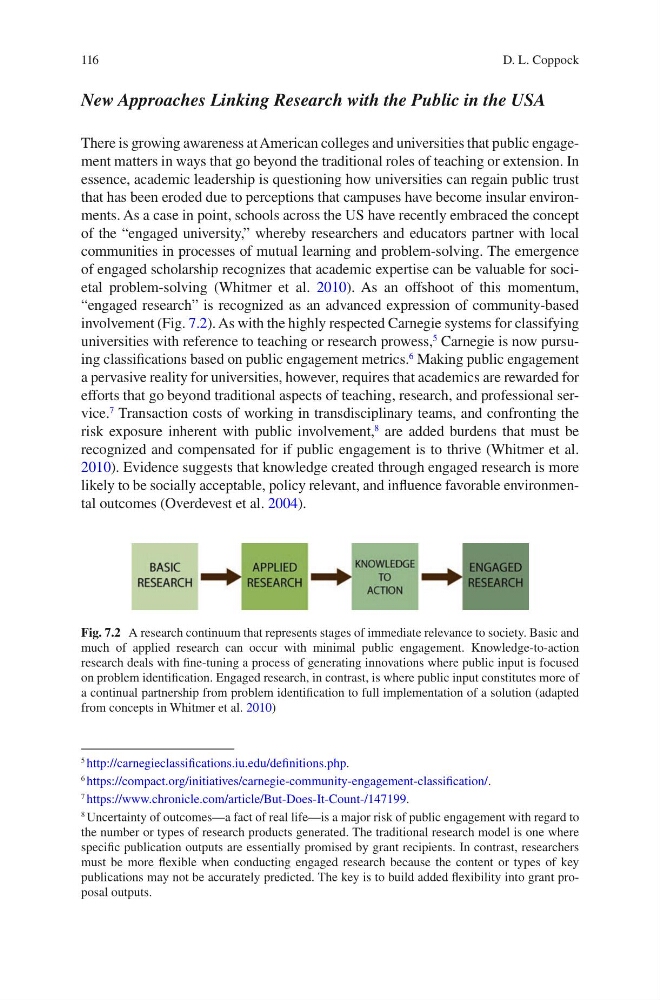
“engaged research” is recognized as an advanced expression of community-based
involvement (Fig. 7.2). As with the highly respected Carnegie systems for classifying
universities with reference to teaching or research prowess,
5
Carnegie is now pursuing classifications based on public engagement metrics.
6
Making public engagement
a pervasive reality for universities, however, requires that academics are rewarded for
efforts that go beyond traditional aspects of teaching, research, and professional service.
7
Transaction costs of working in transdisciplinary teams, and confronting the
risk exposure inherent with public involvement,
8
are added burdens that must be
recognized and compensated for if public engagement is to thrive (Whitmer et al.
2010). Evidence suggests that knowledge created through engaged research is more
likely to be socially acceptable, policy relevant, and influence favorable environmental outcomes (Overdevest et al. 2004).
5 http://carnegieclassifications.iu.edu/definitions.php.
6 https://compact.org/initiatives/carnegie-community-engagement-classification/.
7 https://www.chronicle.com/article/But-Does-It-Count-/147199.
8 Uncertainty of outcomes—a fact of real life—is a major risk of public engagement with regard to
the number or types of research products generated. The traditional research model is one where
specific publication outputs are essentially promised by grant recipients. In contrast, researchers
must be more flexible when conducting engaged research because the content or types of key
publications may not be accurately predicted. The key is to build added flexibility into grant proposal outputs.
Fig. 7.2 A research continuum that represents stages of immediate relevance to society. Basic and
much of applied research can occur with minimal public engagement. Knowledge-to-action
research deals with fine-tuning a process of generating innovations where public input is focused
on problem identification. Engaged research, in contrast, is where public input constitutes more of
a continual partnership from problem identification to full implementation of a solution (adapted
from concepts in Whitmer et al. 2010)
D. L. Coppock
New Approaches Linking Research with the Public in the USA
There is growing awareness at American colleges and universities that public engagement matters in ways that go beyond the traditional roles of teaching or extension. In
essence, academic leadership is questioning how universities can regain public trust
that has been eroded due to perceptions that campuses have become insular environments. As a case in point, schools across the US have recently embraced the concept
of the “engaged university,” whereby researchers and educators partner with local
communities in processes of mutual learning and problem-solving. The emergence
of engaged scholarship recognizes that academic expertise can be valuable for societal problem-solving (Whitmer et al. 2010). As an offshoot of this momentum,
“engaged research” is recognized as an advanced expression of community-based
involvement (Fig. 7.2). As with the highly respected Carnegie systems for classifying
universities with reference to teaching or research prowess,
5
Carnegie is now pursuing classifications based on public engagement metrics.
6
Making public engagement
a pervasive reality for universities, however, requires that academics are rewarded for
efforts that go beyond traditional aspects of teaching, research, and professional service.
7
Transaction costs of working in transdisciplinary teams, and confronting the
risk exposure inherent with public involvement,
8
are added burdens that must be
recognized and compensated for if public engagement is to thrive (Whitmer et al.
2010). Evidence suggests that knowledge created through engaged research is more
likely to be socially acceptable, policy relevant, and influence favorable environmental outcomes (Overdevest et al. 2004).
5 http://carnegieclassifications.iu.edu/definitions.php.
6 https://compact.org/initiatives/carnegie-community-engagement-classification/.
7 https://www.chronicle.com/article/But-Does-It-Count-/147199.
8 Uncertainty of outcomes—a fact of real life—is a major risk of public engagement with regard to
the number or types of research products generated. The traditional research model is one where
specific publication outputs are essentially promised by grant recipients. In contrast, researchers
must be more flexible when conducting engaged research because the content or types of key
publications may not be accurately predicted. The key is to build added flexibility into grant proposal outputs.
Fig. 7.2 A research continuum that represents stages of immediate relevance to society. Basic and
much of applied research can occur with minimal public engagement. Knowledge-to-action
research deals with fine-tuning a process of generating innovations where public input is focused
on problem identification. Engaged research, in contrast, is where public input constitutes more of
a continual partnership from problem identification to full implementation of a solution (adapted
from concepts in Whitmer et al. 2010)
D. L. Coppock