

115
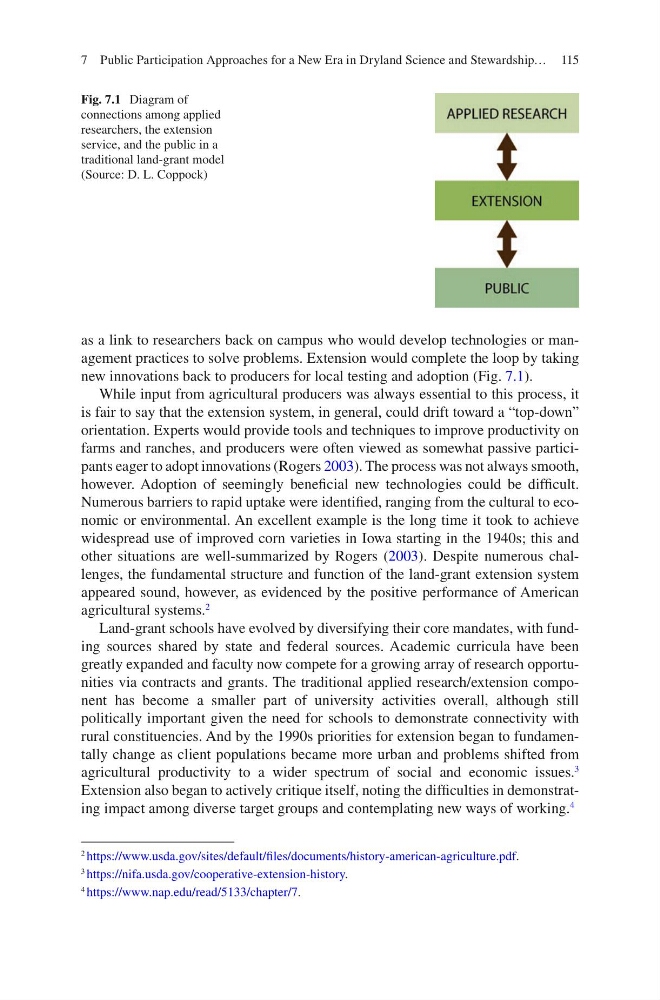
as a link to researchers back on campus who would develop technologies or management practices to solve problems. Extension would complete the loop by taking
new innovations back to producers for local testing and adoption (Fig. 7.1).
While input from agricultural producers was always essential to this process, it
is fair to say that the extension system, in general, could drift toward a “top-down”
orientation. Experts would provide tools and techniques to improve productivity on
farms and ranches, and producers were often viewed as somewhat passive participants eager to adopt innovations (Rogers 2003). The process was not always smooth,
however. Adoption of seemingly beneficial new technologies could be difficult.
Numerous barriers to rapid uptake were identified, ranging from the cultural to economic or environmental. An excellent example is the long time it took to achieve
widespread use of improved corn varieties in Iowa starting in the 1940s; this and
other situations are well-summarized by Rogers (2003). Despite numerous challenges, the fundamental structure and function of the land-grant extension system
appeared sound, however, as evidenced by the positive performance of American
agricultural systems.
2
Land-grant schools have evolved by diversifying their core mandates, with funding sources shared by state and federal sources. Academic curricula have been
greatly expanded and faculty now compete for a growing array of research opportunities via contracts and grants. The traditional applied research/extension component has become a smaller part of university activities overall, although still
politically important given the need for schools to demonstrate connectivity with
rural constituencies. And by the 1990s priorities for extension began to fundamentally change as client populations became more urban and problems shifted from
agricultural productivity to a wider spectrum of social and economic issues.
3
Extension also began to actively critique itself, noting the difficulties in demonstrating impact among diverse target groups and contemplating new ways of working.
4
2 https://www.usda.gov/sites/default/files/documents/history-american-agriculture.pdf.
3 https://nifa.usda.gov/cooperative-extension-history.
4 https://www.nap.edu/read/5133/chapter/7.
Fig. 7.1 Diagram of
connections among applied
researchers, the extension
service, and the public in a
traditional land-grant model
(Source: D. L. Coppock)
7 Public Participation Approaches for a New Era in Dryland Science and Stewardship…
as a link to researchers back on campus who would develop technologies or management practices to solve problems. Extension would complete the loop by taking
new innovations back to producers for local testing and adoption (Fig. 7.1).
While input from agricultural producers was always essential to this process, it
is fair to say that the extension system, in general, could drift toward a “top-down”
orientation. Experts would provide tools and techniques to improve productivity on
farms and ranches, and producers were often viewed as somewhat passive participants eager to adopt innovations (Rogers 2003). The process was not always smooth,
however. Adoption of seemingly beneficial new technologies could be difficult.
Numerous barriers to rapid uptake were identified, ranging from the cultural to economic or environmental. An excellent example is the long time it took to achieve
widespread use of improved corn varieties in Iowa starting in the 1940s; this and
other situations are well-summarized by Rogers (2003). Despite numerous challenges, the fundamental structure and function of the land-grant extension system
appeared sound, however, as evidenced by the positive performance of American
agricultural systems.
2
Land-grant schools have evolved by diversifying their core mandates, with funding sources shared by state and federal sources. Academic curricula have been
greatly expanded and faculty now compete for a growing array of research opportunities via contracts and grants. The traditional applied research/extension component has become a smaller part of university activities overall, although still
politically important given the need for schools to demonstrate connectivity with
rural constituencies. And by the 1990s priorities for extension began to fundamentally change as client populations became more urban and problems shifted from
agricultural productivity to a wider spectrum of social and economic issues.
3
Extension also began to actively critique itself, noting the difficulties in demonstrating impact among diverse target groups and contemplating new ways of working.
4
2 https://www.usda.gov/sites/default/files/documents/history-american-agriculture.pdf.
3 https://nifa.usda.gov/cooperative-extension-history.
4 https://www.nap.edu/read/5133/chapter/7.
Fig. 7.1 Diagram of
connections among applied
researchers, the extension
service, and the public in a
traditional land-grant model
(Source: D. L. Coppock)
7 Public Participation Approaches for a New Era in Dryland Science and Stewardship…