

92
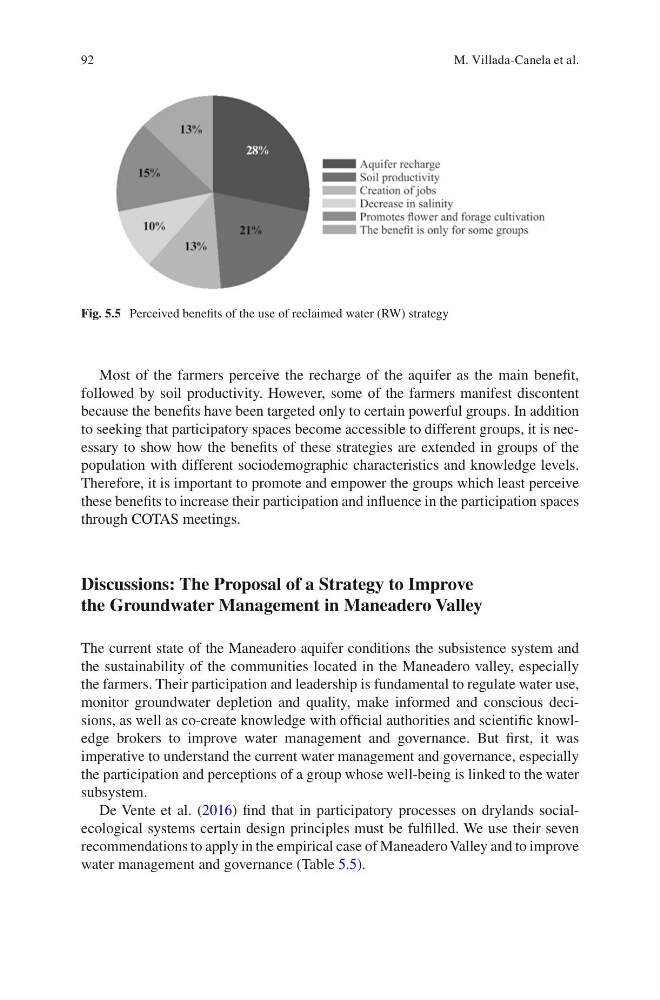
Most of the farmers perceive the recharge of the aquifer as the main benefit,
followed by soil productivity. However, some of the farmers manifest discontent
because the benefits have been targeted only to certain powerful groups. In addition
to seeking that participatory spaces become accessible to different groups, it is necessary to show how the benefits of these strategies are extended in groups of the
population with different sociodemographic characteristics and knowledge levels.
Therefore, it is important to promote and empower the groups which least perceive
these benefits to increase their participation and influence in the participation spaces
through COTAS meetings.
Discussions: The Proposal of a Strategy to Improve
the Groundwater Management in Maneadero Valley
The current state of the Maneadero aquifer conditions the subsistence system and
the sustainability of the communities located in the Maneadero valley, especially
the farmers. Their participation and leadership is fundamental to regulate water use,
monitor groundwater depletion and quality, make informed and conscious decisions, as well as co-create knowledge with official authorities and scientific knowledge brokers to improve water management and governance. But first, it was
imperative to understand the current water management and governance, especially
the participation and perceptions of a group whose well-being is linked to the water
subsystem.
De Vente et al. (2016) find that in participatory processes on drylands socialecological systems certain design principles must be fulfilled. We use their seven
recommendations to apply in the empirical case of Maneadero Valley and to improve
water management and governance (Table 5.5).
Fig. 5.5 Perceived benefits of the use of reclaimed water (RW) strategy
M. Villada-Canela et al.
Most of the farmers perceive the recharge of the aquifer as the main benefit,
followed by soil productivity. However, some of the farmers manifest discontent
because the benefits have been targeted only to certain powerful groups. In addition
to seeking that participatory spaces become accessible to different groups, it is necessary to show how the benefits of these strategies are extended in groups of the
population with different sociodemographic characteristics and knowledge levels.
Therefore, it is important to promote and empower the groups which least perceive
these benefits to increase their participation and influence in the participation spaces
through COTAS meetings.
Discussions: The Proposal of a Strategy to Improve
the Groundwater Management in Maneadero Valley
The current state of the Maneadero aquifer conditions the subsistence system and
the sustainability of the communities located in the Maneadero valley, especially
the farmers. Their participation and leadership is fundamental to regulate water use,
monitor groundwater depletion and quality, make informed and conscious decisions, as well as co-create knowledge with official authorities and scientific knowledge brokers to improve water management and governance. But first, it was
imperative to understand the current water management and governance, especially
the participation and perceptions of a group whose well-being is linked to the water
subsystem.
De Vente et al. (2016) find that in participatory processes on drylands socialecological systems certain design principles must be fulfilled. We use their seven
recommendations to apply in the empirical case of Maneadero Valley and to improve
water management and governance (Table 5.5).
Fig. 5.5 Perceived benefits of the use of reclaimed water (RW) strategy
M. Villada-Canela et al.