

90
Implemented Technical Solutions to Groundwater Scarcity
and Pollution
Two strategies were explored through the survey: the use of private desalination
plants and the use of RW from treated wastewater plants. Private desalination plants
have been perceived as a good alternative to maintain agricultural production by
90% of respondents. Some of farmers are already using desalination plants, but they
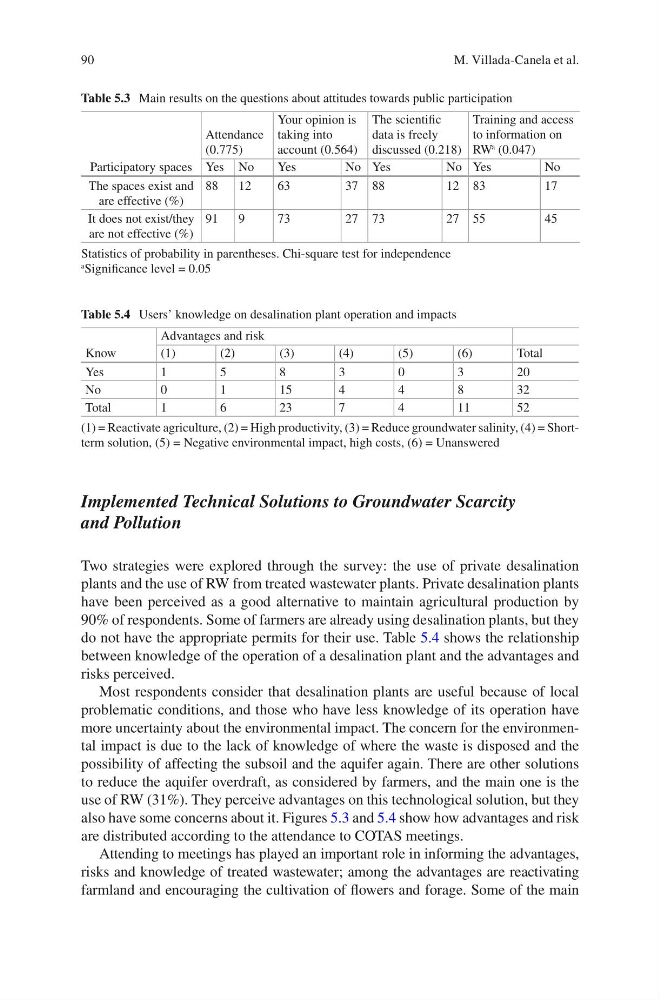
do not have the appropriate permits for their use. Table 5.4 shows the relationship
between knowledge of the operation of a desalination plant and the advantages and
risks perceived.
Most respondents consider that desalination plants are useful because of local
problematic conditions, and those who have less knowledge of its operation have
more uncertainty about the environmental impact. The concern for the environmental impact is due to the lack of knowledge of where the waste is disposed and the
possibility of affecting the subsoil and the aquifer again. There are other solutions
to reduce the aquifer overdraft, as considered by farmers, and the main one is the
use of RW (31%). They perceive advantages on this technological solution, but they
also have some concerns about it. Figures 5.3 and 5.4 show how advantages and risk
are distributed according to the attendance to COTAS meetings.
Attending to meetings has played an important role in informing the advantages,
risks and knowledge of treated wastewater; among the advantages are reactivating
farmland and encouraging the cultivation of flowers and forage. Some of the main
Table 5.3 Main results on the questions about attitudes towards public participation
Participatory spaces
Attendance
(0.775)
Your opinion is
taking into
account (0.564)
The scientific
data is freely
discussed (0.218)
Training and access
to information on
RW
a (0.047)
Yes No
Yes
No Yes
No Yes
No
The spaces exist and
are effective (%)
88
12
63
37 88
12 83
17
It does not exist/they
are not effective (%)
91
9
73
27 73
27 55
45
Statistics of probability in parentheses. Chi-square test for independence
a
Significance level = 0.05
Table 5.4 Users’ knowledge on desalination plant operation and impacts
Know
Advantages and risk
(1)
(2)
(3)
(4)
(5)
(6)
Total
Yes
1
5
8
3
0
3
20
No
0
1
15
4
4
8
32
Total
1
6
23
7
4
11
52
(1) = Reactivate agriculture, (2) = High productivity, (3) = Reduce groundwater salinity, (4) = Shortterm solution, (5) = Negative environmental impact, high costs, (6) = Unanswered
M. Villada-Canela et al.
Implemented Technical Solutions to Groundwater Scarcity
and Pollution
Two strategies were explored through the survey: the use of private desalination
plants and the use of RW from treated wastewater plants. Private desalination plants
have been perceived as a good alternative to maintain agricultural production by
90% of respondents. Some of farmers are already using desalination plants, but they
do not have the appropriate permits for their use. Table 5.4 shows the relationship
between knowledge of the operation of a desalination plant and the advantages and
risks perceived.
Most respondents consider that desalination plants are useful because of local
problematic conditions, and those who have less knowledge of its operation have
more uncertainty about the environmental impact. The concern for the environmental impact is due to the lack of knowledge of where the waste is disposed and the
possibility of affecting the subsoil and the aquifer again. There are other solutions
to reduce the aquifer overdraft, as considered by farmers, and the main one is the
use of RW (31%). They perceive advantages on this technological solution, but they
also have some concerns about it. Figures 5.3 and 5.4 show how advantages and risk
are distributed according to the attendance to COTAS meetings.
Attending to meetings has played an important role in informing the advantages,
risks and knowledge of treated wastewater; among the advantages are reactivating
farmland and encouraging the cultivation of flowers and forage. Some of the main
Table 5.3 Main results on the questions about attitudes towards public participation
Participatory spaces
Attendance
(0.775)
Your opinion is
taking into
account (0.564)
The scientific
data is freely
discussed (0.218)
Training and access
to information on
RW
a (0.047)
Yes No
Yes
No Yes
No Yes
No
The spaces exist and
are effective (%)
88
12
63
37 88
12 83
17
It does not exist/they
are not effective (%)
91
9
73
27 73
27 55
45
Statistics of probability in parentheses. Chi-square test for independence
a
Significance level = 0.05
Table 5.4 Users’ knowledge on desalination plant operation and impacts
Know
Advantages and risk
(1)
(2)
(3)
(4)
(5)
(6)
Total
Yes
1
5
8
3
0
3
20
No
0
1
15
4
4
8
32
Total
1
6
23
7
4
11
52
(1) = Reactivate agriculture, (2) = High productivity, (3) = Reduce groundwater salinity, (4) = Shortterm solution, (5) = Negative environmental impact, high costs, (6) = Unanswered
M. Villada-Canela et al.