

89
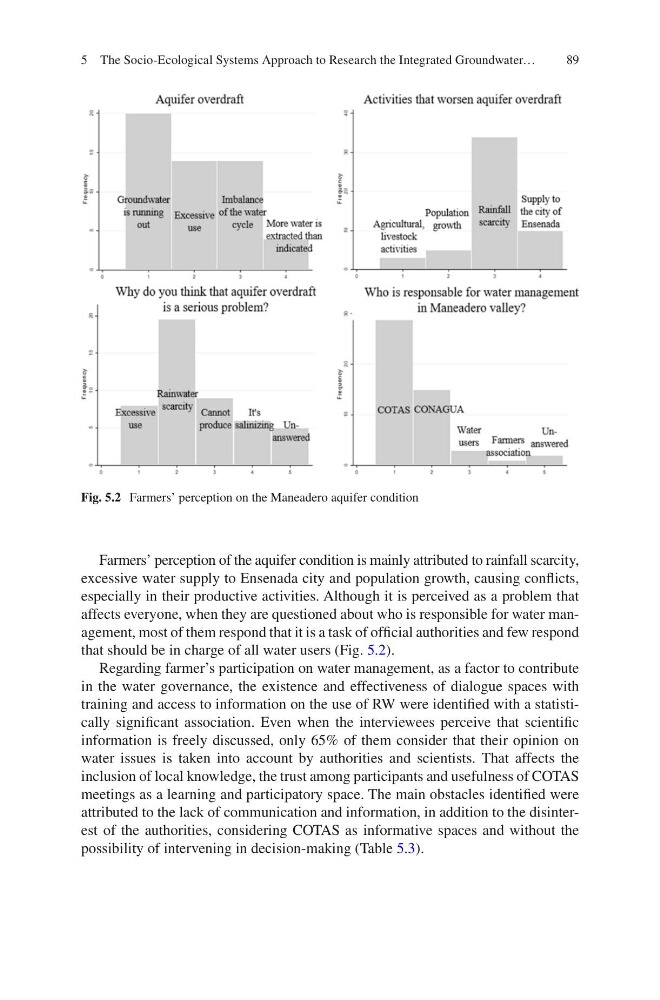
Farmers’ perception of the aquifer condition is mainly attributed to rainfall scarcity,
excessive water supply to Ensenada city and population growth, causing conflicts,
especially in their productive activities. Although it is perceived as a problem that
affects everyone, when they are questioned about who is responsible for water management, most of them respond that it is a task of official authorities and few respond
that should be in charge of all water users (Fig. 5.2).
Regarding farmer’s participation on water management, as a factor to contribute
in the water governance, the existence and effectiveness of dialogue spaces with
training and access to information on the use of RW were identified with a statistically significant association. Even when the interviewees perceive that scientific
information is freely discussed, only 65% of them consider that their opinion on
water issues is taken into account by authorities and scientists. That affects the
inclusion of local knowledge, the trust among participants and usefulness of COTAS
meetings as a learning and participatory space. The main obstacles identified were
attributed to the lack of communication and information, in addition to the disinterest of the authorities, considering COTAS as informative spaces and without the
possibility of intervening in decision-making (Table 5.3).
Fig. 5.2 Farmers’ perception on the Maneadero aquifer condition
5 The Socio-Ecological Systems Approach to Research the Integrated Groundwater…
Farmers’ perception of the aquifer condition is mainly attributed to rainfall scarcity,
excessive water supply to Ensenada city and population growth, causing conflicts,
especially in their productive activities. Although it is perceived as a problem that
affects everyone, when they are questioned about who is responsible for water management, most of them respond that it is a task of official authorities and few respond
that should be in charge of all water users (Fig. 5.2).
Regarding farmer’s participation on water management, as a factor to contribute
in the water governance, the existence and effectiveness of dialogue spaces with
training and access to information on the use of RW were identified with a statistically significant association. Even when the interviewees perceive that scientific
information is freely discussed, only 65% of them consider that their opinion on
water issues is taken into account by authorities and scientists. That affects the
inclusion of local knowledge, the trust among participants and usefulness of COTAS
meetings as a learning and participatory space. The main obstacles identified were
attributed to the lack of communication and information, in addition to the disinterest of the authorities, considering COTAS as informative spaces and without the
possibility of intervening in decision-making (Table 5.3).
Fig. 5.2 Farmers’ perception on the Maneadero aquifer condition
5 The Socio-Ecological Systems Approach to Research the Integrated Groundwater…