

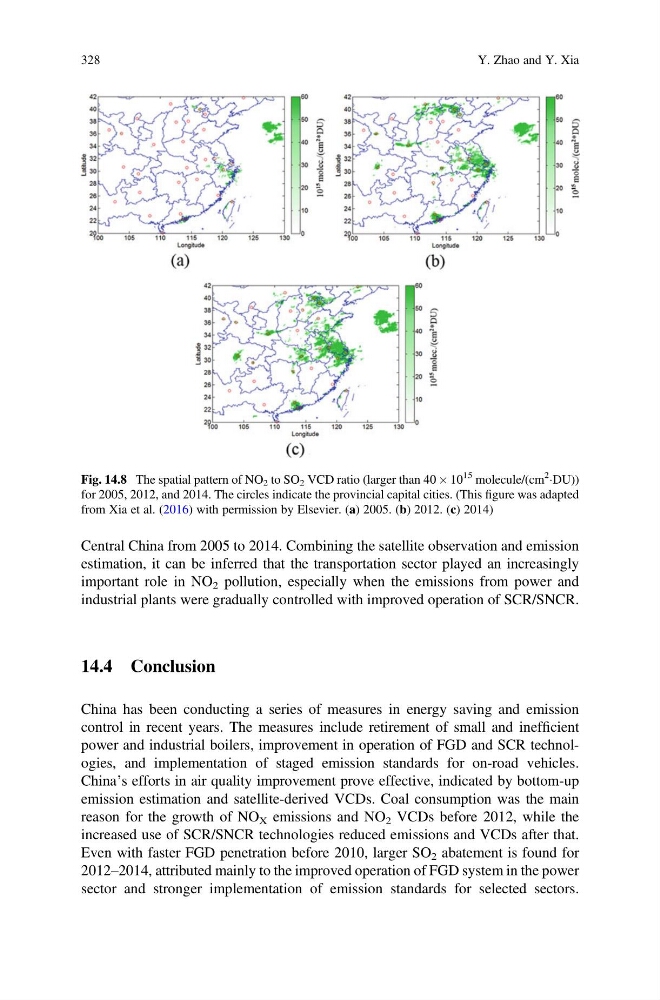
Central China from 2005 to 2014. Combining the satellite observation and emission
estimation, it can be inferred that the transportation sector played an increasingly
important role in NO 2 pollution, especially when the emissions from power and
industrial plants were gradually controlled with improved operation of SCR/SNCR.
14.4 Conclusion
China has been conducting a series of measures in energy saving and emission
control in recent years. The measures include retirement of small and inefficient
power and industrial boilers, improvement in operation of FGD and SCR technologies, and implementation of staged emission standards for on-road vehicles.
China’s efforts in air quality improvement prove effective, indicated by bottom-up
emission estimation and satellite-derived VCDs. Coal consumption was the main
reason for the growth of NO X emissions and NO 2 VCDs before 2012, while the
increased use of SCR/SNCR technologies reduced emissions and VCDs after that.
Even with faster FGD penetration before 2010, larger SO 2 abatement is found for
2012–2014, attributed mainly to the improved operation of FGD system in the power
sector and stronger implementation of emission standards for selected sectors.
Fig. 14.8 The spatial pattern of NO 2 to SO 2 VCD ratio (larger than 40 Â 10
15 molecule/(cm
2
ÁDU))
for 2005, 2012, and 2014. The circles indicate the provincial capital cities. (This figure was adapted
from Xia et al. (2016) with permission by Elsevier. (a) 2005. (b) 2012. (c) 2014)
328
Y. Zhao and Y. Xia
estimation, it can be inferred that the transportation sector played an increasingly
important role in NO 2 pollution, especially when the emissions from power and
industrial plants were gradually controlled with improved operation of SCR/SNCR.
14.4 Conclusion
China has been conducting a series of measures in energy saving and emission
control in recent years. The measures include retirement of small and inefficient
power and industrial boilers, improvement in operation of FGD and SCR technologies, and implementation of staged emission standards for on-road vehicles.
China’s efforts in air quality improvement prove effective, indicated by bottom-up
emission estimation and satellite-derived VCDs. Coal consumption was the main
reason for the growth of NO X emissions and NO 2 VCDs before 2012, while the
increased use of SCR/SNCR technologies reduced emissions and VCDs after that.
Even with faster FGD penetration before 2010, larger SO 2 abatement is found for
2012–2014, attributed mainly to the improved operation of FGD system in the power
sector and stronger implementation of emission standards for selected sectors.
Fig. 14.8 The spatial pattern of NO 2 to SO 2 VCD ratio (larger than 40 Â 10
15 molecule/(cm
2
ÁDU))
for 2005, 2012, and 2014. The circles indicate the provincial capital cities. (This figure was adapted
from Xia et al. (2016) with permission by Elsevier. (a) 2005. (b) 2012. (c) 2014)
328
Y. Zhao and Y. Xia