

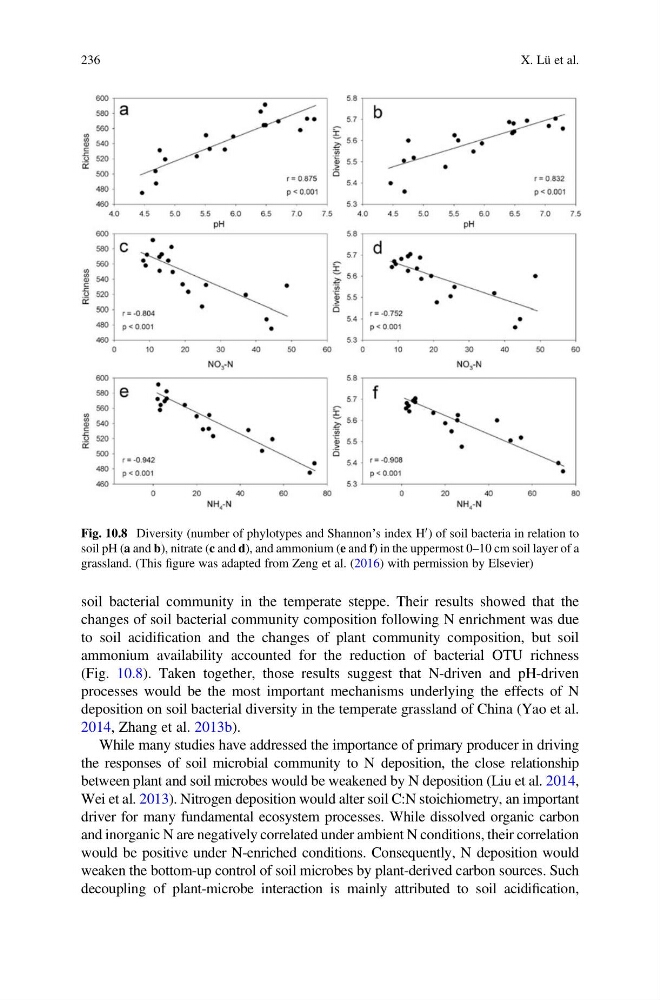
soil bacterial community in the temperate steppe. Their results showed that the
changes of soil bacterial community composition following N enrichment was due
to soil acidification and the changes of plant community composition, but soil
ammonium availability accounted for the reduction of bacterial OTU richness
(Fig. 10.8). Taken together, those results suggest that N-driven and pH-driven
processes would be the most important mechanisms underlying the effects of N
deposition on soil bacterial diversity in the temperate grassland of China (Yao et al.
2014, Zhang et al. 2013b).
While many studies have addressed the importance of primary producer in driving
the responses of soil microbial community to N deposition, the close relationship
between plant and soil microbes would be weakened by N deposition (Liu et al. 2014,
Wei et al. 2013). Nitrogen deposition would alter soil C:N stoichiometry, an important
driver for many fundamental ecosystem processes. While dissolved organic carbon
and inorganic N are negatively correlated under ambient N conditions, their correlation
would be positive under N-enriched conditions. Consequently, N deposition would
weaken the bottom-up control of soil microbes by plant-derived carbon sources. Such
decoupling of plant-microbe interaction is mainly attributed to soil acidification,
Fig. 10.8 Diversity (number of phylotypes and Shannon’s index H
0 ) of soil bacteria in relation to
soil pH (a and b), nitrate (c and d), and ammonium (e and f) in the uppermost 0–10 cm soil layer of a
grassland. (This figure was adapted from Zeng et al. (2016) with permission by Elsevier)
236
X. Lü et al.
changes of soil bacterial community composition following N enrichment was due
to soil acidification and the changes of plant community composition, but soil
ammonium availability accounted for the reduction of bacterial OTU richness
(Fig. 10.8). Taken together, those results suggest that N-driven and pH-driven
processes would be the most important mechanisms underlying the effects of N
deposition on soil bacterial diversity in the temperate grassland of China (Yao et al.
2014, Zhang et al. 2013b).
While many studies have addressed the importance of primary producer in driving
the responses of soil microbial community to N deposition, the close relationship
between plant and soil microbes would be weakened by N deposition (Liu et al. 2014,
Wei et al. 2013). Nitrogen deposition would alter soil C:N stoichiometry, an important
driver for many fundamental ecosystem processes. While dissolved organic carbon
and inorganic N are negatively correlated under ambient N conditions, their correlation
would be positive under N-enriched conditions. Consequently, N deposition would
weaken the bottom-up control of soil microbes by plant-derived carbon sources. Such
decoupling of plant-microbe interaction is mainly attributed to soil acidification,
Fig. 10.8 Diversity (number of phylotypes and Shannon’s index H
0 ) of soil bacteria in relation to
soil pH (a and b), nitrate (c and d), and ammonium (e and f) in the uppermost 0–10 cm soil layer of a
grassland. (This figure was adapted from Zeng et al. (2016) with permission by Elsevier)
236
X. Lü et al.