

Current O 3 levels in China are high enough to cause chronic changes in trees such
as reduced photosynthesis, decreased productivity, and accelerated leaf senescence.
Such severe damage should not be unnoticed because forests and trees are the most
important carbon sinks (Wittig et al. 2009).
China is one of the world’s most forest-deficient countries: forests cover only
22% of the total land area, which is significantly less than a 30% global average
(Fang et al. 2014). Capacity and strength of carbon sink by boreal forests at
midlatitudes of the northern hemisphere are significantly reduced because of
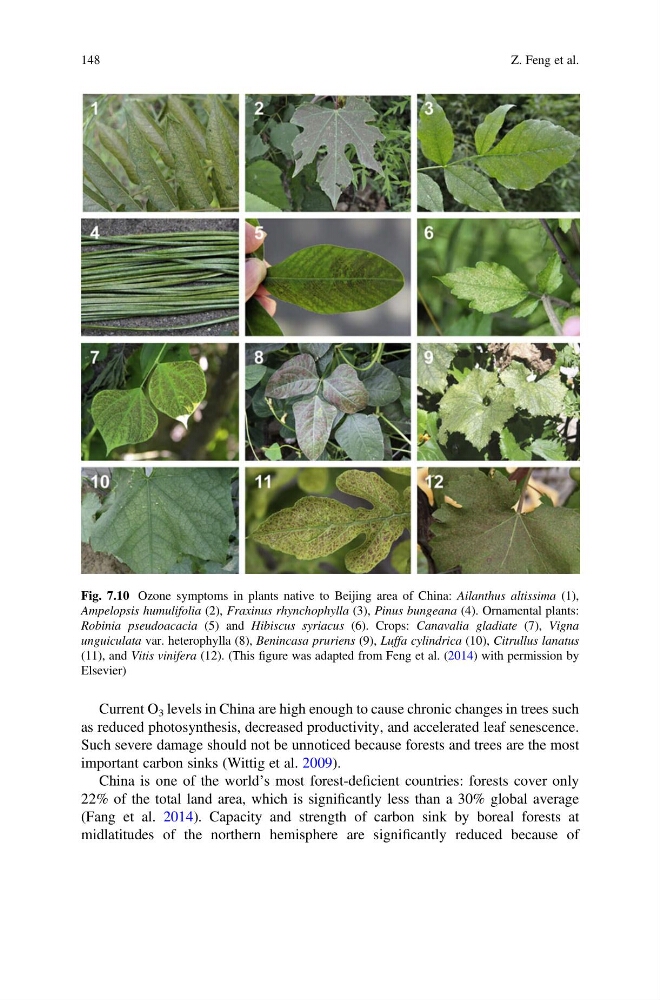
Fig. 7.10 Ozone symptoms in plants native to Beijing area of China: Ailanthus altissima (1),
Ampelopsis humulifolia (2), Fraxinus rhynchophylla (3), Pinus bungeana (4). Ornamental plants:
Robinia pseudoacacia (5) and Hibiscus syriacus (6). Crops: Canavalia gladiate (7), Vigna
unguiculata var. heterophylla (8), Benincasa pruriens (9), Luffa cylindrica (10), Citrullus lanatus
(11), and Vitis vinifera (12). (This figure was adapted from Feng et al. (2014) with permission by
Elsevier)
148
Z. Feng et al.
as reduced photosynthesis, decreased productivity, and accelerated leaf senescence.
Such severe damage should not be unnoticed because forests and trees are the most
important carbon sinks (Wittig et al. 2009).
China is one of the world’s most forest-deficient countries: forests cover only
22% of the total land area, which is significantly less than a 30% global average
(Fang et al. 2014). Capacity and strength of carbon sink by boreal forests at
midlatitudes of the northern hemisphere are significantly reduced because of
Fig. 7.10 Ozone symptoms in plants native to Beijing area of China: Ailanthus altissima (1),
Ampelopsis humulifolia (2), Fraxinus rhynchophylla (3), Pinus bungeana (4). Ornamental plants:
Robinia pseudoacacia (5) and Hibiscus syriacus (6). Crops: Canavalia gladiate (7), Vigna
unguiculata var. heterophylla (8), Benincasa pruriens (9), Luffa cylindrica (10), Citrullus lanatus
(11), and Vitis vinifera (12). (This figure was adapted from Feng et al. (2014) with permission by
Elsevier)
148
Z. Feng et al.