

Nr into the system such as N fixation from N 2 , imports of Nr from outside boundary,
or mobilization of existing Nr. It terminates when Nr is reduced or oxidized to
unreactive N 2 or lost to outside China such as ocean. N deposition is considered as
internal flux due to it being mainly derived from domestic emissions such as NH 3 and
NO x (Gu et al. 2011). The lower boundary of the system is considered to be the
bedrock surface, and soil and water above the bedrock are included, but mineral
resources (e.g. fixed N in coal) are not included (Gu et al. 2012, 2015). Within the
CHANS boundary, the whole system is divided into 14 subsystems: cropland, grassland, forest, livestock, aquaculture, industry, human, pet, urban green land, wastewater
treatment, garbage treatment, atmosphere, surface water, and groundwater. Connections among all 14 subsystems are summarized in Gu et al. (2015)
5.2.2 Budget Calculations
In this chapter, we highlight the atmosphere subsystem (AT) that receives NH 3 ,
NO x , and N 2 O input from the other 13 subsystems and deposits Nr to land-based
subsystems such as forest and cropland. Meanwhile, AT can also transport Nr to or
receive Nr from other countries/oceans through atmospheric circulation. The input of
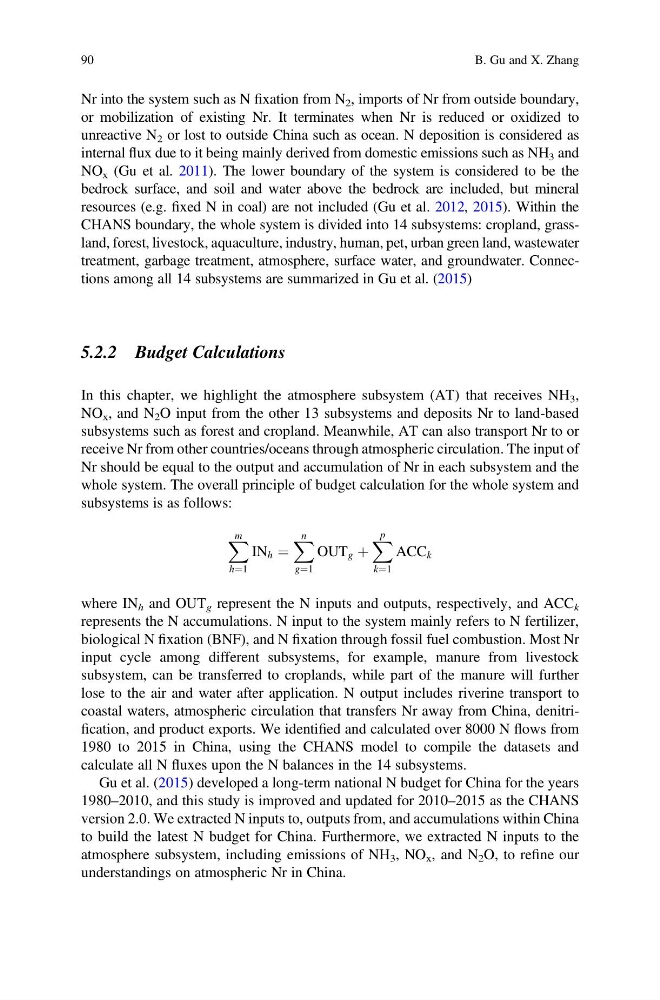
Nr should be equal to the output and accumulation of Nr in each subsystem and the
whole system. The overall principle of budget calculation for the whole system and
subsystems is as follows:
X m
h¼1
IN h ¼
X n
g¼1
OUT g þ
X p
k¼1
ACC k
where IN h and OUT g represent the N inputs and outputs, respectively, and ACC k
represents the N accumulations. N input to the system mainly refers to N fertilizer,
biological N fixation (BNF), and N fixation through fossil fuel combustion. Most Nr
input cycle among different subsystems, for example, manure from livestock
subsystem, can be transferred to croplands, while part of the manure will further
lose to the air and water after application. N output includes riverine transport to
coastal waters, atmospheric circulation that transfers Nr away from China, denitrification, and product exports. We identified and calculated over 8000 N flows from
1980 to 2015 in China, using the CHANS model to compile the datasets and
calculate all N fluxes upon the N balances in the 14 subsystems.
Gu et al. (2015) developed a long-term national N budget for China for the years
1980–2010, and this study is improved and updated for 2010–2015 as the CHANS
version 2.0. We extracted N inputs to, outputs from, and accumulations within China
to build the latest N budget for China. Furthermore, we extracted N inputs to the
atmosphere subsystem, including emissions of NH 3 , NO x , and N 2 O, to refine our
understandings on atmospheric Nr in China.
90
B. Gu and X. Zhang
or mobilization of existing Nr. It terminates when Nr is reduced or oxidized to
unreactive N 2 or lost to outside China such as ocean. N deposition is considered as
internal flux due to it being mainly derived from domestic emissions such as NH 3 and
NO x (Gu et al. 2011). The lower boundary of the system is considered to be the
bedrock surface, and soil and water above the bedrock are included, but mineral
resources (e.g. fixed N in coal) are not included (Gu et al. 2012, 2015). Within the
CHANS boundary, the whole system is divided into 14 subsystems: cropland, grassland, forest, livestock, aquaculture, industry, human, pet, urban green land, wastewater
treatment, garbage treatment, atmosphere, surface water, and groundwater. Connections among all 14 subsystems are summarized in Gu et al. (2015)
5.2.2 Budget Calculations
In this chapter, we highlight the atmosphere subsystem (AT) that receives NH 3 ,
NO x , and N 2 O input from the other 13 subsystems and deposits Nr to land-based
subsystems such as forest and cropland. Meanwhile, AT can also transport Nr to or
receive Nr from other countries/oceans through atmospheric circulation. The input of
Nr should be equal to the output and accumulation of Nr in each subsystem and the
whole system. The overall principle of budget calculation for the whole system and
subsystems is as follows:
X m
h¼1
IN h ¼
X n
g¼1
OUT g þ
X p
k¼1
ACC k
where IN h and OUT g represent the N inputs and outputs, respectively, and ACC k
represents the N accumulations. N input to the system mainly refers to N fertilizer,
biological N fixation (BNF), and N fixation through fossil fuel combustion. Most Nr
input cycle among different subsystems, for example, manure from livestock
subsystem, can be transferred to croplands, while part of the manure will further
lose to the air and water after application. N output includes riverine transport to
coastal waters, atmospheric circulation that transfers Nr away from China, denitrification, and product exports. We identified and calculated over 8000 N flows from
1980 to 2015 in China, using the CHANS model to compile the datasets and
calculate all N fluxes upon the N balances in the 14 subsystems.
Gu et al. (2015) developed a long-term national N budget for China for the years
1980–2010, and this study is improved and updated for 2010–2015 as the CHANS
version 2.0. We extracted N inputs to, outputs from, and accumulations within China
to build the latest N budget for China. Furthermore, we extracted N inputs to the
atmosphere subsystem, including emissions of NH 3 , NO x , and N 2 O, to refine our
understandings on atmospheric Nr in China.
90
B. Gu and X. Zhang