

DNP and TTF grafted with ethylene glycol chains. One approach to synthesize
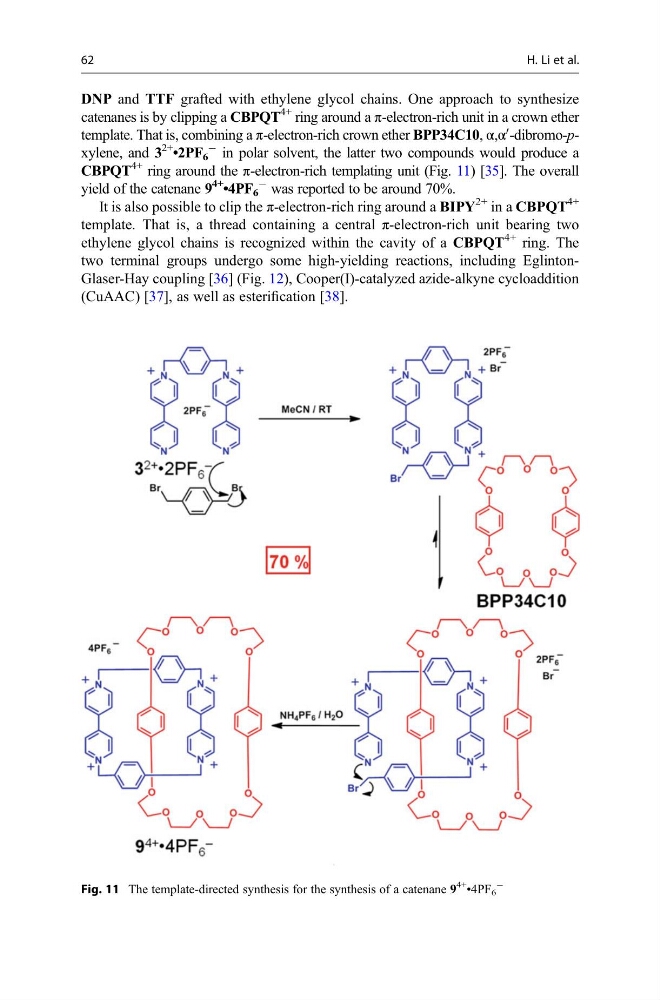
catenanes is by clipping a CBPQT
4+ ring around a π-electron-rich unit in a crown ether
template. That is, combining a π-electron-rich crown ether BPP34C10, α,α
0 -dibromo-pxylene, and 3
2+
•2PF 6
À in polar solvent, the latter two compounds would produce a
CBPQT
4+ ring around the π-electron-rich templating unit (Fig. 11) [35]. The overall
yield of the catenane 9
4+
•4PF 6
À was reported to be around 70%.
It is also possible to clip the π-electron-rich ring around a BIPY
2+ in a CBPQT
4+
template. That is, a thread containing a central π-electron-rich unit bearing two
ethylene glycol chains is recognized within the cavity of a CBPQT
4+ ring. The
two terminal groups undergo some high-yielding reactions, including EglintonGlaser-Hay coupling [36] (Fig. 12), Cooper(I)-catalyzed azide-alkyne cycloaddition
(CuAAC) [37], as well as esterification [38].
Fig. 11 The template-directed synthesis for the synthesis of a catenane 9
4+ •4PF 6
À
62
H. Li et al.
catenanes is by clipping a CBPQT
4+ ring around a π-electron-rich unit in a crown ether
template. That is, combining a π-electron-rich crown ether BPP34C10, α,α
0 -dibromo-pxylene, and 3
2+
•2PF 6
À in polar solvent, the latter two compounds would produce a
CBPQT
4+ ring around the π-electron-rich templating unit (Fig. 11) [35]. The overall
yield of the catenane 9
4+
•4PF 6
À was reported to be around 70%.
It is also possible to clip the π-electron-rich ring around a BIPY
2+ in a CBPQT
4+
template. That is, a thread containing a central π-electron-rich unit bearing two
ethylene glycol chains is recognized within the cavity of a CBPQT
4+ ring. The
two terminal groups undergo some high-yielding reactions, including EglintonGlaser-Hay coupling [36] (Fig. 12), Cooper(I)-catalyzed azide-alkyne cycloaddition
(CuAAC) [37], as well as esterification [38].
Fig. 11 The template-directed synthesis for the synthesis of a catenane 9
4+ •4PF 6
À
62
H. Li et al.