

This result was confirmed by the combination of various techniques, such as
viscosity measurements
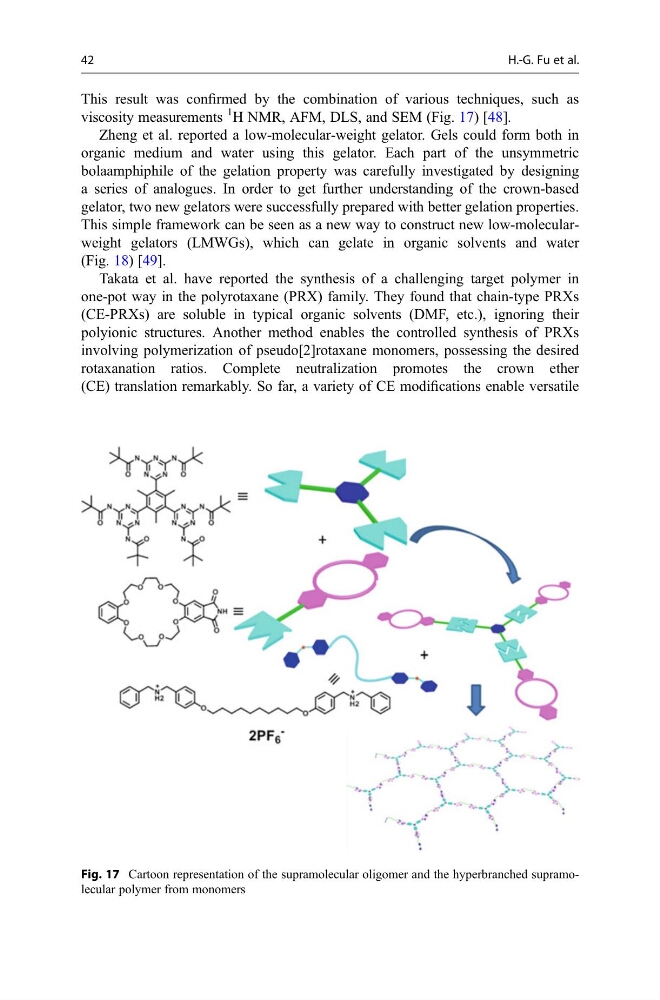
1 H NMR, AFM, DLS, and SEM (Fig. 17) [48].
Zheng et al. reported a low-molecular-weight gelator. Gels could form both in
organic medium and water using this gelator. Each part of the unsymmetric
bolaamphiphile of the gelation property was carefully investigated by designing
a series of analogues. In order to get further understanding of the crown-based
gelator, two new gelators were successfully prepared with better gelation properties.
This simple framework can be seen as a new way to construct new low-molecularweight gelators (LMWGs), which can gelate in organic solvents and water
(Fig. 18) [49].
Takata et al. have reported the synthesis of a challenging target polymer in
one-pot way in the polyrotaxane (PRX) family. They found that chain-type PRXs
(CE-PRXs) are soluble in typical organic solvents (DMF, etc.), ignoring their
polyionic structures. Another method enables the controlled synthesis of PRXs
involving polymerization of pseudo[2]rotaxane monomers, possessing the desired
rotaxanation ratios. Complete neutralization promotes the crown ether
(CE) translation remarkably. So far, a variety of CE modifications enable versatile
Fig. 17 Cartoon representation of the supramolecular oligomer and the hyperbranched supramolecular polymer from monomers
42
H.-G. Fu et al.
viscosity measurements
1 H NMR, AFM, DLS, and SEM (Fig. 17) [48].
Zheng et al. reported a low-molecular-weight gelator. Gels could form both in
organic medium and water using this gelator. Each part of the unsymmetric
bolaamphiphile of the gelation property was carefully investigated by designing
a series of analogues. In order to get further understanding of the crown-based
gelator, two new gelators were successfully prepared with better gelation properties.
This simple framework can be seen as a new way to construct new low-molecularweight gelators (LMWGs), which can gelate in organic solvents and water
(Fig. 18) [49].
Takata et al. have reported the synthesis of a challenging target polymer in
one-pot way in the polyrotaxane (PRX) family. They found that chain-type PRXs
(CE-PRXs) are soluble in typical organic solvents (DMF, etc.), ignoring their
polyionic structures. Another method enables the controlled synthesis of PRXs
involving polymerization of pseudo[2]rotaxane monomers, possessing the desired
rotaxanation ratios. Complete neutralization promotes the crown ether
(CE) translation remarkably. So far, a variety of CE modifications enable versatile
Fig. 17 Cartoon representation of the supramolecular oligomer and the hyperbranched supramolecular polymer from monomers
42
H.-G. Fu et al.