

22.5 Â 10
À3 M, specific viscosity of the gel displaying nonlinear increased which
was continuously larger than polymer.
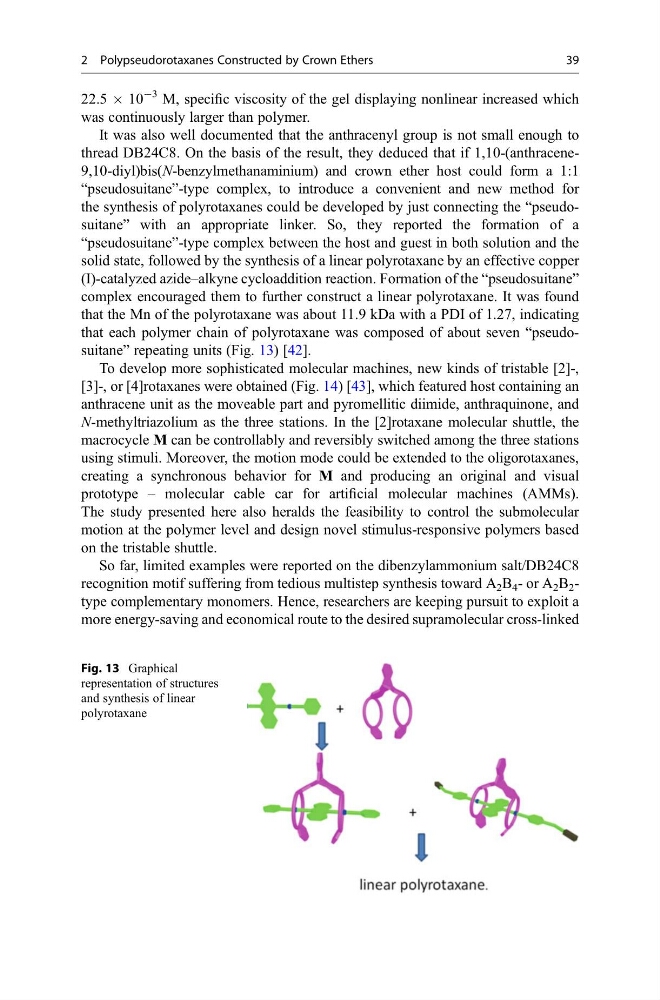
It was also well documented that the anthracenyl group is not small enough to
thread DB24C8. On the basis of the result, they deduced that if 1,10-(anthracene9,10-diyl)bis(N-benzylmethanaminium) and crown ether host could form a 1:1
“pseudosuitane”-type complex, to introduce a convenient and new method for
the synthesis of polyrotaxanes could be developed by just connecting the “pseudosuitane” with an appropriate linker. So, they reported the formation of a
“pseudosuitane”-type complex between the host and guest in both solution and the
solid state, followed by the synthesis of a linear polyrotaxane by an effective copper
(I)-catalyzed azide–alkyne cycloaddition reaction. Formation of the “pseudosuitane”
complex encouraged them to further construct a linear polyrotaxane. It was found
that the Mn of the polyrotaxane was about 11.9 kDa with a PDI of 1.27, indicating
that each polymer chain of polyrotaxane was composed of about seven “pseudosuitane” repeating units (Fig. 13) [42].
To develop more sophisticated molecular machines, new kinds of tristable [2]-,
[3]-, or [4]rotaxanes were obtained (Fig. 14) [43], which featured host containing an
anthracene unit as the moveable part and pyromellitic diimide, anthraquinone, and
N-methyltriazolium as the three stations. In the [2]rotaxane molecular shuttle, the
macrocycle M can be controllably and reversibly switched among the three stations
using stimuli. Moreover, the motion mode could be extended to the oligorotaxanes,
creating a synchronous behavior for M and producing an original and visual
prototype – molecular cable car for artificial molecular machines (AMMs).
The study presented here also heralds the feasibility to control the submolecular
motion at the polymer level and design novel stimulus-responsive polymers based
on the tristable shuttle.
So far, limited examples were reported on the dibenzylammonium salt/DB24C8
recognition motif suffering from tedious multistep synthesis toward A 2 B 4 - or A 2 B 2 -
type complementary monomers. Hence, researchers are keeping pursuit to exploit a
more energy-saving and economical route to the desired supramolecular cross-linked
Fig. 13 Graphical
representation of structures
and synthesis of linear
polyrotaxane
2 Polypseudorotaxanes Constructed by Crown Ethers
39
À3 M, specific viscosity of the gel displaying nonlinear increased which
was continuously larger than polymer.
It was also well documented that the anthracenyl group is not small enough to
thread DB24C8. On the basis of the result, they deduced that if 1,10-(anthracene9,10-diyl)bis(N-benzylmethanaminium) and crown ether host could form a 1:1
“pseudosuitane”-type complex, to introduce a convenient and new method for
the synthesis of polyrotaxanes could be developed by just connecting the “pseudosuitane” with an appropriate linker. So, they reported the formation of a
“pseudosuitane”-type complex between the host and guest in both solution and the
solid state, followed by the synthesis of a linear polyrotaxane by an effective copper
(I)-catalyzed azide–alkyne cycloaddition reaction. Formation of the “pseudosuitane”
complex encouraged them to further construct a linear polyrotaxane. It was found
that the Mn of the polyrotaxane was about 11.9 kDa with a PDI of 1.27, indicating
that each polymer chain of polyrotaxane was composed of about seven “pseudosuitane” repeating units (Fig. 13) [42].
To develop more sophisticated molecular machines, new kinds of tristable [2]-,
[3]-, or [4]rotaxanes were obtained (Fig. 14) [43], which featured host containing an
anthracene unit as the moveable part and pyromellitic diimide, anthraquinone, and
N-methyltriazolium as the three stations. In the [2]rotaxane molecular shuttle, the
macrocycle M can be controllably and reversibly switched among the three stations
using stimuli. Moreover, the motion mode could be extended to the oligorotaxanes,
creating a synchronous behavior for M and producing an original and visual
prototype – molecular cable car for artificial molecular machines (AMMs).
The study presented here also heralds the feasibility to control the submolecular
motion at the polymer level and design novel stimulus-responsive polymers based
on the tristable shuttle.
So far, limited examples were reported on the dibenzylammonium salt/DB24C8
recognition motif suffering from tedious multistep synthesis toward A 2 B 4 - or A 2 B 2 -
type complementary monomers. Hence, researchers are keeping pursuit to exploit a
more energy-saving and economical route to the desired supramolecular cross-linked
Fig. 13 Graphical
representation of structures
and synthesis of linear
polyrotaxane
2 Polypseudorotaxanes Constructed by Crown Ethers
39