

groups such as hyaluronic acid and coupling cyclic iRGD-C were functionalized via
thiol-maleimide reaction into vesicles. Confocal laser scanning microscopy (CLSM)
test confirmed ligand-modified nanoparticles could be uptaken more effectively by
cancer cells compared to those unmodified vesicles. The cytotoxicity experiment
showed these materials have low toxicity even after doxorubicin hydrochloride was
loaded, whereas the cytotoxic effect and apoptosis rate were significantly improved
when triggered by UV irradiation. This work was an example as photo-responsive
self-assembly systems based on host-guest chemistry, which could have practical
applications.
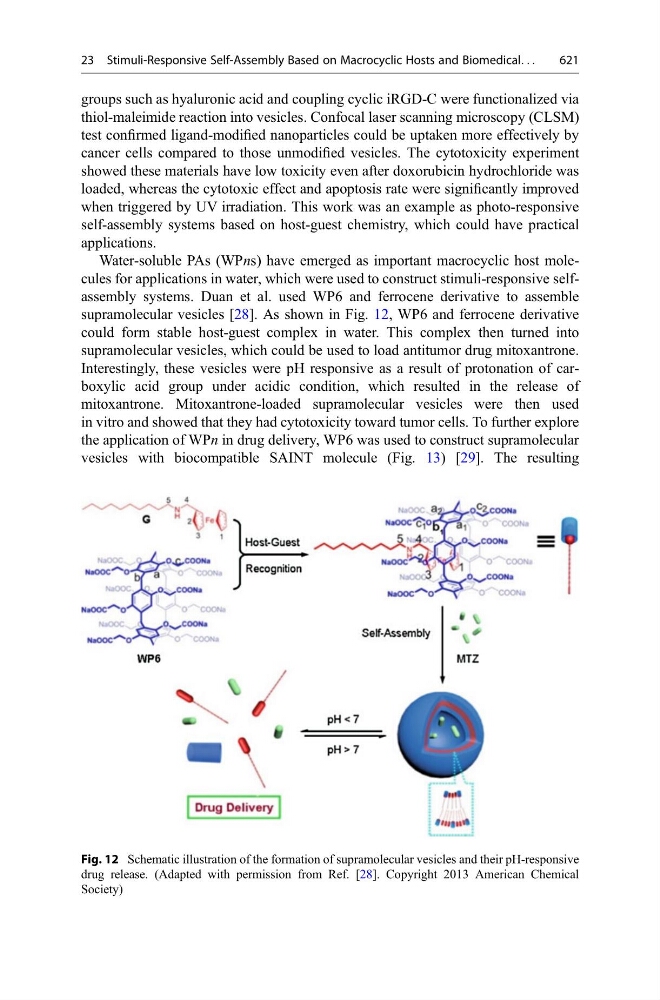
Water-soluble PAs (WPns) have emerged as important macrocyclic host molecules for applications in water, which were used to construct stimuli-responsive selfassembly systems. Duan et al. used WP6 and ferrocene derivative to assemble
supramolecular vesicles [28]. As shown in Fig. 12, WP6 and ferrocene derivative
could form stable host-guest complex in water. This complex then turned into
supramolecular vesicles, which could be used to load antitumor drug mitoxantrone.
Interestingly, these vesicles were pH responsive as a result of protonation of carboxylic acid group under acidic condition, which resulted in the release of
mitoxantrone. Mitoxantrone-loaded supramolecular vesicles were then used
in vitro and showed that they had cytotoxicity toward tumor cells. To further explore
the application of WPn in drug delivery, WP6 was used to construct supramolecular
vesicles with biocompatible SAINT molecule (Fig. 13) [29]. The resulting
Fig. 12 Schematic illustration of the formation of supramolecular vesicles and their pH-responsive
drug release. (Adapted with permission from Ref. [28]. Copyright 2013 American Chemical
Society)
23 Stimuli-Responsive Self-Assembly Based on Macrocyclic Hosts and Biomedical. . .
621