

Triptycenes are a class of compounds with a unique paddle wheel structure and
have wide applications in material science, supramolecular chemistry, and other
research fields [39]. A variety of triptycene-crown ether fused multicavity hosts have
been developed by integrating various sized crown ether rings and the threedimensional paddle wheel-like triptycene scaffold. Chen and coworkers reported
the first triptycene-based tris(crown ether) host in 2005. Connecting triptycene
units through crown ether rings resulted in multicavity macrocyclic hosts with
three-dimensional central cavities. The interacting surfaces of the phenyl planes in
triptycene enabled such hosts to recognize a range of diversified guest species by the
formation of supramolecular assemblies which were further used in the construction
of complex molecular machines.
Chen et al. reported a triptycene-derived powerful host for complexation with
different guests bearing different topology macrotricyclic which contained two
DB24C8 moieties. Interestingly, they found that the new macrocycle formed a 1:2
complex with 2 equiv. dibenzylammonium ions, which inspired them to further
design and synthesize two dibenzylammonium ions and a self-complementary
monomer. They synthesized the monomer and proved its self-assembly into supramolecular polymer networks, which was the first example of supramolecular polymer networks formed by the self-complementary low-molecular-weight monomer
assembly, based on intermolecular host–guest interactions. To their delight, they
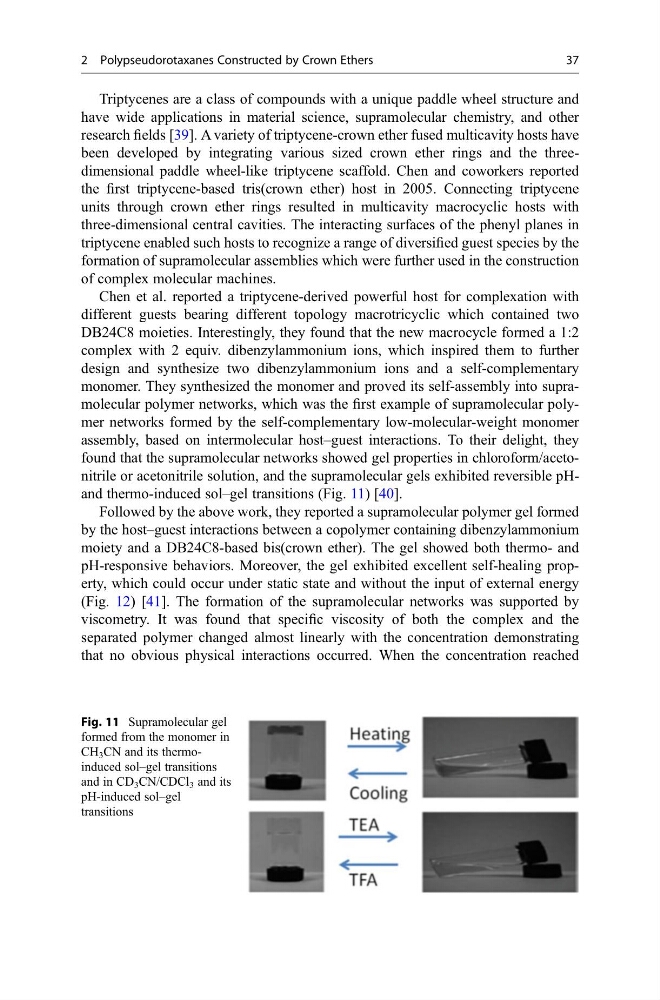
found that the supramolecular networks showed gel properties in chloroform/acetonitrile or acetonitrile solution, and the supramolecular gels exhibited reversible pHand thermo-induced sol–gel transitions (Fig. 11) [40].
Followed by the above work, they reported a supramolecular polymer gel formed
by the host–guest interactions between a copolymer containing dibenzylammonium
moiety and a DB24C8-based bis(crown ether). The gel showed both thermo- and
pH-responsive behaviors. Moreover, the gel exhibited excellent self-healing property, which could occur under static state and without the input of external energy
(Fig. 12) [41]. The formation of the supramolecular networks was supported by
viscometry. It was found that specific viscosity of both the complex and the
separated polymer changed almost linearly with the concentration demonstrating
that no obvious physical interactions occurred. When the concentration reached
Fig. 11 Supramolecular gel
formed from the monomer in
CH 3 CN and its thermoinduced sol–gel transitions
and in CD 3 CN/CDCl 3 and its
pH-induced sol–gel
transitions
2 Polypseudorotaxanes Constructed by Crown Ethers
37
have wide applications in material science, supramolecular chemistry, and other
research fields [39]. A variety of triptycene-crown ether fused multicavity hosts have
been developed by integrating various sized crown ether rings and the threedimensional paddle wheel-like triptycene scaffold. Chen and coworkers reported
the first triptycene-based tris(crown ether) host in 2005. Connecting triptycene
units through crown ether rings resulted in multicavity macrocyclic hosts with
three-dimensional central cavities. The interacting surfaces of the phenyl planes in
triptycene enabled such hosts to recognize a range of diversified guest species by the
formation of supramolecular assemblies which were further used in the construction
of complex molecular machines.
Chen et al. reported a triptycene-derived powerful host for complexation with
different guests bearing different topology macrotricyclic which contained two
DB24C8 moieties. Interestingly, they found that the new macrocycle formed a 1:2
complex with 2 equiv. dibenzylammonium ions, which inspired them to further
design and synthesize two dibenzylammonium ions and a self-complementary
monomer. They synthesized the monomer and proved its self-assembly into supramolecular polymer networks, which was the first example of supramolecular polymer networks formed by the self-complementary low-molecular-weight monomer
assembly, based on intermolecular host–guest interactions. To their delight, they
found that the supramolecular networks showed gel properties in chloroform/acetonitrile or acetonitrile solution, and the supramolecular gels exhibited reversible pHand thermo-induced sol–gel transitions (Fig. 11) [40].
Followed by the above work, they reported a supramolecular polymer gel formed
by the host–guest interactions between a copolymer containing dibenzylammonium
moiety and a DB24C8-based bis(crown ether). The gel showed both thermo- and
pH-responsive behaviors. Moreover, the gel exhibited excellent self-healing property, which could occur under static state and without the input of external energy
(Fig. 12) [41]. The formation of the supramolecular networks was supported by
viscometry. It was found that specific viscosity of both the complex and the
separated polymer changed almost linearly with the concentration demonstrating
that no obvious physical interactions occurred. When the concentration reached
Fig. 11 Supramolecular gel
formed from the monomer in
CH 3 CN and its thermoinduced sol–gel transitions
and in CD 3 CN/CDCl 3 and its
pH-induced sol–gel
transitions
2 Polypseudorotaxanes Constructed by Crown Ethers
37