

using rheological measurements, showing 100% recovery even under 10,000%
strain in less than 10 s over several cycles.
Nowadays, on account of their high selectivity and sensitivity, much attention has
been given to supramolecular cross-linked network-based fluorescent sensors, especially those whose polymeric backbones are fluorescent conjugated polymers
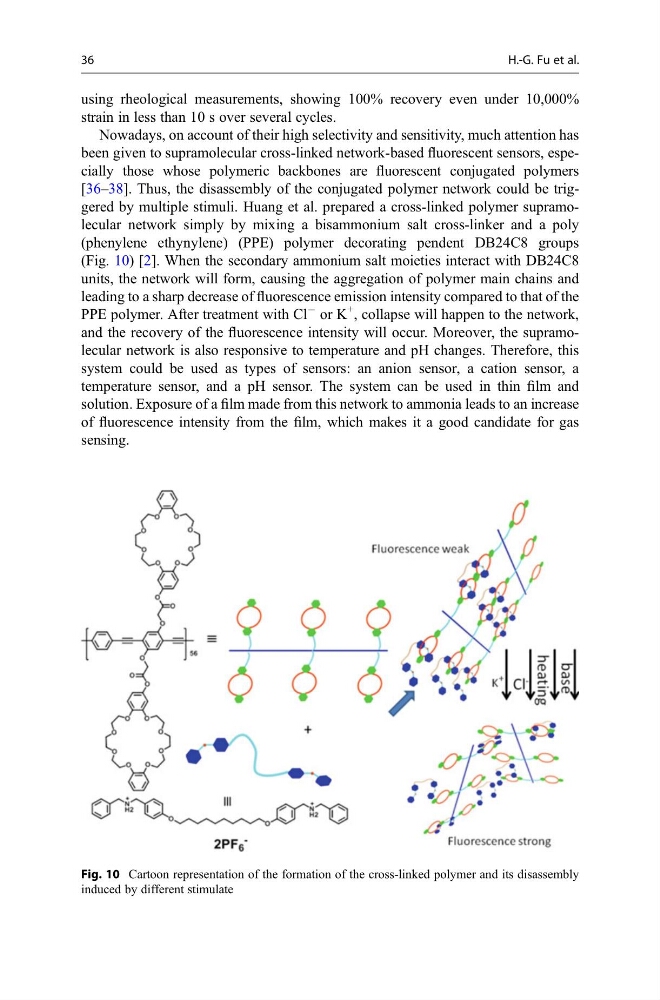
[36–38]. Thus, the disassembly of the conjugated polymer network could be triggered by multiple stimuli. Huang et al. prepared a cross-linked polymer supramolecular network simply by mixing a bisammonium salt cross-linker and a poly
(phenylene ethynylene) (PPE) polymer decorating pendent DB24C8 groups
(Fig. 10) [2]. When the secondary ammonium salt moieties interact with DB24C8
units, the network will form, causing the aggregation of polymer main chains and
leading to a sharp decrease of fluorescence emission intensity compared to that of the
PPE polymer. After treatment with Cl
À or K
+ , collapse will happen to the network,
and the recovery of the fluorescence intensity will occur. Moreover, the supramolecular network is also responsive to temperature and pH changes. Therefore, this
system could be used as types of sensors: an anion sensor, a cation sensor, a
temperature sensor, and a pH sensor. The system can be used in thin film and
solution. Exposure of a film made from this network to ammonia leads to an increase
of fluorescence intensity from the film, which makes it a good candidate for gas
sensing.
Fig. 10 Cartoon representation of the formation of the cross-linked polymer and its disassembly
induced by different stimulate
36
H.-G. Fu et al.
strain in less than 10 s over several cycles.
Nowadays, on account of their high selectivity and sensitivity, much attention has
been given to supramolecular cross-linked network-based fluorescent sensors, especially those whose polymeric backbones are fluorescent conjugated polymers
[36–38]. Thus, the disassembly of the conjugated polymer network could be triggered by multiple stimuli. Huang et al. prepared a cross-linked polymer supramolecular network simply by mixing a bisammonium salt cross-linker and a poly
(phenylene ethynylene) (PPE) polymer decorating pendent DB24C8 groups
(Fig. 10) [2]. When the secondary ammonium salt moieties interact with DB24C8
units, the network will form, causing the aggregation of polymer main chains and
leading to a sharp decrease of fluorescence emission intensity compared to that of the
PPE polymer. After treatment with Cl
À or K
+ , collapse will happen to the network,
and the recovery of the fluorescence intensity will occur. Moreover, the supramolecular network is also responsive to temperature and pH changes. Therefore, this
system could be used as types of sensors: an anion sensor, a cation sensor, a
temperature sensor, and a pH sensor. The system can be used in thin film and
solution. Exposure of a film made from this network to ammonia leads to an increase
of fluorescence intensity from the film, which makes it a good candidate for gas
sensing.
Fig. 10 Cartoon representation of the formation of the cross-linked polymer and its disassembly
induced by different stimulate
36
H.-G. Fu et al.