

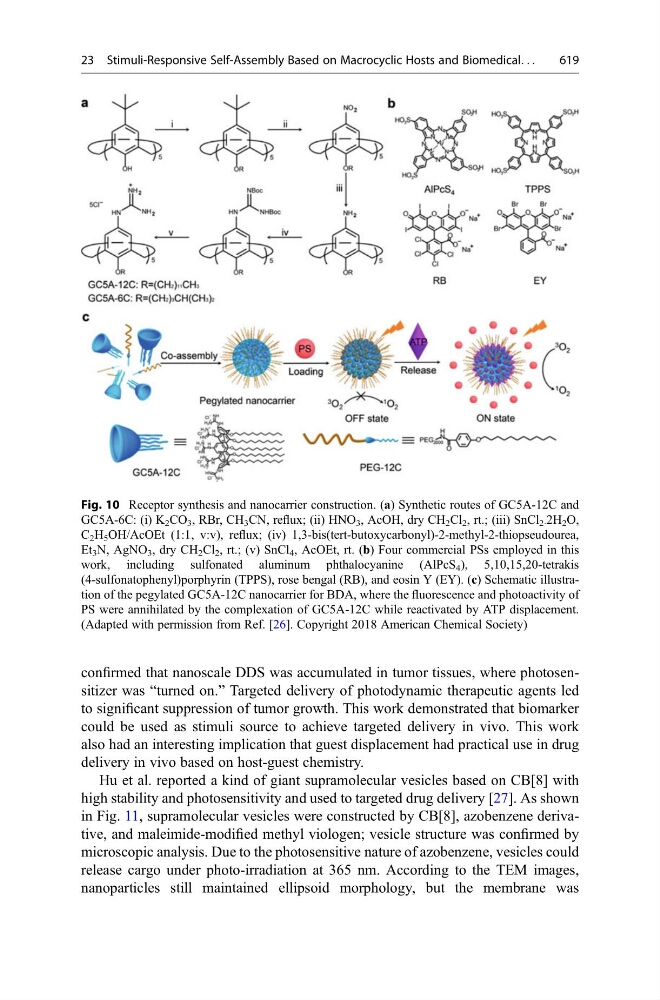
confirmed that nanoscale DDS was accumulated in tumor tissues, where photosensitizer was “turned on.” Targeted delivery of photodynamic therapeutic agents led
to significant suppression of tumor growth. This work demonstrated that biomarker
could be used as stimuli source to achieve targeted delivery in vivo. This work
also had an interesting implication that guest displacement had practical use in drug
delivery in vivo based on host-guest chemistry.
Hu et al. reported a kind of giant supramolecular vesicles based on CB[8] with
high stability and photosensitivity and used to targeted drug delivery [27]. As shown
in Fig. 11, supramolecular vesicles were constructed by CB[8], azobenzene derivative, and maleimide-modified methyl viologen; vesicle structure was confirmed by
microscopic analysis. Due to the photosensitive nature of azobenzene, vesicles could
release cargo under photo-irradiation at 365 nm. According to the TEM images,
nanoparticles still maintained ellipsoid morphology, but the membrane was
Fig. 10 Receptor synthesis and nanocarrier construction. (a) Synthetic routes of GC5A-12C and
GC5A-6C: (i) K 2 CO 3 , RBr, CH 3 CN, reflux; (ii) HNO 3 , AcOH, dry CH 2 Cl 2 , rt.; (iii) SnCl 2Á 2H 2 O,
C 2 H 5 OH/AcOEt (1:1, v:v), reflux; (iv) 1,3-bis(tert-butoxycarbonyl)-2-methyl-2-thiopseudourea,
Et 3 N, AgNO 3 , dry CH 2 Cl 2 , rt.; (v) SnCl 4 , AcOEt, rt. (b) Four commercial PSs employed in this
work, including sulfonated aluminum phthalocyanine (AlPcS 4 ), 5,10,15,20-tetrakis
(4-sulfonatophenyl)porphyrin (TPPS), rose bengal (RB), and eosin Y (EY). (c) Schematic illustration of the pegylated GC5A-12C nanocarrier for BDA, where the fluorescence and photoactivity of
PS were annihilated by the complexation of GC5A-12C while reactivated by ATP displacement.
(Adapted with permission from Ref. [26]. Copyright 2018 American Chemical Society)
23 Stimuli-Responsive Self-Assembly Based on Macrocyclic Hosts and Biomedical. . .
619