

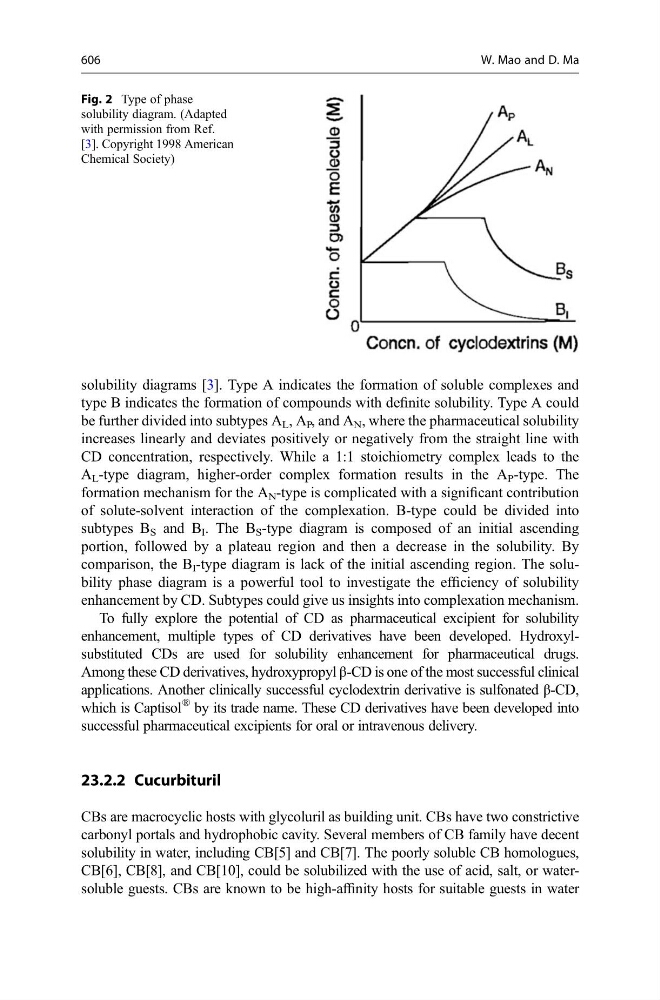
solubility diagrams [3]. Type A indicates the formation of soluble complexes and
type B indicates the formation of compounds with definite solubility. Type A could
be further divided into subtypes A L , A P , and A N , where the pharmaceutical solubility
increases linearly and deviates positively or negatively from the straight line with
CD concentration, respectively. While a 1:1 stoichiometry complex leads to the
A L -type diagram, higher-order complex formation results in the A P -type. The
formation mechanism for the A N -type is complicated with a significant contribution
of solute-solvent interaction of the complexation. B-type could be divided into
subtypes B S and B I . The B S -type diagram is composed of an initial ascending
portion, followed by a plateau region and then a decrease in the solubility. By
comparison, the B I -type diagram is lack of the initial ascending region. The solubility phase diagram is a powerful tool to investigate the efficiency of solubility
enhancement by CD. Subtypes could give us insights into complexation mechanism.
To fully explore the potential of CD as pharmaceutical excipient for solubility
enhancement, multiple types of CD derivatives have been developed. Hydroxylsubstituted CDs are used for solubility enhancement for pharmaceutical drugs.
Among these CD derivatives, hydroxypropyl β-CD is one of the most successful clinical
applications. Another clinically successful cyclodextrin derivative is sulfonated β-CD,
which is Captisol
® by its trade name. These CD derivatives have been developed into
successful pharmaceutical excipients for oral or intravenous delivery.
23.2.2 Cucurbituril
CBs are macrocyclic hosts with glycoluril as building unit. CBs have two constrictive
carbonyl portals and hydrophobic cavity. Several members of CB family have decent
solubility in water, including CB[5] and CB[7]. The poorly soluble CB homologues,
CB[6], CB[8], and CB[10], could be solubilized with the use of acid, salt, or watersoluble guests. CBs are known to be high-affinity hosts for suitable guests in water
Fig. 2 Type of phase
solubility diagram. (Adapted
with permission from Ref.
[3]. Copyright 1998 American
Chemical Society)
606
W. Mao and D. Ma