

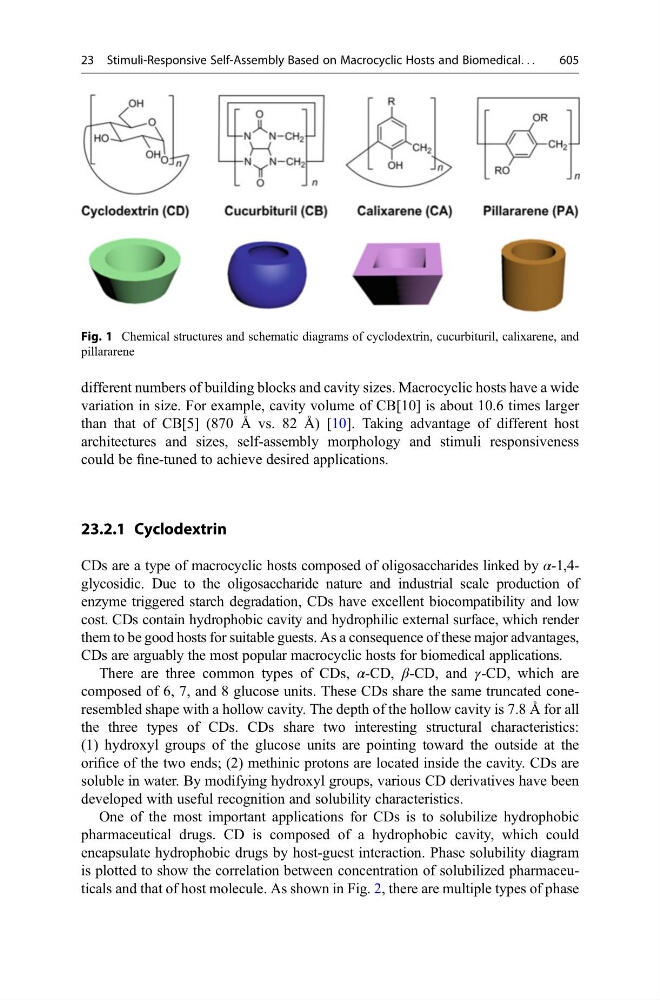
different numbers of building blocks and cavity sizes. Macrocyclic hosts have a wide
variation in size. For example, cavity volume of CB[10] is about 10.6 times larger
than that of CB[5] (870 Å vs. 82 Å) [10]. Taking advantage of different host
architectures and sizes, self-assembly morphology and stimuli responsiveness
could be fine-tuned to achieve desired applications.
23.2.1 Cyclodextrin
CDs are a type of macrocyclic hosts composed of oligosaccharides linked by α-1,4glycosidic. Due to the oligosaccharide nature and industrial scale production of
enzyme triggered starch degradation, CDs have excellent biocompatibility and low
cost. CDs contain hydrophobic cavity and hydrophilic external surface, which render
them to be good hosts for suitable guests. As a consequence of these major advantages,
CDs are arguably the most popular macrocyclic hosts for biomedical applications.
There are three common types of CDs, α-CD, β-CD, and γ-CD, which are
composed of 6, 7, and 8 glucose units. These CDs share the same truncated coneresembled shape with a hollow cavity. The depth of the hollow cavity is 7.8 Å for all
the three types of CDs. CDs share two interesting structural characteristics:
(1) hydroxyl groups of the glucose units are pointing toward the outside at the
orifice of the two ends; (2) methinic protons are located inside the cavity. CDs are
soluble in water. By modifying hydroxyl groups, various CD derivatives have been
developed with useful recognition and solubility characteristics.
One of the most important applications for CDs is to solubilize hydrophobic
pharmaceutical drugs. CD is composed of a hydrophobic cavity, which could
encapsulate hydrophobic drugs by host-guest interaction. Phase solubility diagram
is plotted to show the correlation between concentration of solubilized pharmaceuticals and that of host molecule. As shown in Fig. 2, there are multiple types of phase
Fig. 1 Chemical structures and schematic diagrams of cyclodextrin, cucurbituril, calixarene, and
pillararene
23 Stimuli-Responsive Self-Assembly Based on Macrocyclic Hosts and Biomedical. . .
605