

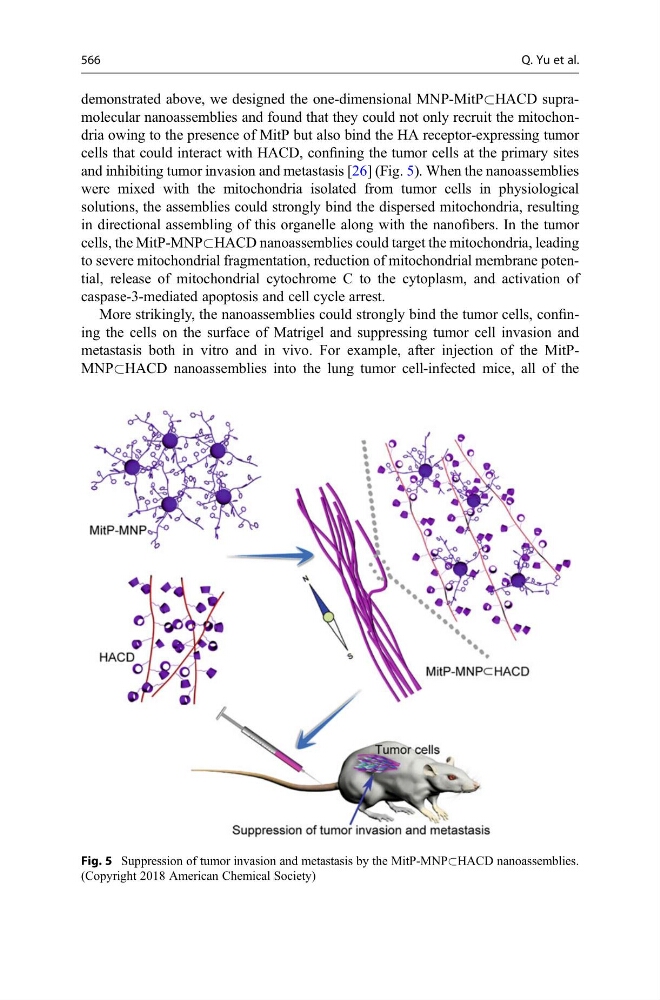
demonstrated above, we designed the one-dimensional MNP-MitP&HACD supramolecular nanoassemblies and found that they could not only recruit the mitochondria owing to the presence of MitP but also bind the HA receptor-expressing tumor
cells that could interact with HACD, confining the tumor cells at the primary sites
and inhibiting tumor invasion and metastasis [26] (Fig. 5). When the nanoassemblies
were mixed with the mitochondria isolated from tumor cells in physiological
solutions, the assemblies could strongly bind the dispersed mitochondria, resulting
in directional assembling of this organelle along with the nanofibers. In the tumor
cells, the MitP-MNP&HACD nanoassemblies could target the mitochondria, leading
to severe mitochondrial fragmentation, reduction of mitochondrial membrane potential, release of mitochondrial cytochrome C to the cytoplasm, and activation of
caspase-3-mediated apoptosis and cell cycle arrest.
More strikingly, the nanoassemblies could strongly bind the tumor cells, confining the cells on the surface of Matrigel and suppressing tumor cell invasion and
metastasis both in vitro and in vivo. For example, after injection of the MitPMNP&HACD nanoassemblies into the lung tumor cell-infected mice, all of the
Fig. 5 Suppression of tumor invasion and metastasis by the MitP-MNP&HACD nanoassemblies.
(Copyright 2018 American Chemical Society)
566
Q. Yu et al.