

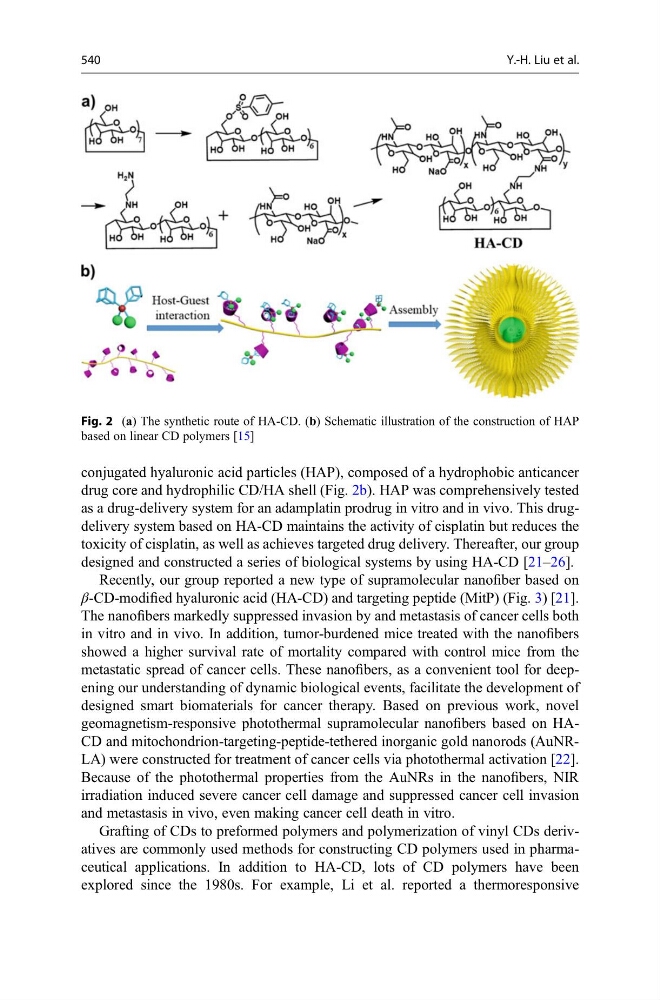
conjugated hyaluronic acid particles (HAP), composed of a hydrophobic anticancer
drug core and hydrophilic CD/HA shell (Fig. 2b). HAP was comprehensively tested
as a drug-delivery system for an adamplatin prodrug in vitro and in vivo. This drugdelivery system based on HA-CD maintains the activity of cisplatin but reduces the
toxicity of cisplatin, as well as achieves targeted drug delivery. Thereafter, our group
designed and constructed a series of biological systems by using HA-CD [21–26].
Recently, our group reported a new type of supramolecular nanofiber based on
β-CD-modified hyaluronic acid (HA-CD) and targeting peptide (MitP) (Fig. 3) [21].
The nanofibers markedly suppressed invasion by and metastasis of cancer cells both
in vitro and in vivo. In addition, tumor-burdened mice treated with the nanofibers
showed a higher survival rate of mortality compared with control mice from the
metastatic spread of cancer cells. These nanofibers, as a convenient tool for deepening our understanding of dynamic biological events, facilitate the development of
designed smart biomaterials for cancer therapy. Based on previous work, novel
geomagnetism-responsive photothermal supramolecular nanofibers based on HACD and mitochondrion-targeting-peptide-tethered inorganic gold nanorods (AuNRLA) were constructed for treatment of cancer cells via photothermal activation [22].
Because of the photothermal properties from the AuNRs in the nanofibers, NIR
irradiation induced severe cancer cell damage and suppressed cancer cell invasion
and metastasis in vivo, even making cancer cell death in vitro.
Grafting of CDs to preformed polymers and polymerization of vinyl CDs derivatives are commonly used methods for constructing CD polymers used in pharmaceutical applications. In addition to HA-CD, lots of CD polymers have been
explored since the 1980s. For example, Li et al. reported a thermoresponsive
Fig. 2 (a) The synthetic route of HA-CD. (b) Schematic illustration of the construction of HAP
based on linear CD polymers [15]
540
Y.-H. Liu et al.