

the other end of the molecule, forming the large mouth end of CD (secondary
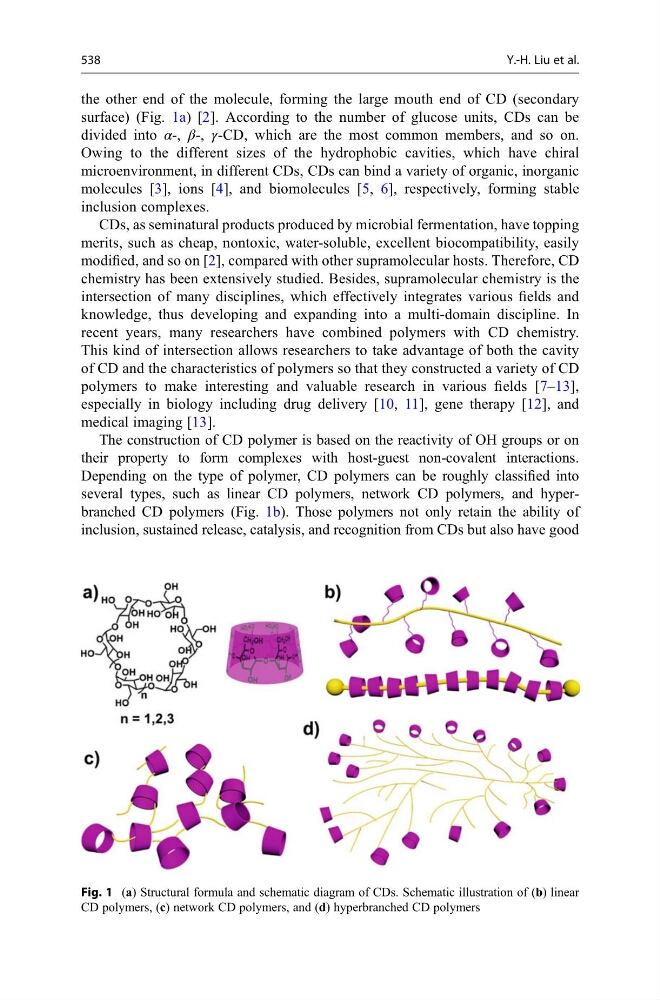
surface) (Fig. 1a) [2]. According to the number of glucose units, CDs can be
divided into α-, β-, γ-CD, which are the most common members, and so on.
Owing to the different sizes of the hydrophobic cavities, which have chiral
microenvironment, in different CDs, CDs can bind a variety of organic, inorganic
molecules [3], ions [4], and biomolecules [5, 6], respectively, forming stable
inclusion complexes.
CDs, as seminatural products produced by microbial fermentation, have topping
merits, such as cheap, nontoxic, water-soluble, excellent biocompatibility, easily
modified, and so on [2], compared with other supramolecular hosts. Therefore, CD
chemistry has been extensively studied. Besides, supramolecular chemistry is the
intersection of many disciplines, which effectively integrates various fields and
knowledge, thus developing and expanding into a multi-domain discipline. In
recent years, many researchers have combined polymers with CD chemistry.
This kind of intersection allows researchers to take advantage of both the cavity
of CD and the characteristics of polymers so that they constructed a variety of CD
polymers to make interesting and valuable research in various fields [7–13],
especially in biology including drug delivery [10, 11], gene therapy [12], and
medical imaging [13].
The construction of CD polymer is based on the reactivity of OH groups or on
their property to form complexes with host-guest non-covalent interactions.
Depending on the type of polymer, CD polymers can be roughly classified into
several types, such as linear CD polymers, network CD polymers, and hyperbranched CD polymers (Fig. 1b). Those polymers not only retain the ability of
inclusion, sustained release, catalysis, and recognition from CDs but also have good
Fig. 1 (a) Structural formula and schematic diagram of CDs. Schematic illustration of (b) linear
CD polymers, (c) network CD polymers, and (d) hyperbranched CD polymers
538
Y.-H. Liu et al.