

concentrations of CDNS. For example, in the photoisomerization of 58ZZ sensitized by β-CDNS 62a, the ee of 58EZ obtained decreases from 4.7% to 0% as the
phase changes from solution to suspension, but then increases to 6.1% in rigid gel.
Although γ-CDNS 62c affords racemic 58EZ in both solution and flowing gel, its
ee increases to 13.3% in rigid gel. Similar phase-dependent enantioselectivity has
been observed for the photoisomerization of 57Z mediated by CDNSs, for which
the chiral microenvironment varied with the phase transition of CDNS is likely to
be responsible.
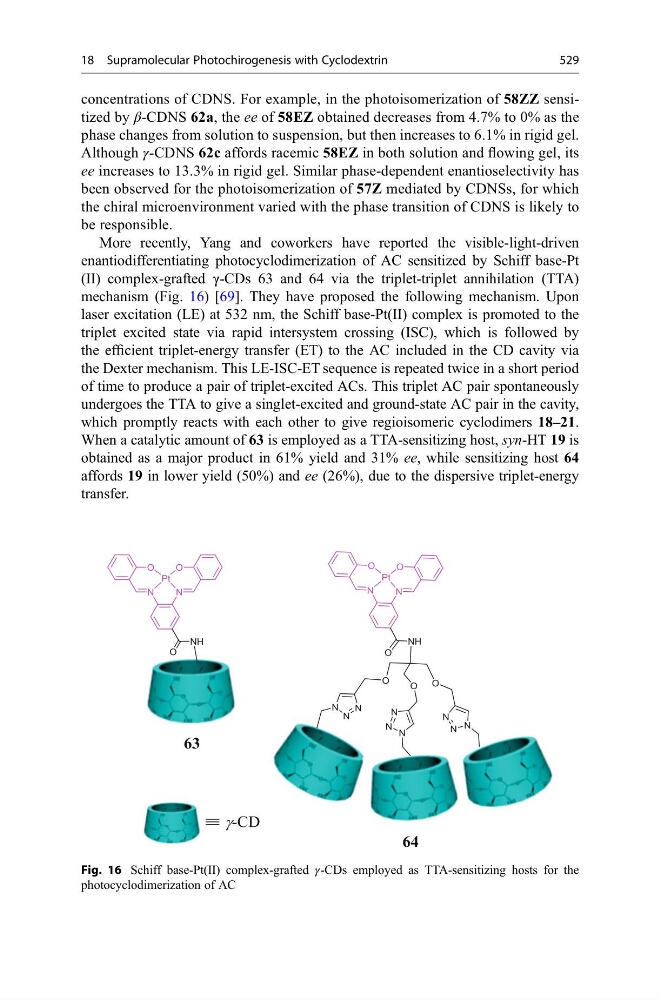
More recently, Yang and coworkers have reported the visible-light-driven
enantiodifferentiating photocyclodimerization of AC sensitized by Schiff base-Pt
(II) complex-grafted γ-CDs 63 and 64 via the triplet-triplet annihilation (TTA)
mechanism (Fig. 16) [69]. They have proposed the following mechanism. Upon
laser excitation (LE) at 532 nm, the Schiff base-Pt(II) complex is promoted to the
triplet excited state via rapid intersystem crossing (ISC), which is followed by
the efficient triplet-energy transfer (ET) to the AC included in the CD cavity via
the Dexter mechanism. This LE-ISC-ET sequence is repeated twice in a short period
of time to produce a pair of triplet-excited ACs. This triplet AC pair spontaneously
undergoes the TTA to give a singlet-excited and ground-state AC pair in the cavity,
which promptly reacts with each other to give regioisomeric cyclodimers 18–21.
When a catalytic amount of 63 is employed as a TTA-sensitizing host, syn-HT 19 is
obtained as a major product in 61% yield and 31% ee, while sensitizing host 64
affords 19 in lower yield (50%) and ee (26%), due to the dispersive triplet-energy
transfer.
Fig. 16 Schiff base-Pt(II) complex-grafted γ-CDs employed as TTA-sensitizing hosts for the
photocyclodimerization of AC
18 Supramolecular Photochirogenesis with Cyclodextrin
529