

molecule in the γ-CD cavity together with the biphenyl axle, which in turn promotes
the sensitized photoisomerization of 58ZZ inside the cavity to afford 58EZ in 15%
ee [66]. This study provides a new strategy for creating a conformationally flexible,
yet structurally robust, chiral photosensitizing binding site by implanting an
end-capped achiral chromophore into a chiral large cavity. A crucial difference
from the chromophore-modified CDs is the unremovable or non-flipping-out nature
of the implanted chromophore.
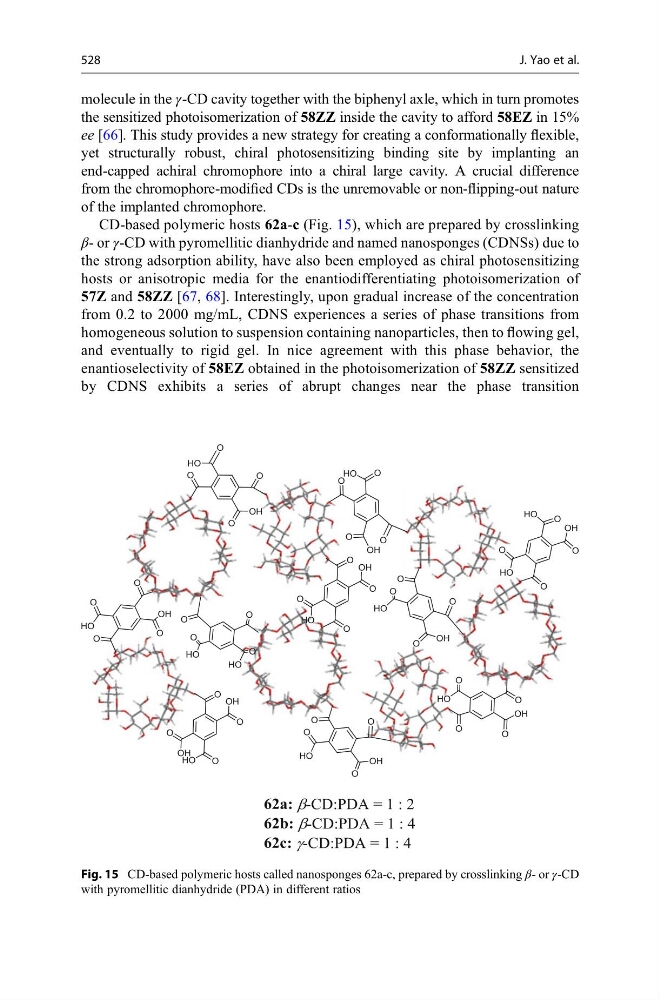
CD-based polymeric hosts 62a-c (Fig. 15), which are prepared by crosslinking
β- or γ-CD with pyromellitic dianhydride and named nanosponges (CDNSs) due to
the strong adsorption ability, have also been employed as chiral photosensitizing
hosts or anisotropic media for the enantiodifferentiating photoisomerization of
57Z and 58ZZ [67, 68]. Interestingly, upon gradual increase of the concentration
from 0.2 to 2000 mg/mL, CDNS experiences a series of phase transitions from
homogeneous solution to suspension containing nanoparticles, then to flowing gel,
and eventually to rigid gel. In nice agreement with this phase behavior, the
enantioselectivity of 58EZ obtained in the photoisomerization of 58ZZ sensitized
by CDNS exhibits a series of abrupt changes near the phase transition
Fig. 15 CD-based polymeric hosts called nanosponges 62a-c, prepared by crosslinking β- or γ-CD
with pyromellitic dianhydride (PDA) in different ratios
528
J. Yao et al.