

azobenzene transferred between its trans- and cis-states, thus inducing the change of
gels’ mechanical properties and even sol-gel transformation of the CD hydrogels.
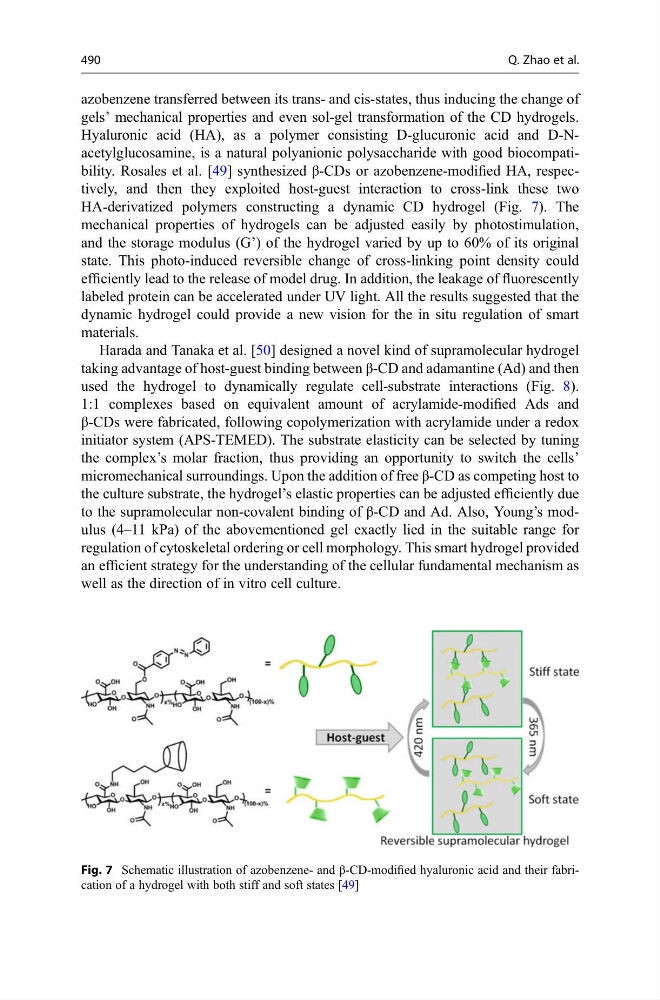
Hyaluronic acid (HA), as a polymer consisting D-glucuronic acid and D-Nacetylglucosamine, is a natural polyanionic polysaccharide with good biocompatibility. Rosales et al. [49] synthesized β-CDs or azobenzene-modified HA, respectively, and then they exploited host-guest interaction to cross-link these two
HA-derivatized polymers constructing a dynamic CD hydrogel (Fig. 7). The
mechanical properties of hydrogels can be adjusted easily by photostimulation,
and the storage modulus (G’) of the hydrogel varied by up to 60% of its original
state. This photo-induced reversible change of cross-linking point density could
efficiently lead to the release of model drug. In addition, the leakage of fluorescently
labeled protein can be accelerated under UV light. All the results suggested that the
dynamic hydrogel could provide a new vision for the in situ regulation of smart
materials.
Harada and Tanaka et al. [50] designed a novel kind of supramolecular hydrogel
taking advantage of host-guest binding between β-CD and adamantine (Ad) and then
used the hydrogel to dynamically regulate cell-substrate interactions (Fig. 8).
1:1 complexes based on equivalent amount of acrylamide-modified Ads and
β-CDs were fabricated, following copolymerization with acrylamide under a redox
initiator system (APS-TEMED). The substrate elasticity can be selected by tuning
the complex’s molar fraction, thus providing an opportunity to switch the cells’
micromechanical surroundings. Upon the addition of free β-CD as competing host to
the culture substrate, the hydrogel’s elastic properties can be adjusted efficiently due
to the supramolecular non-covalent binding of β-CD and Ad. Also, Young’s modulus (4–11 kPa) of the abovementioned gel exactly lied in the suitable range for
regulation of cytoskeletal ordering or cell morphology. This smart hydrogel provided
an efficient strategy for the understanding of the cellular fundamental mechanism as
well as the direction of in vitro cell culture.
Fig. 7 Schematic illustration of azobenzene- and β-CD-modified hyaluronic acid and their fabrication of a hydrogel with both stiff and soft states [49]
490
Q. Zhao et al.