

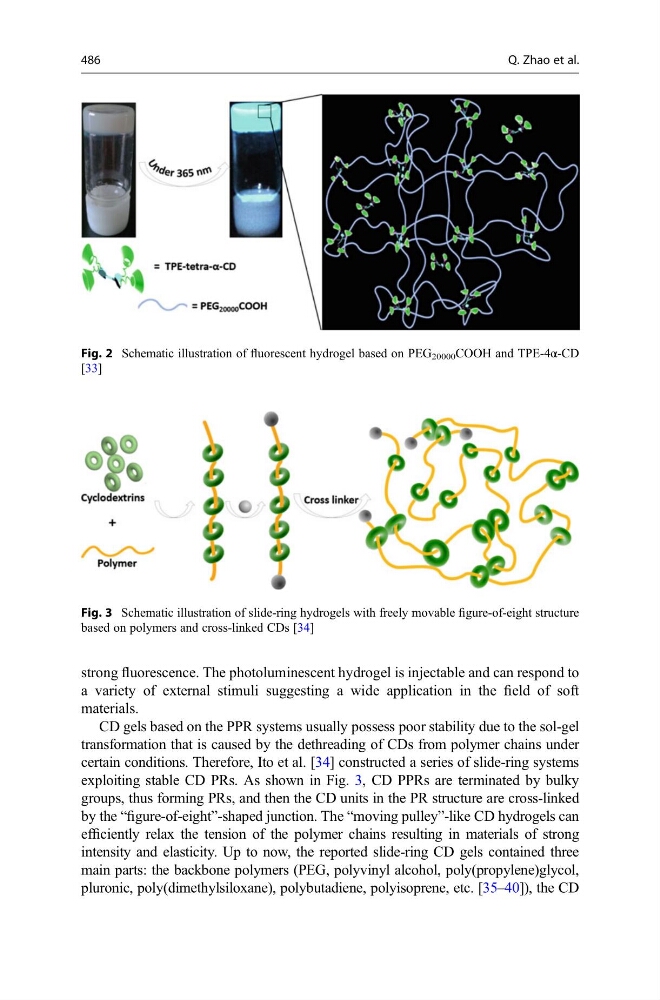
strong fluorescence. The photoluminescent hydrogel is injectable and can respond to
a variety of external stimuli suggesting a wide application in the field of soft
materials.
CD gels based on the PPR systems usually possess poor stability due to the sol-gel
transformation that is caused by the dethreading of CDs from polymer chains under
certain conditions. Therefore, Ito et al. [34] constructed a series of slide-ring systems
exploiting stable CD PRs. As shown in Fig. 3, CD PPRs are terminated by bulky
groups, thus forming PRs, and then the CD units in the PR structure are cross-linked
by the “figure-of-eight”-shaped junction. The “moving pulley”-like CD hydrogels can
efficiently relax the tension of the polymer chains resulting in materials of strong
intensity and elasticity. Up to now, the reported slide-ring CD gels contained three
main parts: the backbone polymers (PEG, polyvinyl alcohol, poly(propylene)glycol,
pluronic, poly(dimethylsiloxane), polybutadiene, polyisoprene, etc. [35–40]), the CD
Fig. 2 Schematic illustration of fluorescent hydrogel based on PEG 20000 COOH and TPE-4α-CD
[33]
Fig. 3 Schematic illustration of slide-ring hydrogels with freely movable figure-of-eight structure
based on polymers and cross-linked CDs [34]
486
Q. Zhao et al.