

following section, typical examples are used for brief discussion and introduction of
the CD gels’ construction according to the driving forces.
17.2.1 CD Gels Based on Polyrotaxanes and Pseudopolyrotaxanes
As the main driving force for molecular aggregation, hydrogen binding plays a
crucial role in the construction of the so-called “molecular necklace” and “slidering” supramolecular gels based on CDs. In 1993, Kamachi and Harada [31]
reported the inclusion complex of polyethylene glycol (PEG, molecular weight
200) and α-CDs and confirmed the stoichiometries of the ethylene glycol unit
and α-CD as 2:1 which is consistent well with the length of two ethylene glycol units
and the depth of α-CD cavity. Then the driving force was proven to be hydrogen
bonding through the breaking of the complexes by urea (hydrogen bond disturbance
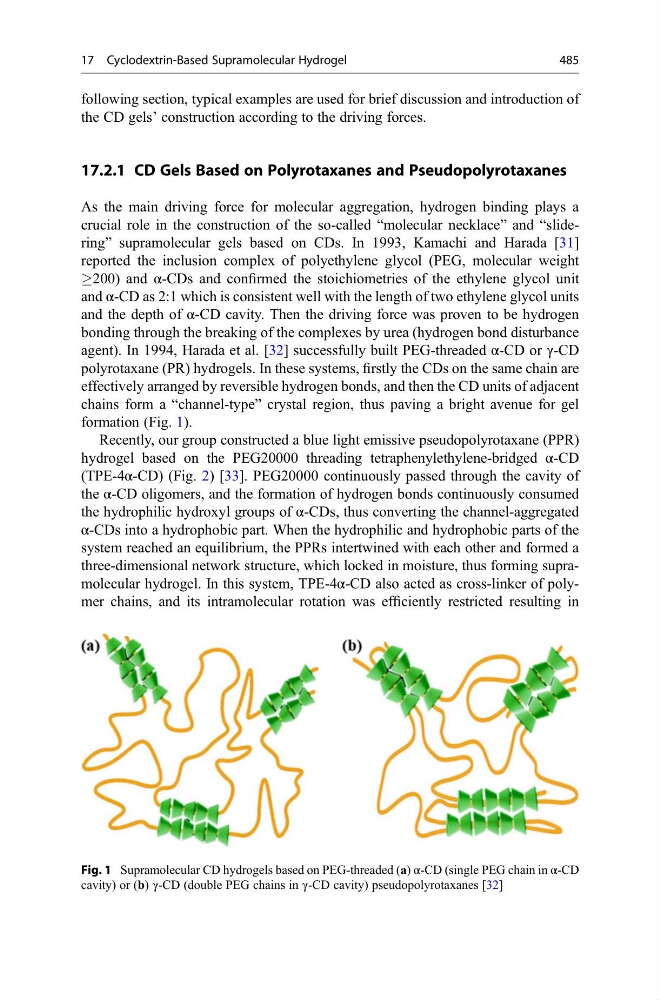
agent). In 1994, Harada et al. [32] successfully built PEG-threaded α-CD or γ-CD
polyrotaxane (PR) hydrogels. In these systems, firstly the CDs on the same chain are
effectively arranged by reversible hydrogen bonds, and then the CD units of adjacent
chains form a “channel-type” crystal region, thus paving a bright avenue for gel
formation (Fig. 1).
Recently, our group constructed a blue light emissive pseudopolyrotaxane (PPR)
hydrogel based on the PEG20000 threading tetraphenylethylene-bridged α-CD
(TPE-4α-CD) (Fig. 2) [33]. PEG20000 continuously passed through the cavity of
the α-CD oligomers, and the formation of hydrogen bonds continuously consumed
the hydrophilic hydroxyl groups of α-CDs, thus converting the channel-aggregated
α-CDs into a hydrophobic part. When the hydrophilic and hydrophobic parts of the
system reached an equilibrium, the PPRs intertwined with each other and formed a
three-dimensional network structure, which locked in moisture, thus forming supramolecular hydrogel. In this system, TPE-4α-CD also acted as cross-linker of polymer chains, and its intramolecular rotation was efficiently restricted resulting in
Fig. 1 Supramolecular CD hydrogels based on PEG-threaded (a) α-CD (single PEG chain in α-CD
cavity) or (b) γ-CD (double PEG chains in γ-CD cavity) pseudopolyrotaxanes [32]
17 Cyclodextrin-Based Supramolecular Hydrogel
485