

16.4.2 Conjugated Polymer Network and Its Disassembly Induced
by Different Signals
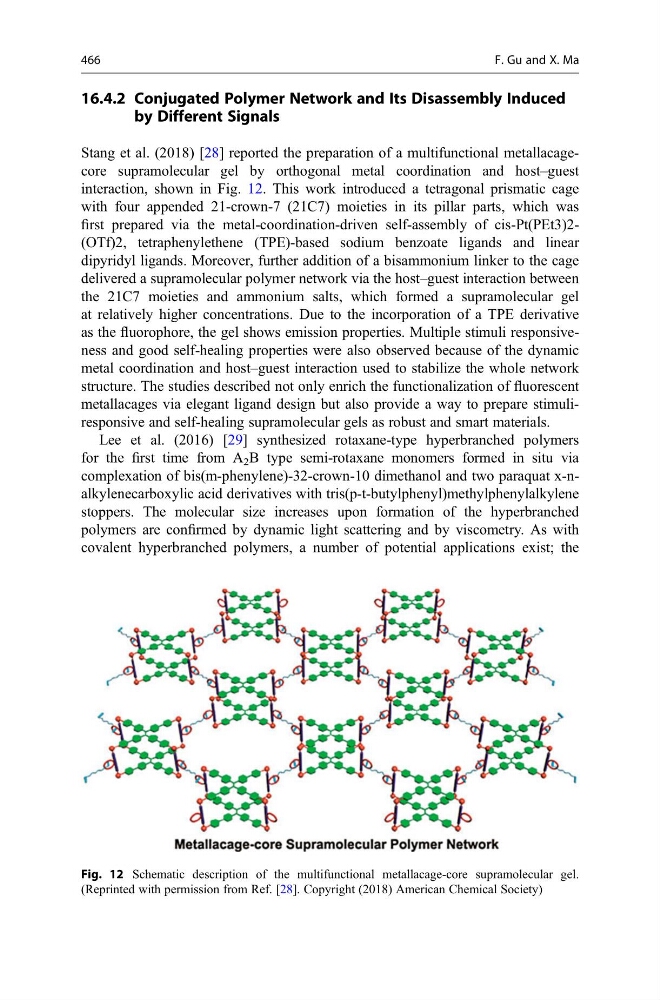
Stang et al. (2018) [28] reported the preparation of a multifunctional metallacagecore supramolecular gel by orthogonal metal coordination and host–guest
interaction, shown in Fig. 12. This work introduced a tetragonal prismatic cage
with four appended 21-crown-7 (21C7) moieties in its pillar parts, which was
first prepared via the metal-coordination-driven self-assembly of cis-Pt(PEt3)2(OTf)2, tetraphenylethene (TPE)-based sodium benzoate ligands and linear
dipyridyl ligands. Moreover, further addition of a bisammonium linker to the cage
delivered a supramolecular polymer network via the host–guest interaction between
the 21C7 moieties and ammonium salts, which formed a supramolecular gel
at relatively higher concentrations. Due to the incorporation of a TPE derivative
as the fluorophore, the gel shows emission properties. Multiple stimuli responsiveness and good self-healing properties were also observed because of the dynamic
metal coordination and host–guest interaction used to stabilize the whole network
structure. The studies described not only enrich the functionalization of fluorescent
metallacages via elegant ligand design but also provide a way to prepare stimuliresponsive and self-healing supramolecular gels as robust and smart materials.
Lee et al. (2016) [29] synthesized rotaxane-type hyperbranched polymers
for the first time from A 2 B type semi-rotaxane monomers formed in situ via
complexation of bis(m-phenylene)-32-crown-10 dimethanol and two paraquat x-nalkylenecarboxylic acid derivatives with tris(p-t-butylphenyl)methylphenylalkylene
stoppers. The molecular size increases upon formation of the hyperbranched
polymers are confirmed by dynamic light scattering and by viscometry. As with
covalent hyperbranched polymers, a number of potential applications exist; the
Fig. 12 Schematic description of the multifunctional metallacage-core supramolecular gel.
(Reprinted with permission from Ref. [28]. Copyright (2018) American Chemical Society)
466
F. Gu and X. Ma