

pH of the media changed between 1 and 7. On the other hand, the acid group is far
away from the recognition site of G6 & H1; the reversible change of acid group
shows limited influence to the binding strength. By using UV-vis spectrophotometry
titration, the K a values are determined to be 1.3 Â 10
3 M
À1 and 1.2 Â 10
3 M
À1 at
pH = 1 and 7, respectively. However, the deprotonation at the end group of acid,
affected mainly to the kinetic of binding process. The negative charge on each end of
the G6 axle would generate a strong electrostatic repulsion to threading process of
G6 & H1. By using stopped-flow methodology, the energy barrier of G6 is determined to be 44.5 kJ/mol at pH = 1, but the energy barrier increases to 56.4 kJ/mol at
pH = 7, revealing that the deprotonated acid group of G7 electrostatically hindered
the threading of H1. The threading/dethreading rate can be finely tuned through pH
of the solution, achieving an 100 times acceleration.
Recently, “supramolecular amphiphiles,” which are generated by noncovalent
synthesis, have emerged as a smart strategy to construct supramolecular nanoarchitectures [36]. Huang et al. reported novel supramolecular amphiphilic polymer
constructed by crown ether-based molecular recognition. A water-soluble crown
ether, named (m-phenylene)-32-crown-10 dicarboxylate, has moderate associated
constant of 1.5 Â 10
3 M
À1 to associate with bipyridinium guests. Poly(ethylene
oxide) is linked to a bis(m-phenylene)-32-crown-10 dicarboxylate to further increase
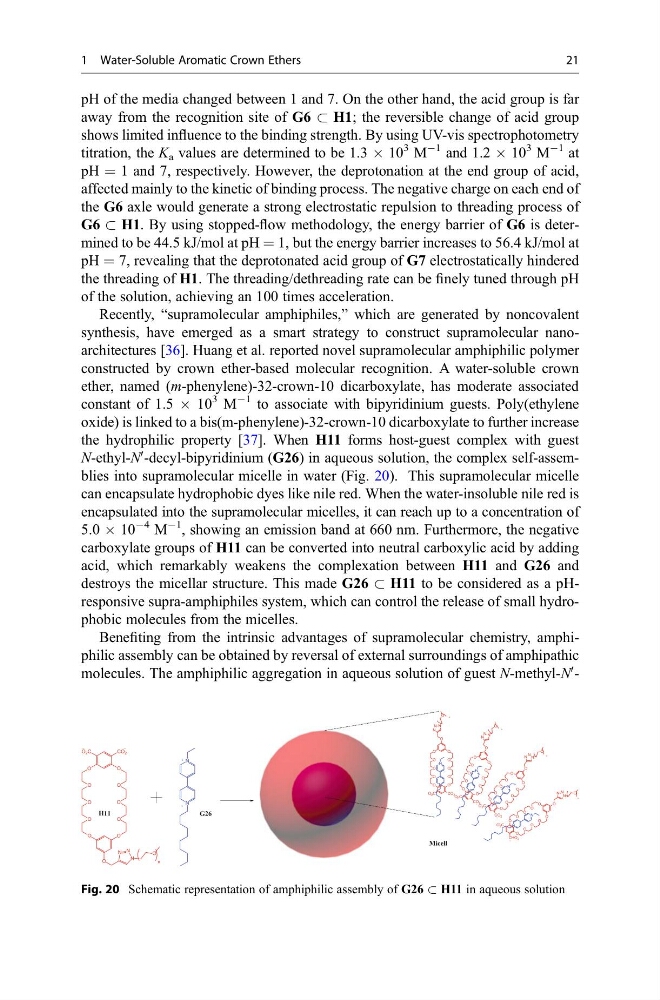
the hydrophilic property [37]. When H11 forms host-guest complex with guest
N-ethyl-N
0 -decyl-bipyridinium (G26) in aqueous solution, the complex self-assemblies into supramolecular micelle in water (Fig. 20). This supramolecular micelle
can encapsulate hydrophobic dyes like nile red. When the water-insoluble nile red is
encapsulated into the supramolecular micelles, it can reach up to a concentration of
5.0 Â 10
À4 M
À1 , showing an emission band at 660 nm. Furthermore, the negative
carboxylate groups of H11 can be converted into neutral carboxylic acid by adding
acid, which remarkably weakens the complexation between H11 and G26 and
destroys the micellar structure. This made G26 & H11 to be considered as a pHresponsive supra-amphiphiles system, which can control the release of small hydrophobic molecules from the micelles.
Benefiting from the intrinsic advantages of supramolecular chemistry, amphiphilic assembly can be obtained by reversal of external surroundings of amphipathic
molecules. The amphiphilic aggregation in aqueous solution of guest N-methyl-N
0 -
O
O
O
O
O
O
O
O
O
O
O2C
CO2
O
N
N
N
O
n
N
N
O
O
O
O
O
O
O
O
O
O
CO2
O2C
O
N
N
N
O
n
N
N
O
O
O
O
O
O
O
O
O
O
CO2
O2C
O
N
N
N
O
n
N
N
O
O
O
O
O
O
O
O
O
O
CO2
O2C
O
N
N
N
O
n
N
N
O O O O
O
O
O
O
O
O
CHO2
O2C
O
N
N
N
O
n
N
N
Micell
H11
G26
Fig. 20 Schematic representation of amphiphilic assembly of G26 & H11 in aqueous solution
1 Water-Soluble Aromatic Crown Ethers
21
away from the recognition site of G6 & H1; the reversible change of acid group
shows limited influence to the binding strength. By using UV-vis spectrophotometry
titration, the K a values are determined to be 1.3 Â 10
3 M
À1 and 1.2 Â 10
3 M
À1 at
pH = 1 and 7, respectively. However, the deprotonation at the end group of acid,
affected mainly to the kinetic of binding process. The negative charge on each end of
the G6 axle would generate a strong electrostatic repulsion to threading process of
G6 & H1. By using stopped-flow methodology, the energy barrier of G6 is determined to be 44.5 kJ/mol at pH = 1, but the energy barrier increases to 56.4 kJ/mol at
pH = 7, revealing that the deprotonated acid group of G7 electrostatically hindered
the threading of H1. The threading/dethreading rate can be finely tuned through pH
of the solution, achieving an 100 times acceleration.
Recently, “supramolecular amphiphiles,” which are generated by noncovalent
synthesis, have emerged as a smart strategy to construct supramolecular nanoarchitectures [36]. Huang et al. reported novel supramolecular amphiphilic polymer
constructed by crown ether-based molecular recognition. A water-soluble crown
ether, named (m-phenylene)-32-crown-10 dicarboxylate, has moderate associated
constant of 1.5 Â 10
3 M
À1 to associate with bipyridinium guests. Poly(ethylene
oxide) is linked to a bis(m-phenylene)-32-crown-10 dicarboxylate to further increase
the hydrophilic property [37]. When H11 forms host-guest complex with guest
N-ethyl-N
0 -decyl-bipyridinium (G26) in aqueous solution, the complex self-assemblies into supramolecular micelle in water (Fig. 20). This supramolecular micelle
can encapsulate hydrophobic dyes like nile red. When the water-insoluble nile red is
encapsulated into the supramolecular micelles, it can reach up to a concentration of
5.0 Â 10
À4 M
À1 , showing an emission band at 660 nm. Furthermore, the negative
carboxylate groups of H11 can be converted into neutral carboxylic acid by adding
acid, which remarkably weakens the complexation between H11 and G26 and
destroys the micellar structure. This made G26 & H11 to be considered as a pHresponsive supra-amphiphiles system, which can control the release of small hydrophobic molecules from the micelles.
Benefiting from the intrinsic advantages of supramolecular chemistry, amphiphilic assembly can be obtained by reversal of external surroundings of amphipathic
molecules. The amphiphilic aggregation in aqueous solution of guest N-methyl-N
0 -
O
O
O
O
O
O
O
O
O
O
O2C
CO2
O
N
N
N
O
n
N
N
O
O
O
O
O
O
O
O
O
O
CO2
O2C
O
N
N
N
O
n
N
N
O
O
O
O
O
O
O
O
O
O
CO2
O2C
O
N
N
N
O
n
N
N
O
O
O
O
O
O
O
O
O
O
CO2
O2C
O
N
N
N
O
n
N
N
O O O O
O
O
O
O
O
O
CHO2
O2C
O
N
N
N
O
n
N
N
Micell
H11
G26
Fig. 20 Schematic representation of amphiphilic assembly of G26 & H11 in aqueous solution
1 Water-Soluble Aromatic Crown Ethers
21