

(H 2 O)(MeNO 2 ) 2 , indicating that each zinc core would coordinate with four pyridinyl
groups, and these MOFs are two-periodic coordination grid polymers. Each Zn(II)
center adopts an octahedral geometry and two water ligands coordinating to the
remaining axial sites by hydrogen bonds. The grid layers are expanded in two
dimensions and stacked in an alternating AB fashion along with the axial dimension
by coordinated water molecules. The space of neighboring grid layers is 7.82 Å.
Large voids in the grid layers are filled with solvent molecules. Treating the MOFs
under mild vacuum at room temperature results in a porous solid with 42% void
space, which could be applied to adsorb small molecules. Three-periodic MOFs
were synthesized using the same reaction conditions as above but in the presence of
[Me 4 N] 2 [SO 4 ] with formula [Zn(G4 & H1) 2 ][(Zn(SO 4 )(H 2 O) 2 (MeOH) 2 ) 2 ]Á
(MeNO 2 ). The MOFs are three-periodic coordination polymers consisting of Zn
(II) metal ions and [G4 & H1] linkers as well as ZnSO 4 -based clusters pillaring the
layers. As in two-dimensional periodic MOFs, the three-periodic MOFs contain
neutral square grids consisted of [Zn(G4 & H1) 2 ] units, that is, each Zn(II) core
coordinates with four pyridinyl groups of G4 & H1 and each G4 & H1 coordinates
with another two Zn(II); the coordinate layers repeat in two dimensions to form a
square grid. In contrast to the two-dimensional MOFs above, the two-periodic grids
in this MOFs are no longer spaced together by hydrogen bonds, but are pillared
by inorganic clusters of (Zn(SO 4 )(H 2 O) 2 (MeOH) 2 ) 2 , which make the MOFs be
stabilized in the third dimension.
Initial investigations of Loeb and Tiburcio had revealed that H1 prefers to
associate with guests containing 1,2-bis(pyridinium)ethane moieties due to the
electrostatic attraction between guests and H1. Therefore, it seems that an extension
of this concept would be to change the positive charge numbers which could
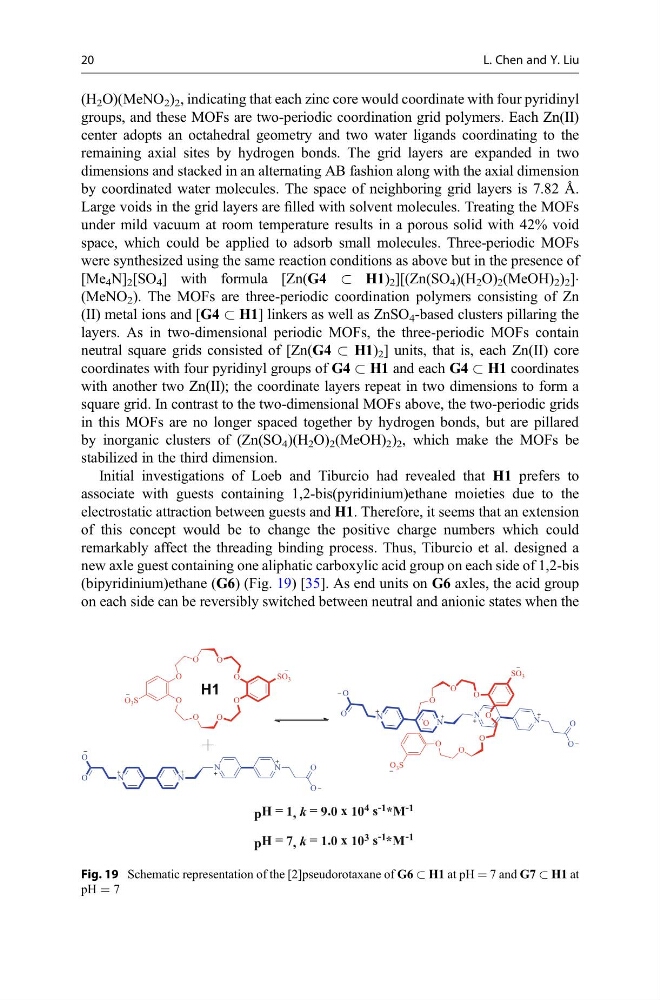
remarkably affect the threading binding process. Thus, Tiburcio et al. designed a
new axle guest containing one aliphatic carboxylic acid group on each side of 1,2-bis
(bipyridinium)ethane (G6) (Fig. 19) [35]. As end units on G6 axles, the acid group
on each side can be reversibly switched between neutral and anionic states when the
O
O
O
O
O
O
O
O
O 3 S
SO 3
N
N
N
N
O
O
O
O
O
O
O
O
O
O
O
O
O 3 S
SO 3
N
N
N
N
O
O
O
O
p H = 1 , k = 9.0 x 10 4 s -1 *M
-1
-1
-1
p H = 7 , k = 1.0 x 10 3 s *M
H1
Fig. 19 Schematic representation of the [2]pseudorotaxane of G6 & H1 at pH = 7 and G7 & H1 at
pH = 7
20
L. Chen and Y. Liu
groups, and these MOFs are two-periodic coordination grid polymers. Each Zn(II)
center adopts an octahedral geometry and two water ligands coordinating to the
remaining axial sites by hydrogen bonds. The grid layers are expanded in two
dimensions and stacked in an alternating AB fashion along with the axial dimension
by coordinated water molecules. The space of neighboring grid layers is 7.82 Å.
Large voids in the grid layers are filled with solvent molecules. Treating the MOFs
under mild vacuum at room temperature results in a porous solid with 42% void
space, which could be applied to adsorb small molecules. Three-periodic MOFs
were synthesized using the same reaction conditions as above but in the presence of
[Me 4 N] 2 [SO 4 ] with formula [Zn(G4 & H1) 2 ][(Zn(SO 4 )(H 2 O) 2 (MeOH) 2 ) 2 ]Á
(MeNO 2 ). The MOFs are three-periodic coordination polymers consisting of Zn
(II) metal ions and [G4 & H1] linkers as well as ZnSO 4 -based clusters pillaring the
layers. As in two-dimensional periodic MOFs, the three-periodic MOFs contain
neutral square grids consisted of [Zn(G4 & H1) 2 ] units, that is, each Zn(II) core
coordinates with four pyridinyl groups of G4 & H1 and each G4 & H1 coordinates
with another two Zn(II); the coordinate layers repeat in two dimensions to form a
square grid. In contrast to the two-dimensional MOFs above, the two-periodic grids
in this MOFs are no longer spaced together by hydrogen bonds, but are pillared
by inorganic clusters of (Zn(SO 4 )(H 2 O) 2 (MeOH) 2 ) 2 , which make the MOFs be
stabilized in the third dimension.
Initial investigations of Loeb and Tiburcio had revealed that H1 prefers to
associate with guests containing 1,2-bis(pyridinium)ethane moieties due to the
electrostatic attraction between guests and H1. Therefore, it seems that an extension
of this concept would be to change the positive charge numbers which could
remarkably affect the threading binding process. Thus, Tiburcio et al. designed a
new axle guest containing one aliphatic carboxylic acid group on each side of 1,2-bis
(bipyridinium)ethane (G6) (Fig. 19) [35]. As end units on G6 axles, the acid group
on each side can be reversibly switched between neutral and anionic states when the
O
O
O
O
O
O
O
O
O 3 S
SO 3
N
N
N
N
O
O
O
O
O
O
O
O
O
O
O
O
O 3 S
SO 3
N
N
N
N
O
O
O
O
p H = 1 , k = 9.0 x 10 4 s -1 *M
-1
-1
-1
p H = 7 , k = 1.0 x 10 3 s *M
H1
Fig. 19 Schematic representation of the [2]pseudorotaxane of G6 & H1 at pH = 7 and G7 & H1 at
pH = 7
20
L. Chen and Y. Liu