

host–guest inclusion between the CD–mannose and the Azo. After ultraviolet
irradiation (365 nm) for 30 min, the trans-Azo changed to its cis form to escape
the CD cavity, resulting in release of the bacteria. The form of Azo can be transformed by irradiation with different wavelengths of light. Therefore, this system can
capture and release bacteria by repeated irradiation with different types of light,
showing great potential for applications in biosensors and diagnostic devices [90]
(Fig. 20).
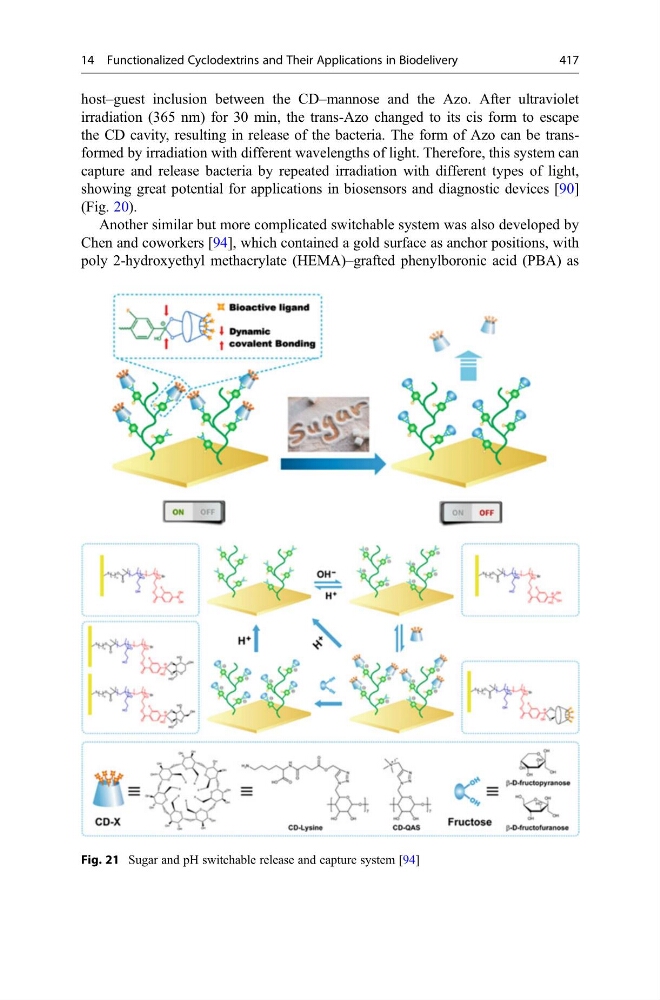
Another similar but more complicated switchable system was also developed by
Chen and coworkers [94], which contained a gold surface as anchor positions, with
poly 2-hydroxyethyl methacrylate (HEMA)–grafted phenylboronic acid (PBA) as
Fig. 21 Sugar and pH switchable release and capture system [94]
14 Functionalized Cyclodextrins and Their Applications in Biodelivery
417
irradiation (365 nm) for 30 min, the trans-Azo changed to its cis form to escape
the CD cavity, resulting in release of the bacteria. The form of Azo can be transformed by irradiation with different wavelengths of light. Therefore, this system can
capture and release bacteria by repeated irradiation with different types of light,
showing great potential for applications in biosensors and diagnostic devices [90]
(Fig. 20).
Another similar but more complicated switchable system was also developed by
Chen and coworkers [94], which contained a gold surface as anchor positions, with
poly 2-hydroxyethyl methacrylate (HEMA)–grafted phenylboronic acid (PBA) as
Fig. 21 Sugar and pH switchable release and capture system [94]
14 Functionalized Cyclodextrins and Their Applications in Biodelivery
417