

coworkers treated the capped CD 41 with DIBAL-H. In different concentrations of
DIBAL-H and at different temperatures, it displayed different selectivity. For example,
treated 41 with 1 M of DIBAL-H, heated to 50
C, produced 42-A in a 90% yield.
With 0.1 M of DIBAL-H at room temperature, it produced 42-B in a 52% yield.
Compound 42-A was treated with tert-butyldimethylsilyl trifluoromethanesulfonate
(TBSOTf) and then Pd to form tridifferentiated compound 43, and compound 42-B
was also further modified to give 44-A and 44-B [14, 17]. In comparison with the
olefin cap strategy, this new strategy was a great improvement in terms of both yield
and selectivity, and even provided a new selectivity by which Sollogoub and
coworkers could make a primary-rim-differentiated CD, especially to achieve hexadifferentiated α-CD [3] (Scheme 8).
In the work on hexadifferentiated α-CD, the propene cap played a very important
role in offering precise selectivity for deprotecting the benzyl at the C sugar unit.
Sollogoub and coworkers [3] introduced hexadifferentiated groups into the primary
rim of α-CD via five DIBAL-H deprotection reactions. First, perbenzylated α-CD 45
was treated with DIBAL-H to afford monol-CD 46, then the only hydroxyl
group was substituted by olefin after oxidizing and Wittig reactions; second,
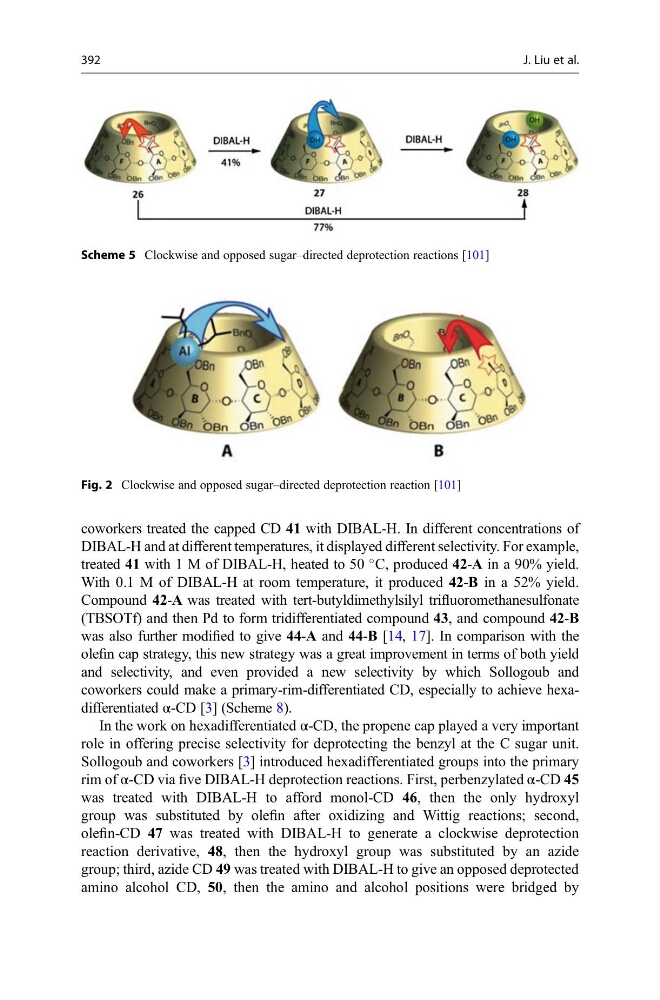
olefin-CD 47 was treated with DIBAL-H to generate a clockwise deprotection
reaction derivative, 48, then the hydroxyl group was substituted by an azide
group; third, azide CD 49 was treated with DIBAL-H to give an opposed deprotected
amino alcohol CD, 50, then the amino and alcohol positions were bridged by
Scheme 5 Clockwise and opposed sugar–directed deprotection reactions [101]
Fig. 2 Clockwise and opposed sugar–directed deprotection reaction [101]
392
J. Liu et al.
DIBAL-H and at different temperatures, it displayed different selectivity. For example,
treated 41 with 1 M of DIBAL-H, heated to 50
C, produced 42-A in a 90% yield.
With 0.1 M of DIBAL-H at room temperature, it produced 42-B in a 52% yield.
Compound 42-A was treated with tert-butyldimethylsilyl trifluoromethanesulfonate
(TBSOTf) and then Pd to form tridifferentiated compound 43, and compound 42-B
was also further modified to give 44-A and 44-B [14, 17]. In comparison with the
olefin cap strategy, this new strategy was a great improvement in terms of both yield
and selectivity, and even provided a new selectivity by which Sollogoub and
coworkers could make a primary-rim-differentiated CD, especially to achieve hexadifferentiated α-CD [3] (Scheme 8).
In the work on hexadifferentiated α-CD, the propene cap played a very important
role in offering precise selectivity for deprotecting the benzyl at the C sugar unit.
Sollogoub and coworkers [3] introduced hexadifferentiated groups into the primary
rim of α-CD via five DIBAL-H deprotection reactions. First, perbenzylated α-CD 45
was treated with DIBAL-H to afford monol-CD 46, then the only hydroxyl
group was substituted by olefin after oxidizing and Wittig reactions; second,
olefin-CD 47 was treated with DIBAL-H to generate a clockwise deprotection
reaction derivative, 48, then the hydroxyl group was substituted by an azide
group; third, azide CD 49 was treated with DIBAL-H to give an opposed deprotected
amino alcohol CD, 50, then the amino and alcohol positions were bridged by
Scheme 5 Clockwise and opposed sugar–directed deprotection reactions [101]
Fig. 2 Clockwise and opposed sugar–directed deprotection reaction [101]
392
J. Liu et al.