

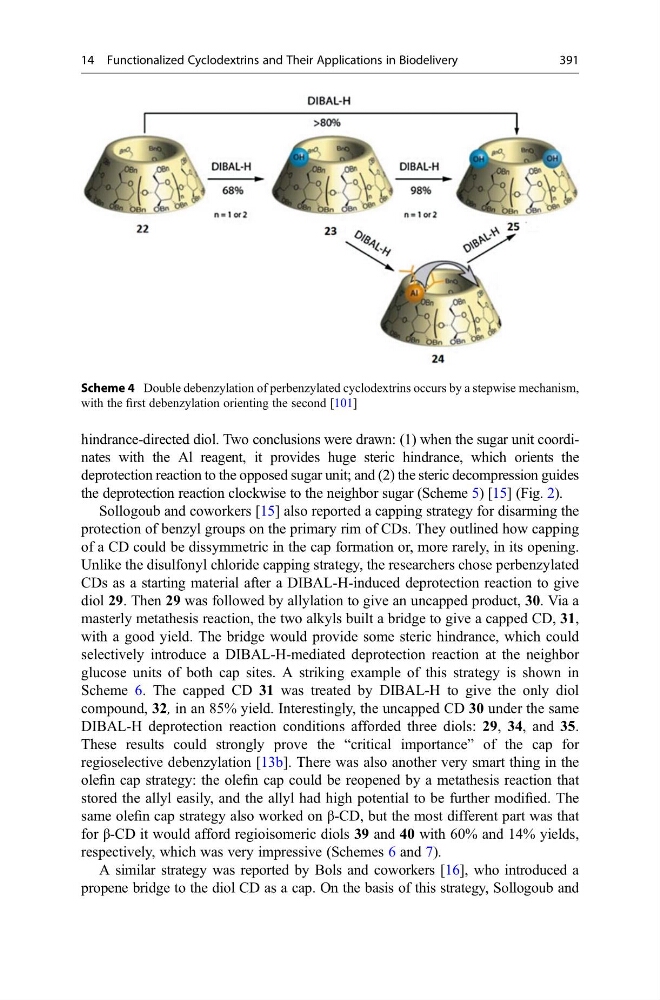
hindrance-directed diol. Two conclusions were drawn: (1) when the sugar unit coordinates with the Al reagent, it provides huge steric hindrance, which orients the
deprotection reaction to the opposed sugar unit; and (2) the steric decompression guides
the deprotection reaction clockwise to the neighbor sugar (Scheme 5) [15] (Fig. 2).
Sollogoub and coworkers [15] also reported a capping strategy for disarming the
protection of benzyl groups on the primary rim of CDs. They outlined how capping
of a CD could be dissymmetric in the cap formation or, more rarely, in its opening.
Unlike the disulfonyl chloride capping strategy, the researchers chose perbenzylated
CDs as a starting material after a DIBAL-H-induced deprotection reaction to give
diol 29. Then 29 was followed by allylation to give an uncapped product, 30. Via a
masterly metathesis reaction, the two alkyls built a bridge to give a capped CD, 31,
with a good yield. The bridge would provide some steric hindrance, which could
selectively introduce a DIBAL-H-mediated deprotection reaction at the neighbor
glucose units of both cap sites. A striking example of this strategy is shown in
Scheme 6. The capped CD 31 was treated by DIBAL-H to give the only diol
compound, 32, in an 85% yield. Interestingly, the uncapped CD 30 under the same
DIBAL-H deprotection reaction conditions afforded three diols: 29, 34, and 35.
These results could strongly prove the “critical importance” of the cap for
regioselective debenzylation [13b]. There was also another very smart thing in the
olefin cap strategy: the olefin cap could be reopened by a metathesis reaction that
stored the allyl easily, and the allyl had high potential to be further modified. The
same olefin cap strategy also worked on β-CD, but the most different part was that
for β-CD it would afford regioisomeric diols 39 and 40 with 60% and 14% yields,
respectively, which was very impressive (Schemes 6 and 7).
A similar strategy was reported by Bols and coworkers [16], who introduced a
propene bridge to the diol CD as a cap. On the basis of this strategy, Sollogoub and
Scheme 4 Double debenzylation of perbenzylated cyclodextrins occurs by a stepwise mechanism,
with the first debenzylation orienting the second [101]
14 Functionalized Cyclodextrins and Their Applications in Biodelivery
391
deprotection reaction to the opposed sugar unit; and (2) the steric decompression guides
the deprotection reaction clockwise to the neighbor sugar (Scheme 5) [15] (Fig. 2).
Sollogoub and coworkers [15] also reported a capping strategy for disarming the
protection of benzyl groups on the primary rim of CDs. They outlined how capping
of a CD could be dissymmetric in the cap formation or, more rarely, in its opening.
Unlike the disulfonyl chloride capping strategy, the researchers chose perbenzylated
CDs as a starting material after a DIBAL-H-induced deprotection reaction to give
diol 29. Then 29 was followed by allylation to give an uncapped product, 30. Via a
masterly metathesis reaction, the two alkyls built a bridge to give a capped CD, 31,
with a good yield. The bridge would provide some steric hindrance, which could
selectively introduce a DIBAL-H-mediated deprotection reaction at the neighbor
glucose units of both cap sites. A striking example of this strategy is shown in
Scheme 6. The capped CD 31 was treated by DIBAL-H to give the only diol
compound, 32, in an 85% yield. Interestingly, the uncapped CD 30 under the same
DIBAL-H deprotection reaction conditions afforded three diols: 29, 34, and 35.
These results could strongly prove the “critical importance” of the cap for
regioselective debenzylation [13b]. There was also another very smart thing in the
olefin cap strategy: the olefin cap could be reopened by a metathesis reaction that
stored the allyl easily, and the allyl had high potential to be further modified. The
same olefin cap strategy also worked on β-CD, but the most different part was that
for β-CD it would afford regioisomeric diols 39 and 40 with 60% and 14% yields,
respectively, which was very impressive (Schemes 6 and 7).
A similar strategy was reported by Bols and coworkers [16], who introduced a
propene bridge to the diol CD as a cap. On the basis of this strategy, Sollogoub and
Scheme 4 Double debenzylation of perbenzylated cyclodextrins occurs by a stepwise mechanism,
with the first debenzylation orienting the second [101]
14 Functionalized Cyclodextrins and Their Applications in Biodelivery
391