

transfer process would be broken, resulting in a variation in the fluorescence signal,
which could be used to track the process of translocation, drug release, and excretion
of the nanomedicine.
13.3.4 Application for Optical Materials
Fluorescent material is an important kind of smart material, which can be applied in
fluorescent sensors, optoelectronics, probes, biomedicine imaging, and light-emitting diodes [41]. Among the various fluorescent materials, fluorescent supramolecular polymers are very interesting as the fluorescent nature of the chromophores can
be controllably regulated by polymerization process of supramolecular polymers.
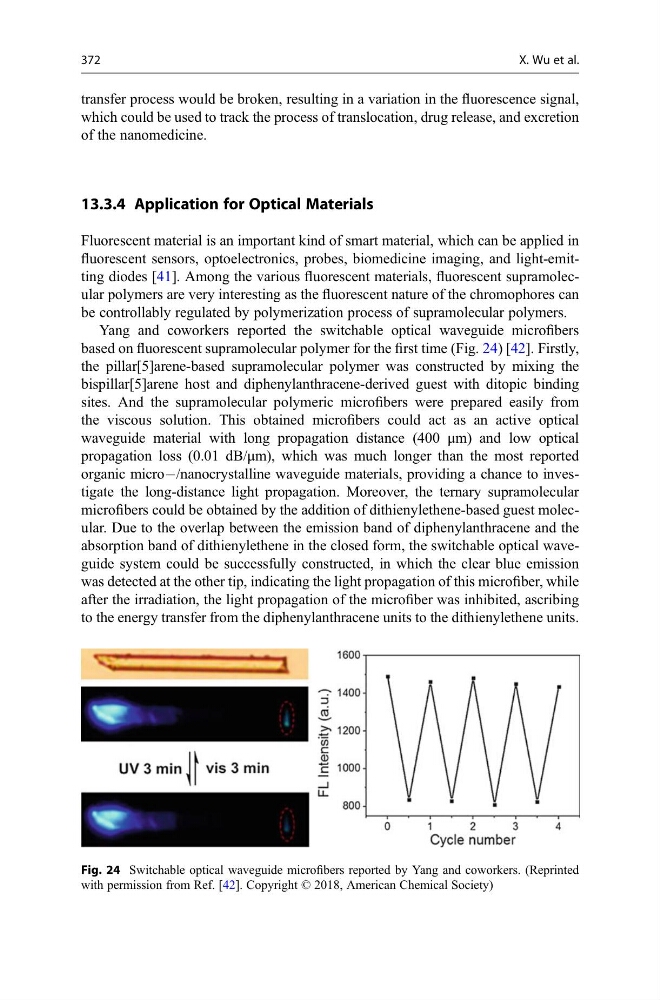
Yang and coworkers reported the switchable optical waveguide microfibers
based on fluorescent supramolecular polymer for the first time (Fig. 24) [42]. Firstly,
the pillar[5]arene-based supramolecular polymer was constructed by mixing the
bispillar[5]arene host and diphenylanthracene-derived guest with ditopic binding
sites. And the supramolecular polymeric microfibers were prepared easily from
the viscous solution. This obtained microfibers could act as an active optical
waveguide material with long propagation distance (400 μm) and low optical
propagation loss (0.01 dB/μm), which was much longer than the most reported
organic microÀ/nanocrystalline waveguide materials, providing a chance to investigate the long-distance light propagation. Moreover, the ternary supramolecular
microfibers could be obtained by the addition of dithienylethene-based guest molecular. Due to the overlap between the emission band of diphenylanthracene and the
absorption band of dithienylethene in the closed form, the switchable optical waveguide system could be successfully constructed, in which the clear blue emission
was detected at the other tip, indicating the light propagation of this microfiber, while
after the irradiation, the light propagation of the microfiber was inhibited, ascribing
to the energy transfer from the diphenylanthracene units to the dithienylethene units.
Fig. 24 Switchable optical waveguide microfibers reported by Yang and coworkers. (Reprinted
with permission from Ref. [42]. Copyright © 2018, American Chemical Society)
372
X. Wu et al.
which could be used to track the process of translocation, drug release, and excretion
of the nanomedicine.
13.3.4 Application for Optical Materials
Fluorescent material is an important kind of smart material, which can be applied in
fluorescent sensors, optoelectronics, probes, biomedicine imaging, and light-emitting diodes [41]. Among the various fluorescent materials, fluorescent supramolecular polymers are very interesting as the fluorescent nature of the chromophores can
be controllably regulated by polymerization process of supramolecular polymers.
Yang and coworkers reported the switchable optical waveguide microfibers
based on fluorescent supramolecular polymer for the first time (Fig. 24) [42]. Firstly,
the pillar[5]arene-based supramolecular polymer was constructed by mixing the
bispillar[5]arene host and diphenylanthracene-derived guest with ditopic binding
sites. And the supramolecular polymeric microfibers were prepared easily from
the viscous solution. This obtained microfibers could act as an active optical
waveguide material with long propagation distance (400 μm) and low optical
propagation loss (0.01 dB/μm), which was much longer than the most reported
organic microÀ/nanocrystalline waveguide materials, providing a chance to investigate the long-distance light propagation. Moreover, the ternary supramolecular
microfibers could be obtained by the addition of dithienylethene-based guest molecular. Due to the overlap between the emission band of diphenylanthracene and the
absorption band of dithienylethene in the closed form, the switchable optical waveguide system could be successfully constructed, in which the clear blue emission
was detected at the other tip, indicating the light propagation of this microfiber, while
after the irradiation, the light propagation of the microfiber was inhibited, ascribing
to the energy transfer from the diphenylanthracene units to the dithienylethene units.
Fig. 24 Switchable optical waveguide microfibers reported by Yang and coworkers. (Reprinted
with permission from Ref. [42]. Copyright © 2018, American Chemical Society)
372
X. Wu et al.