

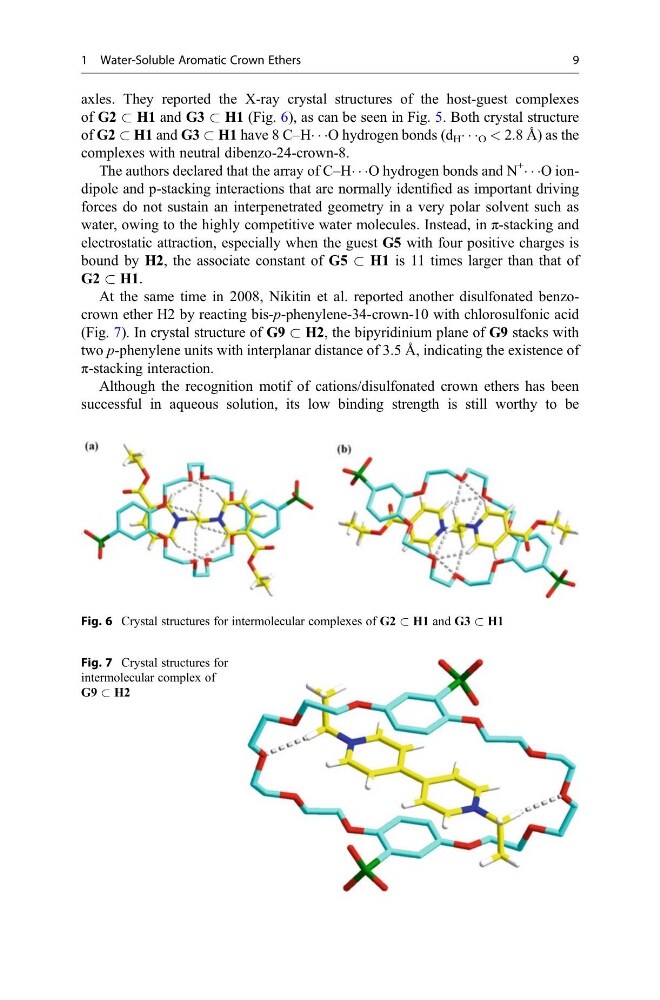
axles. They reported the X-ray crystal structures of the host-guest complexes
of G2 & H1 and G3 & H1 (Fig. 6), as can be seen in Fig. 5. Both crystal structure
of G2 & H1 and G3 & H1 have 8 C–HÁ Á ÁO hydrogen bonds (d H Á Á Á O < 2.8 Å) as the
complexes with neutral dibenzo-24-crown-8.
The authors declared that the array of C–HÁ Á ÁO hydrogen bonds and N
+
Á Á ÁO iondipole and p-stacking interactions that are normally identified as important driving
forces do not sustain an interpenetrated geometry in a very polar solvent such as
water, owing to the highly competitive water molecules. Instead, in π-stacking and
electrostatic attraction, especially when the guest G5 with four positive charges is
bound by H2, the associate constant of G5 & H1 is 11 times larger than that of
G2 & H1.
At the same time in 2008, Nikitin et al. reported another disulfonated benzocrown ether H2 by reacting bis-p-phenylene-34-crown-10 with chlorosulfonic acid
(Fig. 7). In crystal structure of G9 & H2, the bipyridinium plane of G9 stacks with
two p-phenylene units with interplanar distance of 3.5 Å, indicating the existence of
π-stacking interaction.
Although the recognition motif of cations/disulfonated crown ethers has been
successful in aqueous solution, its low binding strength is still worthy to be
Fig. 6 Crystal structures for intermolecular complexes of G2 & H1 and G3 & H1
Fig. 7 Crystal structures for
intermolecular complex of
G9 & H2
1 Water-Soluble Aromatic Crown Ethers
9
of G2 & H1 and G3 & H1 (Fig. 6), as can be seen in Fig. 5. Both crystal structure
of G2 & H1 and G3 & H1 have 8 C–HÁ Á ÁO hydrogen bonds (d H Á Á Á O < 2.8 Å) as the
complexes with neutral dibenzo-24-crown-8.
The authors declared that the array of C–HÁ Á ÁO hydrogen bonds and N
+
Á Á ÁO iondipole and p-stacking interactions that are normally identified as important driving
forces do not sustain an interpenetrated geometry in a very polar solvent such as
water, owing to the highly competitive water molecules. Instead, in π-stacking and
electrostatic attraction, especially when the guest G5 with four positive charges is
bound by H2, the associate constant of G5 & H1 is 11 times larger than that of
G2 & H1.
At the same time in 2008, Nikitin et al. reported another disulfonated benzocrown ether H2 by reacting bis-p-phenylene-34-crown-10 with chlorosulfonic acid
(Fig. 7). In crystal structure of G9 & H2, the bipyridinium plane of G9 stacks with
two p-phenylene units with interplanar distance of 3.5 Å, indicating the existence of
π-stacking interaction.
Although the recognition motif of cations/disulfonated crown ethers has been
successful in aqueous solution, its low binding strength is still worthy to be
Fig. 6 Crystal structures for intermolecular complexes of G2 & H1 and G3 & H1
Fig. 7 Crystal structures for
intermolecular complex of
G9 & H2
1 Water-Soluble Aromatic Crown Ethers
9