

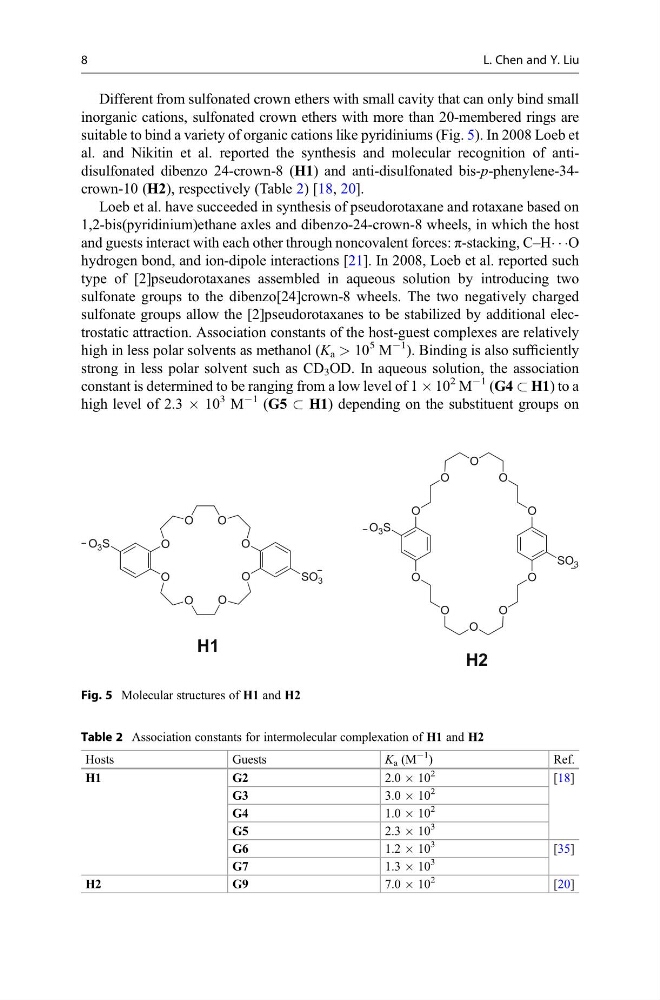
Different from sulfonated crown ethers with small cavity that can only bind small
inorganic cations, sulfonated crown ethers with more than 20-membered rings are
suitable to bind a variety of organic cations like pyridiniums (Fig. 5). In 2008 Loeb et
al. and Nikitin et al. reported the synthesis and molecular recognition of antidisulfonated dibenzo 24-crown-8 (H1) and anti-disulfonated bis-p-phenylene-34crown-10 (H2), respectively (Table 2) [18, 20].
Loeb et al. have succeeded in synthesis of pseudorotaxane and rotaxane based on
1,2-bis(pyridinium)ethane axles and dibenzo-24-crown-8 wheels, in which the host
and guests interact with each other through noncovalent forces: π-stacking, C–HÁ Á ÁO
hydrogen bond, and ion-dipole interactions [21]. In 2008, Loeb et al. reported such
type of [2]pseudorotaxanes assembled in aqueous solution by introducing two
sulfonate groups to the dibenzo[24]crown-8 wheels. The two negatively charged
sulfonate groups allow the [2]pseudorotaxanes to be stabilized by additional electrostatic attraction. Association constants of the host-guest complexes are relatively
high in less polar solvents as methanol (K a > 10
5 M
À1 ). Binding is also sufficiently
strong in less polar solvent such as CD 3 OD. In aqueous solution, the association
constant is determined to be ranging from a low level of 1 Â 10
2 M
À1 (G4 & H1) to a
high level of 2.3 Â 10
3 M
À1 (G5 & H1) depending on the substituent groups on
O
O
O
O
O
O
O
O
SO 3
O 3 S
O
O
O
O
O
O
O
O
O
O
O 3 S
SO 3
H1
H2
Fig. 5 Molecular structures of H1 and H2
Table 2 Association constants for intermolecular complexation of H1 and H2
Hosts
Guests
K a (M
À1
)
Ref.
H1
G2
2.0 Â 10
2
[18]
G3
3.0 Â 10
2
G4
1.0 Â 10
2
G5
2.3 Â 10
3
G6
1.2 Â 10
3
[35]
G7
1.3 Â 10
3
H2
G9
7.0 Â 10
2
[20]
8
L. Chen and Y. Liu
inorganic cations, sulfonated crown ethers with more than 20-membered rings are
suitable to bind a variety of organic cations like pyridiniums (Fig. 5). In 2008 Loeb et
al. and Nikitin et al. reported the synthesis and molecular recognition of antidisulfonated dibenzo 24-crown-8 (H1) and anti-disulfonated bis-p-phenylene-34crown-10 (H2), respectively (Table 2) [18, 20].
Loeb et al. have succeeded in synthesis of pseudorotaxane and rotaxane based on
1,2-bis(pyridinium)ethane axles and dibenzo-24-crown-8 wheels, in which the host
and guests interact with each other through noncovalent forces: π-stacking, C–HÁ Á ÁO
hydrogen bond, and ion-dipole interactions [21]. In 2008, Loeb et al. reported such
type of [2]pseudorotaxanes assembled in aqueous solution by introducing two
sulfonate groups to the dibenzo[24]crown-8 wheels. The two negatively charged
sulfonate groups allow the [2]pseudorotaxanes to be stabilized by additional electrostatic attraction. Association constants of the host-guest complexes are relatively
high in less polar solvents as methanol (K a > 10
5 M
À1 ). Binding is also sufficiently
strong in less polar solvent such as CD 3 OD. In aqueous solution, the association
constant is determined to be ranging from a low level of 1 Â 10
2 M
À1 (G4 & H1) to a
high level of 2.3 Â 10
3 M
À1 (G5 & H1) depending on the substituent groups on
O
O
O
O
O
O
O
O
SO 3
O 3 S
O
O
O
O
O
O
O
O
O
O
O 3 S
SO 3
H1
H2
Fig. 5 Molecular structures of H1 and H2
Table 2 Association constants for intermolecular complexation of H1 and H2
Hosts
Guests
K a (M
À1
)
Ref.
H1
G2
2.0 Â 10
2
[18]
G3
3.0 Â 10
2
G4
1.0 Â 10
2
G5
2.3 Â 10
3
G6
1.2 Â 10
3
[35]
G7
1.3 Â 10
3
H2
G9
7.0 Â 10
2
[20]
8
L. Chen and Y. Liu