

12.8 Neutral p-Electron Deficient Guests
44BP4 is capable of forming inclusion complexes with not only organic cationic
guests but also with neutral π-electron deficient molecules because of its π-electron
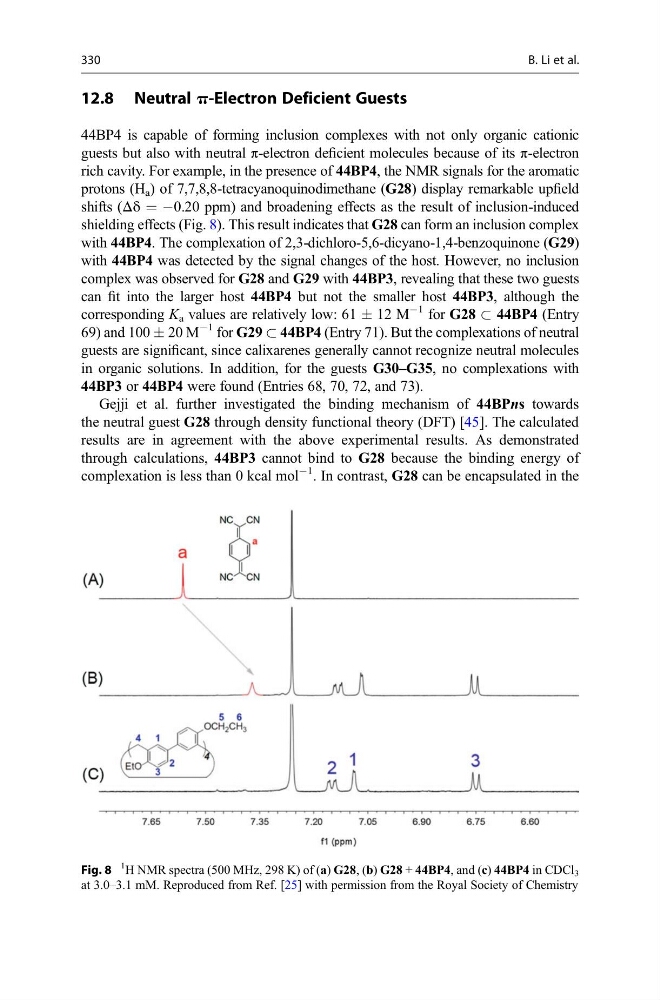
rich cavity. For example, in the presence of 44BP4, the NMR signals for the aromatic
protons (H a ) of 7,7,8,8-tetracyanoquinodimethane (G28) display remarkable upfield
shifts (Δδ = À0.20 ppm) and broadening effects as the result of inclusion-induced
shielding effects (Fig. 8). This result indicates that G28 can form an inclusion complex
with 44BP4. The complexation of 2,3-dichloro-5,6-dicyano-1,4-benzoquinone (G29)
with 44BP4 was detected by the signal changes of the host. However, no inclusion
complex was observed for G28 and G29 with 44BP3, revealing that these two guests
can fit into the larger host 44BP4 but not the smaller host 44BP3, although the
corresponding K a values are relatively low: 61 Æ 12 M
À1 for G28 & 44BP4 (Entry
69) and 100 Æ 20 M
À1 for G29 & 44BP4 (Entry 71). But the complexations of neutral
guests are significant, since calixarenes generally cannot recognize neutral molecules
in organic solutions. In addition, for the guests G30–G35, no complexations with
44BP3 or 44BP4 were found (Entries 68, 70, 72, and 73).
Gejji et al. further investigated the binding mechanism of 44BPns towards
the neutral guest G28 through density functional theory (DFT) [45]. The calculated
results are in agreement with the above experimental results. As demonstrated
through calculations, 44BP3 cannot bind to G28 because the binding energy of
complexation is less than 0 kcal mol
À1 . In contrast, G28 can be encapsulated in the
Fig. 8
1
H NMR spectra (500 MHz, 298 K) of (a) G28, (b) G28 + 44BP4, and (c) 44BP4 in CDCl 3
at 3.0–3.1 mM. Reproduced from Ref. [25] with permission from the Royal Society of Chemistry
330
B. Li et al.
44BP4 is capable of forming inclusion complexes with not only organic cationic
guests but also with neutral π-electron deficient molecules because of its π-electron
rich cavity. For example, in the presence of 44BP4, the NMR signals for the aromatic
protons (H a ) of 7,7,8,8-tetracyanoquinodimethane (G28) display remarkable upfield
shifts (Δδ = À0.20 ppm) and broadening effects as the result of inclusion-induced
shielding effects (Fig. 8). This result indicates that G28 can form an inclusion complex
with 44BP4. The complexation of 2,3-dichloro-5,6-dicyano-1,4-benzoquinone (G29)
with 44BP4 was detected by the signal changes of the host. However, no inclusion
complex was observed for G28 and G29 with 44BP3, revealing that these two guests
can fit into the larger host 44BP4 but not the smaller host 44BP3, although the
corresponding K a values are relatively low: 61 Æ 12 M
À1 for G28 & 44BP4 (Entry
69) and 100 Æ 20 M
À1 for G29 & 44BP4 (Entry 71). But the complexations of neutral
guests are significant, since calixarenes generally cannot recognize neutral molecules
in organic solutions. In addition, for the guests G30–G35, no complexations with
44BP3 or 44BP4 were found (Entries 68, 70, 72, and 73).
Gejji et al. further investigated the binding mechanism of 44BPns towards
the neutral guest G28 through density functional theory (DFT) [45]. The calculated
results are in agreement with the above experimental results. As demonstrated
through calculations, 44BP3 cannot bind to G28 because the binding energy of
complexation is less than 0 kcal mol
À1 . In contrast, G28 can be encapsulated in the
Fig. 8
1
H NMR spectra (500 MHz, 298 K) of (a) G28, (b) G28 + 44BP4, and (c) 44BP4 in CDCl 3
at 3.0–3.1 mM. Reproduced from Ref. [25] with permission from the Royal Society of Chemistry
330
B. Li et al.