

value of (2.4 Æ 0.1) Â 10
4 M
À1 (Entry 38) in aqueous solution and their solution
exhibited a color change. This finding is reasonable because charge-transfer interactions and electrostatic attraction forces should be much stronger in aqueous
solution than in organic solution, and these interactions are the dominant driving
forces in host–guest complexation. It is worth noting that the host–guest binding
modes between 44CBP3 and 44CBP4 with guests are different. For instance,
G13Á2I can lie at the portal of 44CBP3 in an accumbent orientation with a K a
value of (1.1 Æ 0.2) Â 10
4 M
À1 , while it can interpenetrate the 44CBP4 cavity with a
K a value of (2.52 Æ 0.23) Â 10
4 M
À1 .
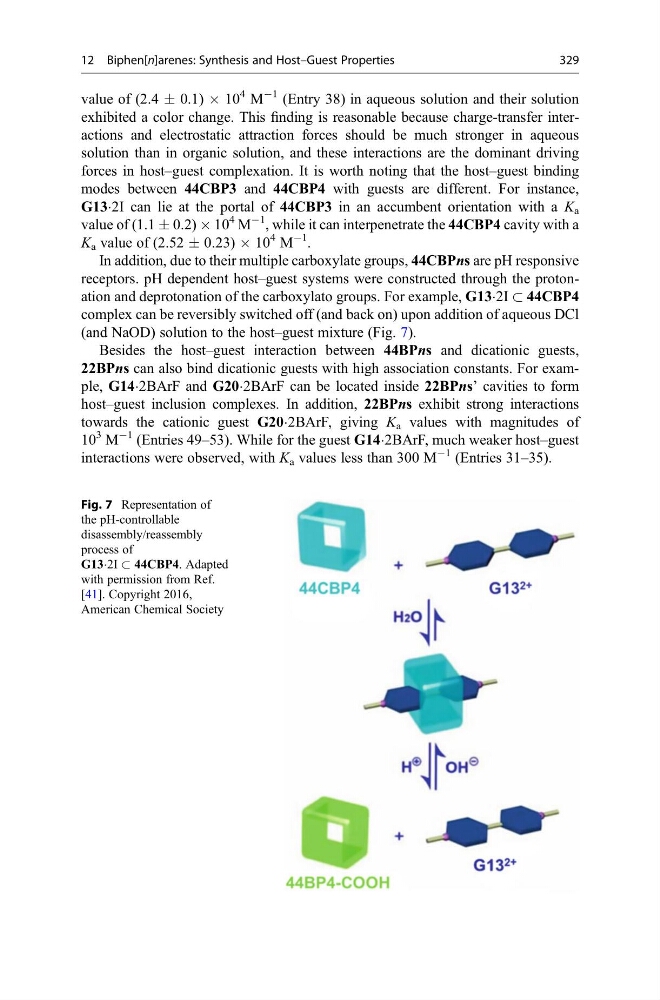
In addition, due to their multiple carboxylate groups, 44CBPns are pH responsive
receptors. pH dependent host–guest systems were constructed through the protonation and deprotonation of the carboxylato groups. For example, G13Á2I & 44CBP4
complex can be reversibly switched off (and back on) upon addition of aqueous DCl
(and NaOD) solution to the host–guest mixture (Fig. 7).
Besides the host–guest interaction between 44BPns and dicationic guests,
22BPns can also bind dicationic guests with high association constants. For example, G14Á2BArF and G20Á2BArF can be located inside 22BPns’ cavities to form
host–guest inclusion complexes. In addition, 22BPns exhibit strong interactions
towards the cationic guest G20Á2BArF, giving K a values with magnitudes of
10
3 M
À1 (Entries 49–53). While for the guest G14Á2BArF, much weaker host–guest
interactions were observed, with K a values less than 300 M
À1 (Entries 31–35).
Fig. 7 Representation of
the pH-controllable
disassembly/reassembly
process of
G13Á2I & 44CBP4. Adapted
with permission from Ref.
[41]. Copyright 2016,
American Chemical Society
12 Biphen[n]arenes: Synthesis and Host–Guest Properties
329
4 M
À1 (Entry 38) in aqueous solution and their solution
exhibited a color change. This finding is reasonable because charge-transfer interactions and electrostatic attraction forces should be much stronger in aqueous
solution than in organic solution, and these interactions are the dominant driving
forces in host–guest complexation. It is worth noting that the host–guest binding
modes between 44CBP3 and 44CBP4 with guests are different. For instance,
G13Á2I can lie at the portal of 44CBP3 in an accumbent orientation with a K a
value of (1.1 Æ 0.2) Â 10
4 M
À1 , while it can interpenetrate the 44CBP4 cavity with a
K a value of (2.52 Æ 0.23) Â 10
4 M
À1 .
In addition, due to their multiple carboxylate groups, 44CBPns are pH responsive
receptors. pH dependent host–guest systems were constructed through the protonation and deprotonation of the carboxylato groups. For example, G13Á2I & 44CBP4
complex can be reversibly switched off (and back on) upon addition of aqueous DCl
(and NaOD) solution to the host–guest mixture (Fig. 7).
Besides the host–guest interaction between 44BPns and dicationic guests,
22BPns can also bind dicationic guests with high association constants. For example, G14Á2BArF and G20Á2BArF can be located inside 22BPns’ cavities to form
host–guest inclusion complexes. In addition, 22BPns exhibit strong interactions
towards the cationic guest G20Á2BArF, giving K a values with magnitudes of
10
3 M
À1 (Entries 49–53). While for the guest G14Á2BArF, much weaker host–guest
interactions were observed, with K a values less than 300 M
À1 (Entries 31–35).
Fig. 7 Representation of
the pH-controllable
disassembly/reassembly
process of
G13Á2I & 44CBP4. Adapted
with permission from Ref.
[41]. Copyright 2016,
American Chemical Society
12 Biphen[n]arenes: Synthesis and Host–Guest Properties
329