

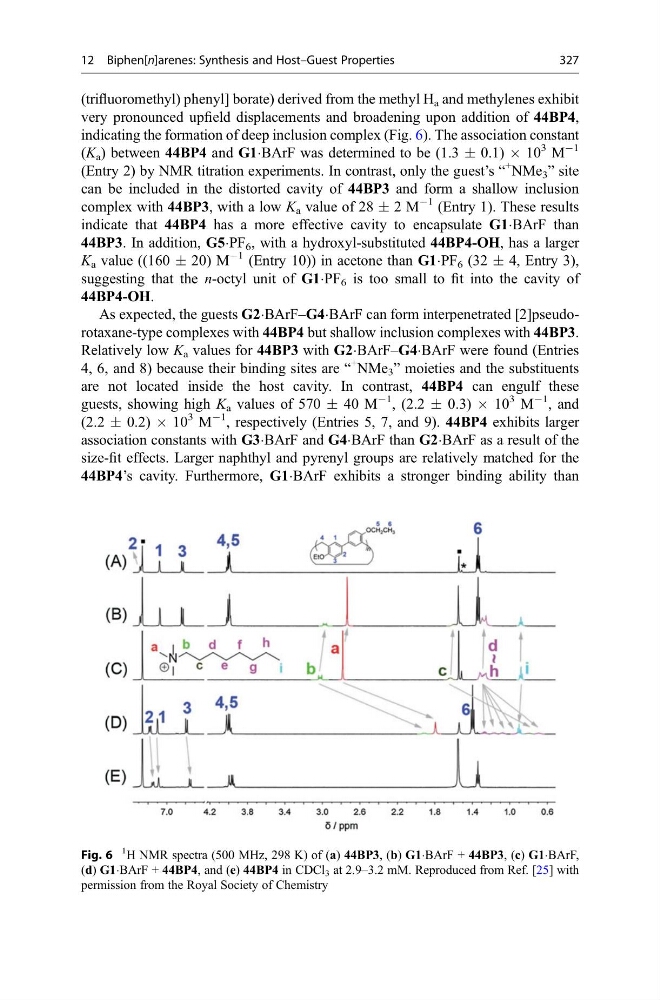
(trifluoromethyl) phenyl] borate) derived from the methyl H a and methylenes exhibit
very pronounced upfield displacements and broadening upon addition of 44BP4,
indicating the formation of deep inclusion complex (Fig. 6). The association constant
(K a ) between 44BP4 and G1ÁBArF was determined to be (1.3 Æ 0.1) Â 10
3 M
À1
(Entry 2) by NMR titration experiments. In contrast, only the guest’s “
+
NMe 3 ” site
can be included in the distorted cavity of 44BP3 and form a shallow inclusion
complex with 44BP3, with a low K a value of 28 Æ 2 M
À1 (Entry 1). These results
indicate that 44BP4 has a more effective cavity to encapsulate G1ÁBArF than
44BP3. In addition, G5ÁPF 6 , with a hydroxyl-substituted 44BP4-OH, has a larger
K a value ((160 Æ 20) M
À1 (Entry 10)) in acetone than G1ÁPF 6 (32 Æ 4, Entry 3),
suggesting that the n-octyl unit of G1ÁPF 6 is too small to fit into the cavity of
44BP4-OH.
As expected, the guests G2ÁBArF–G4ÁBArF can form interpenetrated [2]pseudorotaxane-type complexes with 44BP4 but shallow inclusion complexes with 44BP3.
Relatively low K a values for 44BP3 with G2ÁBArF–G4ÁBArF were found (Entries
4, 6, and 8) because their binding sites are “
+
NMe 3 ” moieties and the substituents
are not located inside the host cavity. In contrast, 44BP4 can engulf these
guests, showing high K a values of 570 Æ 40 M
À1 , (2.2 Æ 0.3) Â 10
3 M
À1 , and
(2.2 Æ 0.2) Â 10
3 M
À1 , respectively (Entries 5, 7, and 9). 44BP4 exhibits larger
association constants with G3ÁBArF and G4ÁBArF than G2ÁBArF as a result of the
size-fit effects. Larger naphthyl and pyrenyl groups are relatively matched for the
44BP4’s cavity. Furthermore, G1ÁBArF exhibits a stronger binding ability than
Fig. 6
1
H NMR spectra (500 MHz, 298 K) of (a) 44BP3, (b) G1ÁBArF + 44BP3, (c) G1ÁBArF,
(d) G1ÁBArF + 44BP4, and (e) 44BP4 in CDCl 3 at 2.9–3.2 mM. Reproduced from Ref. [25] with
permission from the Royal Society of Chemistry
12 Biphen[n]arenes: Synthesis and Host–Guest Properties
327
very pronounced upfield displacements and broadening upon addition of 44BP4,
indicating the formation of deep inclusion complex (Fig. 6). The association constant
(K a ) between 44BP4 and G1ÁBArF was determined to be (1.3 Æ 0.1) Â 10
3 M
À1
(Entry 2) by NMR titration experiments. In contrast, only the guest’s “
+
NMe 3 ” site
can be included in the distorted cavity of 44BP3 and form a shallow inclusion
complex with 44BP3, with a low K a value of 28 Æ 2 M
À1 (Entry 1). These results
indicate that 44BP4 has a more effective cavity to encapsulate G1ÁBArF than
44BP3. In addition, G5ÁPF 6 , with a hydroxyl-substituted 44BP4-OH, has a larger
K a value ((160 Æ 20) M
À1 (Entry 10)) in acetone than G1ÁPF 6 (32 Æ 4, Entry 3),
suggesting that the n-octyl unit of G1ÁPF 6 is too small to fit into the cavity of
44BP4-OH.
As expected, the guests G2ÁBArF–G4ÁBArF can form interpenetrated [2]pseudorotaxane-type complexes with 44BP4 but shallow inclusion complexes with 44BP3.
Relatively low K a values for 44BP3 with G2ÁBArF–G4ÁBArF were found (Entries
4, 6, and 8) because their binding sites are “
+
NMe 3 ” moieties and the substituents
are not located inside the host cavity. In contrast, 44BP4 can engulf these
guests, showing high K a values of 570 Æ 40 M
À1 , (2.2 Æ 0.3) Â 10
3 M
À1 , and
(2.2 Æ 0.2) Â 10
3 M
À1 , respectively (Entries 5, 7, and 9). 44BP4 exhibits larger
association constants with G3ÁBArF and G4ÁBArF than G2ÁBArF as a result of the
size-fit effects. Larger naphthyl and pyrenyl groups are relatively matched for the
44BP4’s cavity. Furthermore, G1ÁBArF exhibits a stronger binding ability than
Fig. 6
1
H NMR spectra (500 MHz, 298 K) of (a) 44BP3, (b) G1ÁBArF + 44BP3, (c) G1ÁBArF,
(d) G1ÁBArF + 44BP4, and (e) 44BP4 in CDCl 3 at 2.9–3.2 mM. Reproduced from Ref. [25] with
permission from the Royal Society of Chemistry
12 Biphen[n]arenes: Synthesis and Host–Guest Properties
327