

With their electron-rich cavities and various structures, biphen[n]arenes and their
derivatives can easily bind a variety of suitable electron-accepting molecules in
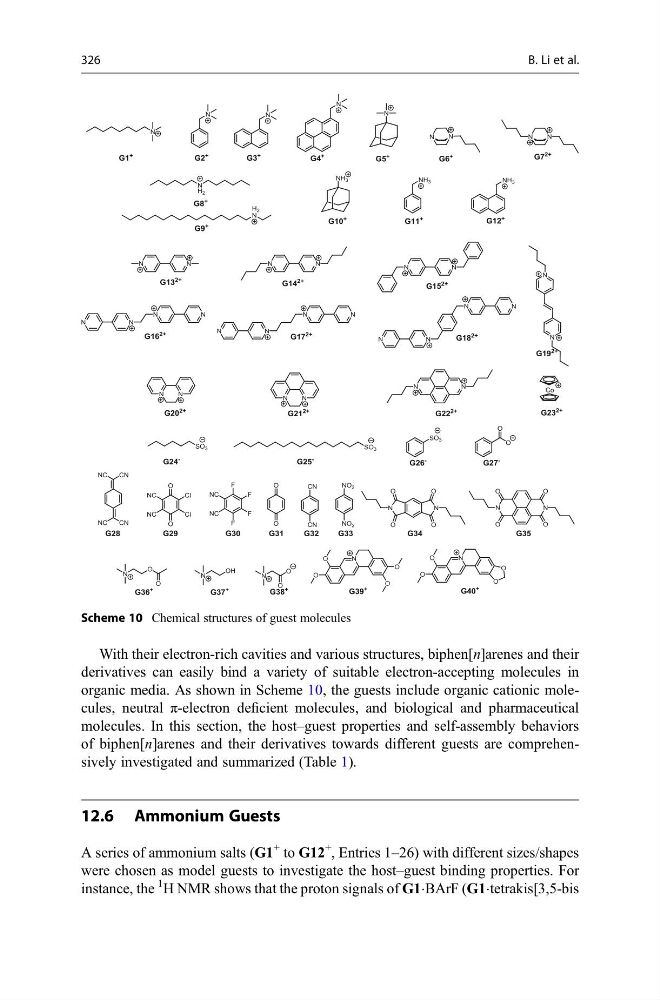
organic media. As shown in Scheme 10, the guests include organic cationic molecules, neutral π-electron deficient molecules, and biological and pharmaceutical
molecules. In this section, the host–guest properties and self-assembly behaviors
of biphen[n]arenes and their derivatives towards different guests are comprehensively investigated and summarized (Table 1).
12.6 Ammonium Guests
A series of ammonium salts (G1
+ to G12
+
, Entries 1–26) with different sizes/shapes
were chosen as model guests to investigate the host–guest binding properties. For
instance, the
1 H NMR shows that the proton signals of G1ÁBArF (G1Átetrakis[3,5-bis
Scheme 10 Chemical structures of guest molecules
326
B. Li et al.
derivatives can easily bind a variety of suitable electron-accepting molecules in
organic media. As shown in Scheme 10, the guests include organic cationic molecules, neutral π-electron deficient molecules, and biological and pharmaceutical
molecules. In this section, the host–guest properties and self-assembly behaviors
of biphen[n]arenes and their derivatives towards different guests are comprehensively investigated and summarized (Table 1).
12.6 Ammonium Guests
A series of ammonium salts (G1
+ to G12
+
, Entries 1–26) with different sizes/shapes
were chosen as model guests to investigate the host–guest binding properties. For
instance, the
1 H NMR shows that the proton signals of G1ÁBArF (G1Átetrakis[3,5-bis
Scheme 10 Chemical structures of guest molecules
326
B. Li et al.