

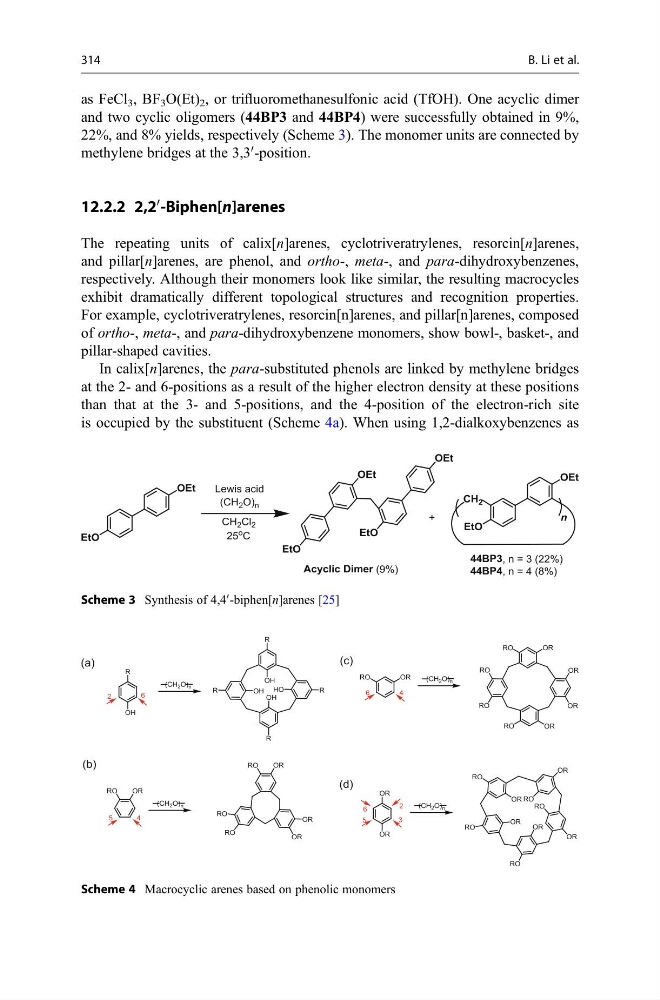
as FeCl 3 , BF 3 O(Et) 2 , or trifluoromethanesulfonic acid (TfOH). One acyclic dimer
and two cyclic oligomers (44BP3 and 44BP4) were successfully obtained in 9%,
22%, and 8% yields, respectively (Scheme 3). The monomer units are connected by
methylene bridges at the 3,3
0 -position.
12.2.2 2,2
0 -Biphen[n]arenes
The repeating units of calix[n]arenes, cyclotriveratrylenes, resorcin[n]arenes,
and pillar[n]arenes, are phenol, and ortho-, meta-, and para-dihydroxybenzenes,
respectively. Although their monomers look like similar, the resulting macrocycles
exhibit dramatically different topological structures and recognition properties.
For example, cyclotriveratrylenes, resorcin[n]arenes, and pillar[n]arenes, composed
of ortho-, meta-, and para-dihydroxybenzene monomers, show bowl-, basket-, and
pillar-shaped cavities.
In calix[n]arenes, the para-substituted phenols are linked by methylene bridges
at the 2- and 6-positions as a result of the higher electron density at these positions
than that at the 3- and 5-positions, and the 4-position of the electron-rich site
is occupied by the substituent (Scheme 4a). When using 1,2-dialkoxybenzenes as
Scheme 3 Synthesis of 4,4
0 -biphen[n]arenes [25]
Scheme 4 Macrocyclic arenes based on phenolic monomers
314
B. Li et al.
and two cyclic oligomers (44BP3 and 44BP4) were successfully obtained in 9%,
22%, and 8% yields, respectively (Scheme 3). The monomer units are connected by
methylene bridges at the 3,3
0 -position.
12.2.2 2,2
0 -Biphen[n]arenes
The repeating units of calix[n]arenes, cyclotriveratrylenes, resorcin[n]arenes,
and pillar[n]arenes, are phenol, and ortho-, meta-, and para-dihydroxybenzenes,
respectively. Although their monomers look like similar, the resulting macrocycles
exhibit dramatically different topological structures and recognition properties.
For example, cyclotriveratrylenes, resorcin[n]arenes, and pillar[n]arenes, composed
of ortho-, meta-, and para-dihydroxybenzene monomers, show bowl-, basket-, and
pillar-shaped cavities.
In calix[n]arenes, the para-substituted phenols are linked by methylene bridges
at the 2- and 6-positions as a result of the higher electron density at these positions
than that at the 3- and 5-positions, and the 4-position of the electron-rich site
is occupied by the substituent (Scheme 4a). When using 1,2-dialkoxybenzenes as
Scheme 3 Synthesis of 4,4
0 -biphen[n]arenes [25]
Scheme 4 Macrocyclic arenes based on phenolic monomers
314
B. Li et al.