

host–guest properties. Above all, their topological structures are remarkably unique.
For example, 4,4
0 -biphen[3]arene displays distorted triangular-prism structure;
4,4
0 -biphen[4]arene shows cuboid-like box; and terphen[n]arenes and quaterphen
[n]arenes exhibit giant cavity sizes and nice self-assembly properties due to long and
rigid terphenyl and quaterphenyl monomers. Particularly, the cavity diameter of the
largest macrocyclic molecule, quaterphen[6]arene, is more than 3.0 nm, which far
exceeds the cavity sizes of traditional macrocycles. Due to the above interesting
properties, biphen[n]arene chemistry has been attracted tremendous attentions in the
past 4 years. In this chapter, the latest progress in the synthesis, structural features,
their application in molecular recognition, and self-assembly properties of biphen[n]
arenes and extended biphen-[n]arenes will be reviewed.
12.2 Synthesis of Biphen[n]arenes
The development of synthetic macrocycles with distinctive structures is great
significance in the field of supramolecular chemistry. Even though some new macrocyclic receptors have been constructed, far more are needed to advance macrocyclic
chemistry. In the following section, the syntheses of novel biphen[n]arenes, terphen
[n]arenes, and quaterphen[n]arenes are discussed and introduced. All of these
macrocycles can be obtained through simple one-step reactions from commercially
available or easy-to-made monomers.
12.2.1 4,4
0 -Biphen[n]arenes
In 2015, our group successfully synthesized 4,4
0 -biphen[n]arenes (44BPns) [25].
The 44BPns are prepared through a one-pot condensation of 4,4
0 -biphenol diethyl
ether and paraformaldehyde in CH 2 Cl 2 in the presence of a Lewis acid catalyst such
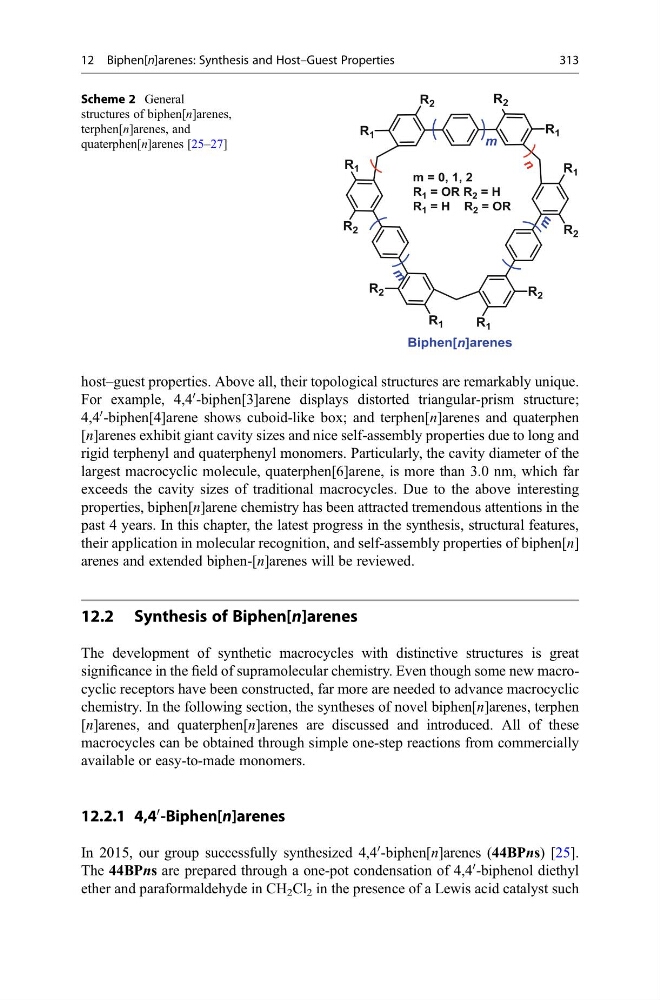
Scheme 2 General
structures of biphen[n]arenes,
terphen[n]arenes, and
quaterphen[n]arenes [25–27]
12 Biphen[n]arenes: Synthesis and Host–Guest Properties
313
For example, 4,4
0 -biphen[3]arene displays distorted triangular-prism structure;
4,4
0 -biphen[4]arene shows cuboid-like box; and terphen[n]arenes and quaterphen
[n]arenes exhibit giant cavity sizes and nice self-assembly properties due to long and
rigid terphenyl and quaterphenyl monomers. Particularly, the cavity diameter of the
largest macrocyclic molecule, quaterphen[6]arene, is more than 3.0 nm, which far
exceeds the cavity sizes of traditional macrocycles. Due to the above interesting
properties, biphen[n]arene chemistry has been attracted tremendous attentions in the
past 4 years. In this chapter, the latest progress in the synthesis, structural features,
their application in molecular recognition, and self-assembly properties of biphen[n]
arenes and extended biphen-[n]arenes will be reviewed.
12.2 Synthesis of Biphen[n]arenes
The development of synthetic macrocycles with distinctive structures is great
significance in the field of supramolecular chemistry. Even though some new macrocyclic receptors have been constructed, far more are needed to advance macrocyclic
chemistry. In the following section, the syntheses of novel biphen[n]arenes, terphen
[n]arenes, and quaterphen[n]arenes are discussed and introduced. All of these
macrocycles can be obtained through simple one-step reactions from commercially
available or easy-to-made monomers.
12.2.1 4,4
0 -Biphen[n]arenes
In 2015, our group successfully synthesized 4,4
0 -biphen[n]arenes (44BPns) [25].
The 44BPns are prepared through a one-pot condensation of 4,4
0 -biphenol diethyl
ether and paraformaldehyde in CH 2 Cl 2 in the presence of a Lewis acid catalyst such
Scheme 2 General
structures of biphen[n]arenes,
terphen[n]arenes, and
quaterphen[n]arenes [25–27]
12 Biphen[n]arenes: Synthesis and Host–Guest Properties
313