

polymer- and silica-bound rotaxanes can be driven reversibly by acid/base stimulus
cleanly, as the excess reagents can be washed away, while the switches remain
attached due to the strong covalent bonding with the surfaces. These works demonstrated a general strategy to fabricate novel solid-state molecular switches based on
stimuli-responsive rotaxanes and significantly advanced the evolution of rotaxanes
from solution- to solid-phase applications.
Besides the above strategy to transfer rotaxane switching into solid state, other
approaches have been reported for the construction of rotaxane-functionalized solid
materials. The precise control of surface properties by stimuli-responsive molecular
motion can also lead to fascinating switchable surfaces, including bending a gold
sheet through the molecular shuttling motion of thousands of immobilized rotaxanes
[61], transporting a liquid drop by the irradiation of light [18a], or altering the surface
plasmonic resonance of the gold nanodisks [62].
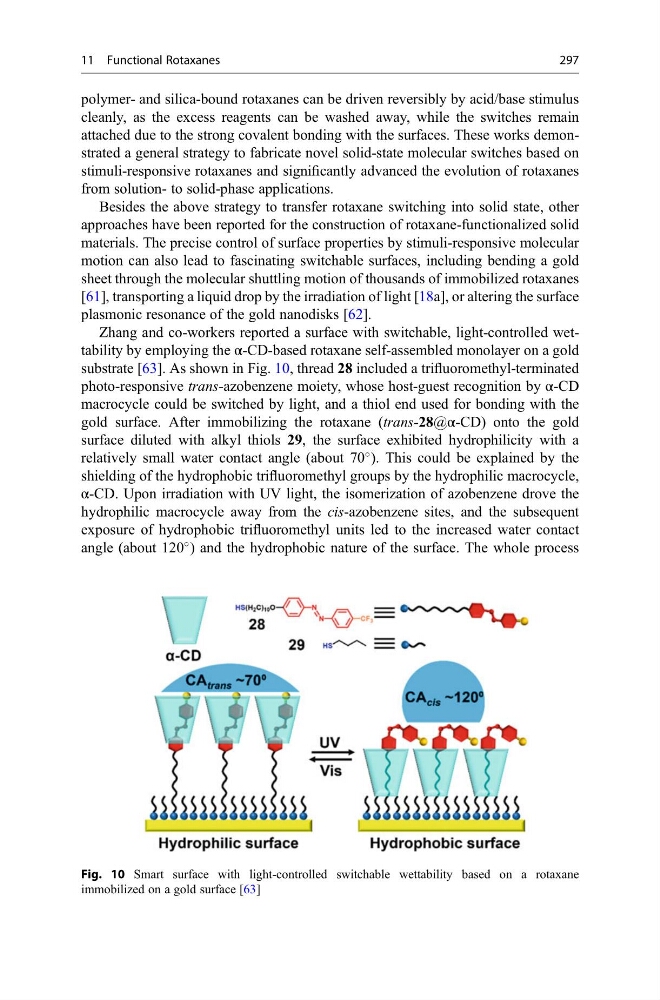
Zhang and co-workers reported a surface with switchable, light-controlled wettability by employing the α-CD-based rotaxane self-assembled monolayer on a gold
substrate [63]. As shown in Fig. 10, thread 28 included a trifluoromethyl-terminated
photo-responsive trans-azobenzene moiety, whose host-guest recognition by α-CD
macrocycle could be switched by light, and a thiol end used for bonding with the
gold surface. After immobilizing the rotaxane (trans-28@α-CD) onto the gold
surface diluted with alkyl thiols 29, the surface exhibited hydrophilicity with a
relatively small water contact angle (about 70
). This could be explained by the
shielding of the hydrophobic trifluoromethyl groups by the hydrophilic macrocycle,
α-CD. Upon irradiation with UV light, the isomerization of azobenzene drove the
hydrophilic macrocycle away from the cis-azobenzene sites, and the subsequent
exposure of hydrophobic trifluoromethyl units led to the increased water contact
angle (about 120
) and the hydrophobic nature of the surface. The whole process
Fig. 10 Smart surface with light-controlled switchable wettability based on a rotaxane
immobilized on a gold surface [63]
11 Functional Rotaxanes
297
cleanly, as the excess reagents can be washed away, while the switches remain
attached due to the strong covalent bonding with the surfaces. These works demonstrated a general strategy to fabricate novel solid-state molecular switches based on
stimuli-responsive rotaxanes and significantly advanced the evolution of rotaxanes
from solution- to solid-phase applications.
Besides the above strategy to transfer rotaxane switching into solid state, other
approaches have been reported for the construction of rotaxane-functionalized solid
materials. The precise control of surface properties by stimuli-responsive molecular
motion can also lead to fascinating switchable surfaces, including bending a gold
sheet through the molecular shuttling motion of thousands of immobilized rotaxanes
[61], transporting a liquid drop by the irradiation of light [18a], or altering the surface
plasmonic resonance of the gold nanodisks [62].
Zhang and co-workers reported a surface with switchable, light-controlled wettability by employing the α-CD-based rotaxane self-assembled monolayer on a gold
substrate [63]. As shown in Fig. 10, thread 28 included a trifluoromethyl-terminated
photo-responsive trans-azobenzene moiety, whose host-guest recognition by α-CD
macrocycle could be switched by light, and a thiol end used for bonding with the
gold surface. After immobilizing the rotaxane (trans-28@α-CD) onto the gold
surface diluted with alkyl thiols 29, the surface exhibited hydrophilicity with a
relatively small water contact angle (about 70
). This could be explained by the
shielding of the hydrophobic trifluoromethyl groups by the hydrophilic macrocycle,
α-CD. Upon irradiation with UV light, the isomerization of azobenzene drove the
hydrophilic macrocycle away from the cis-azobenzene sites, and the subsequent
exposure of hydrophobic trifluoromethyl units led to the increased water contact
angle (about 120
) and the hydrophobic nature of the surface. The whole process
Fig. 10 Smart surface with light-controlled switchable wettability based on a rotaxane
immobilized on a gold surface [63]
11 Functional Rotaxanes
297