

advantages of the two solid materials lie on their excellent optical transparency,
facile preparation and modification, and wide applications in optoelectronic devices,
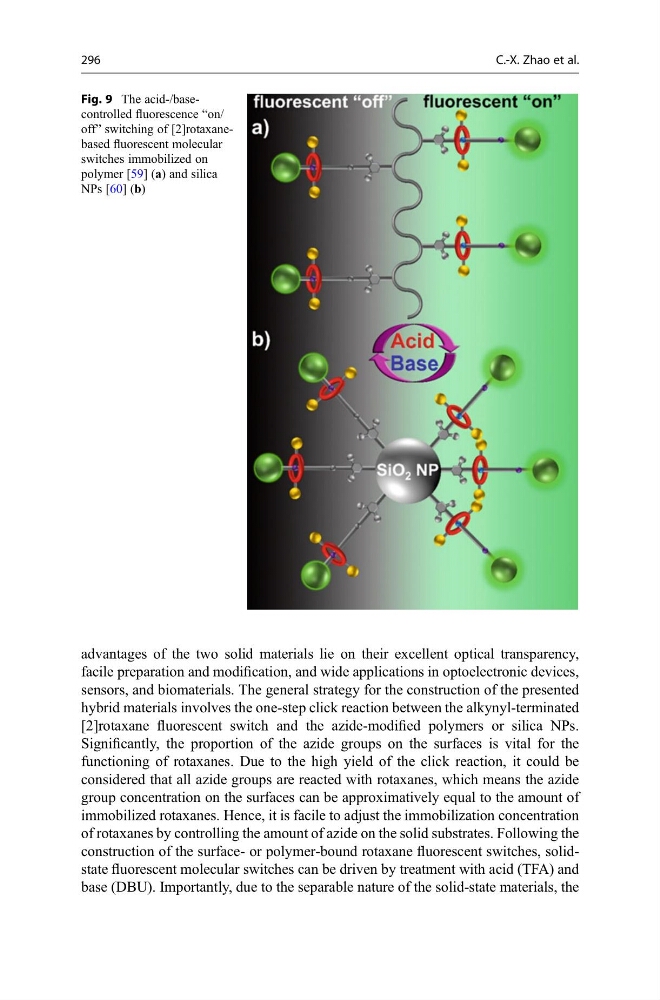
sensors, and biomaterials. The general strategy for the construction of the presented
hybrid materials involves the one-step click reaction between the alkynyl-terminated
[2]rotaxane fluorescent switch and the azide-modified polymers or silica NPs.
Significantly, the proportion of the azide groups on the surfaces is vital for the
functioning of rotaxanes. Due to the high yield of the click reaction, it could be
considered that all azide groups are reacted with rotaxanes, which means the azide
group concentration on the surfaces can be approximatively equal to the amount of
immobilized rotaxanes. Hence, it is facile to adjust the immobilization concentration
of rotaxanes by controlling the amount of azide on the solid substrates. Following the
construction of the surface- or polymer-bound rotaxane fluorescent switches, solidstate fluorescent molecular switches can be driven by treatment with acid (TFA) and
base (DBU). Importantly, due to the separable nature of the solid-state materials, the
Fig. 9 The acid-/basecontrolled fluorescence “on/
off” switching of [2]rotaxanebased fluorescent molecular
switches immobilized on
polymer [59] (a) and silica
NPs [60] (b)
296
C.-X. Zhao et al.
facile preparation and modification, and wide applications in optoelectronic devices,
sensors, and biomaterials. The general strategy for the construction of the presented
hybrid materials involves the one-step click reaction between the alkynyl-terminated
[2]rotaxane fluorescent switch and the azide-modified polymers or silica NPs.
Significantly, the proportion of the azide groups on the surfaces is vital for the
functioning of rotaxanes. Due to the high yield of the click reaction, it could be
considered that all azide groups are reacted with rotaxanes, which means the azide
group concentration on the surfaces can be approximatively equal to the amount of
immobilized rotaxanes. Hence, it is facile to adjust the immobilization concentration
of rotaxanes by controlling the amount of azide on the solid substrates. Following the
construction of the surface- or polymer-bound rotaxane fluorescent switches, solidstate fluorescent molecular switches can be driven by treatment with acid (TFA) and
base (DBU). Importantly, due to the separable nature of the solid-state materials, the
Fig. 9 The acid-/basecontrolled fluorescence “on/
off” switching of [2]rotaxanebased fluorescent molecular
switches immobilized on
polymer [59] (a) and silica
NPs [60] (b)
296
C.-X. Zhao et al.