

1.2
The Binding Behaviors of Crown Ethers in Aqueous
Solution
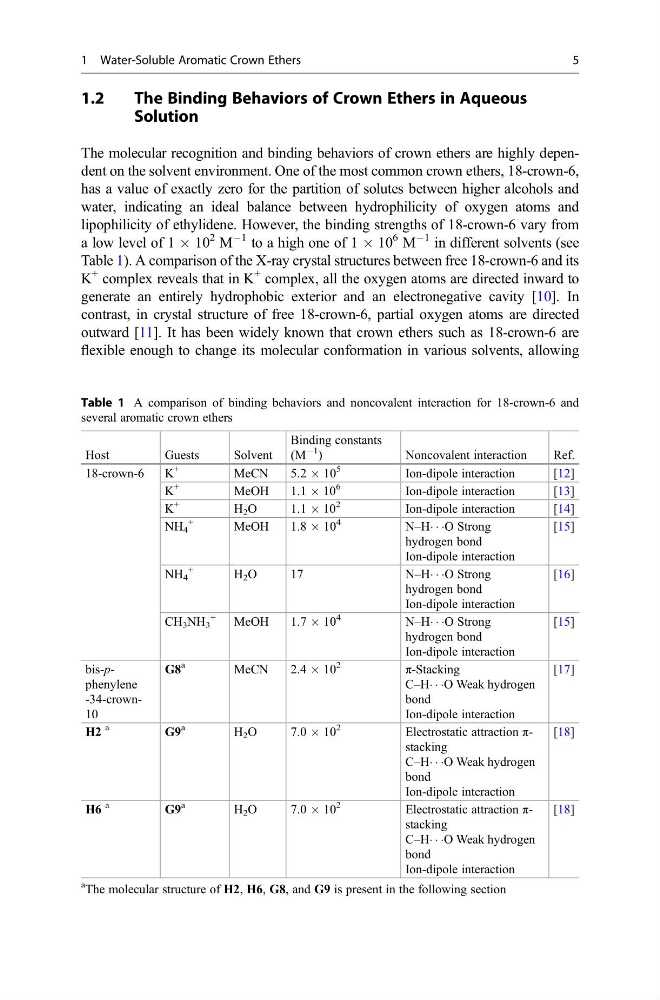
The molecular recognition and binding behaviors of crown ethers are highly dependent on the solvent environment. One of the most common crown ethers, 18-crown-6,
has a value of exactly zero for the partition of solutes between higher alcohols and
water, indicating an ideal balance between hydrophilicity of oxygen atoms and
lipophilicity of ethylidene. However, the binding strengths of 18-crown-6 vary from
a low level of 1 Â 10
2 M
À1 to a high one of 1 Â 10
6 M
À1 in different solvents (see
Table 1). A comparison of the X-ray crystal structures between free 18-crown-6 and its
K
+ complex reveals that in K
+ complex, all the oxygen atoms are directed inward to
generate an entirely hydrophobic exterior and an electronegative cavity [10]. In
contrast, in crystal structure of free 18-crown-6, partial oxygen atoms are directed
outward [11]. It has been widely known that crown ethers such as 18-crown-6 are
flexible enough to change its molecular conformation in various solvents, allowing
Table 1 A comparison of binding behaviors and noncovalent interaction for 18-crown-6 and
several aromatic crown ethers
Host
Guests
Solvent
Binding constants
(M
À1
)
Noncovalent interaction
Ref.
18-crown-6
K
+
MeCN
5.2 Â 10
5
Ion-dipole interaction
[12]
K
+
MeOH
1.1 Â 10
6
Ion-dipole interaction
[13]
K
+
H 2 O
1.1 Â 10
2
Ion-dipole interaction
[14]
NH 4
+
MeOH
1.8 Â 10
4
N–HÁ Á ÁO Strong
hydrogen bond
Ion-dipole interaction
[15]
NH 4
+
H 2 O
1 7
N –HÁ Á ÁO Strong
hydrogen bond
Ion-dipole interaction
[16]
CH 3 NH 3
+
MeOH
1.7 Â 10
4
N–HÁ Á ÁO Strong
hydrogen bond
Ion-dipole interaction
[15]
bis-pphenylene
-34-crown10
G8
a
MeCN
2.4 Â 10
2
π-Stacking
C–HÁ Á ÁO Weak hydrogen
bond
Ion-dipole interaction
[17]
H2
a
G9
a
H 2 O
7.0 Â 10
2
Electrostatic attraction πstacking
C–HÁ Á ÁO Weak hydrogen
bond
Ion-dipole interaction
[18]
H6
a
G9
a
H 2 O
7.0 Â 10
2
Electrostatic attraction πstacking
C–HÁ Á ÁO Weak hydrogen
bond
Ion-dipole interaction
[18]
a The molecular structure of H2, H6, G8, and G9 is present in the following section
1 Water-Soluble Aromatic Crown Ethers
5
The Binding Behaviors of Crown Ethers in Aqueous
Solution
The molecular recognition and binding behaviors of crown ethers are highly dependent on the solvent environment. One of the most common crown ethers, 18-crown-6,
has a value of exactly zero for the partition of solutes between higher alcohols and
water, indicating an ideal balance between hydrophilicity of oxygen atoms and
lipophilicity of ethylidene. However, the binding strengths of 18-crown-6 vary from
a low level of 1 Â 10
2 M
À1 to a high one of 1 Â 10
6 M
À1 in different solvents (see
Table 1). A comparison of the X-ray crystal structures between free 18-crown-6 and its
K
+ complex reveals that in K
+ complex, all the oxygen atoms are directed inward to
generate an entirely hydrophobic exterior and an electronegative cavity [10]. In
contrast, in crystal structure of free 18-crown-6, partial oxygen atoms are directed
outward [11]. It has been widely known that crown ethers such as 18-crown-6 are
flexible enough to change its molecular conformation in various solvents, allowing
Table 1 A comparison of binding behaviors and noncovalent interaction for 18-crown-6 and
several aromatic crown ethers
Host
Guests
Solvent
Binding constants
(M
À1
)
Noncovalent interaction
Ref.
18-crown-6
K
+
MeCN
5.2 Â 10
5
Ion-dipole interaction
[12]
K
+
MeOH
1.1 Â 10
6
Ion-dipole interaction
[13]
K
+
H 2 O
1.1 Â 10
2
Ion-dipole interaction
[14]
NH 4
+
MeOH
1.8 Â 10
4
N–HÁ Á ÁO Strong
hydrogen bond
Ion-dipole interaction
[15]
NH 4
+
H 2 O
1 7
N –HÁ Á ÁO Strong
hydrogen bond
Ion-dipole interaction
[16]
CH 3 NH 3
+
MeOH
1.7 Â 10
4
N–HÁ Á ÁO Strong
hydrogen bond
Ion-dipole interaction
[15]
bis-pphenylene
-34-crown10
G8
a
MeCN
2.4 Â 10
2
π-Stacking
C–HÁ Á ÁO Weak hydrogen
bond
Ion-dipole interaction
[17]
H2
a
G9
a
H 2 O
7.0 Â 10
2
Electrostatic attraction πstacking
C–HÁ Á ÁO Weak hydrogen
bond
Ion-dipole interaction
[18]
H6
a
G9
a
H 2 O
7.0 Â 10
2
Electrostatic attraction πstacking
C–HÁ Á ÁO Weak hydrogen
bond
Ion-dipole interaction
[18]
a The molecular structure of H2, H6, G8, and G9 is present in the following section
1 Water-Soluble Aromatic Crown Ethers
5