

ammoniums, and diazonium [4]. To broaden the range of molecular recognition
of crown ethers, lots of crown ethers with aromatic backbones have been
developed which can associate with π-electron-poor guests like organic ammonium [5], pyridinium [6], pyromellitic diimide [7], and naphthalene diimide
with the aid of π-stacking interaction [8]. During the past three decades, a lot of
supramolecular architecture based on molecular recognition of aromatic crown
ethers has been developed [9].
Almost all the neutral aromatic crown ethers are insoluble in aqueous
environment. To increase the solubility in aqueous solution, a common method
is introducing negatively charged groups to the aromatic backbone of crown
ethers. To date, different synthetic strategies have been developed by many
research groups to synthesize negatively charged crown ethers with versatile
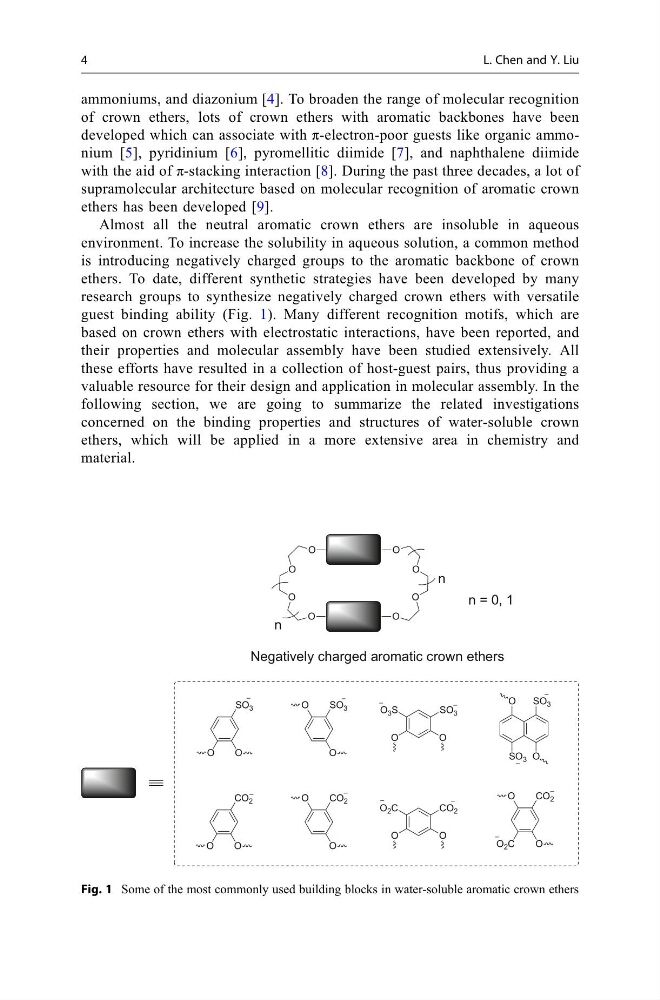
guest binding ability (Fig. 1). Many different recognition motifs, which are
based on crown ethers with electrostatic interactions, have been reported, and
their properties and molecular assembly have been studied extensively. All
these efforts have resulted in a collection of host-guest pairs, thus providing a
valuable resource for their design and application in molecular assembly. In the
following section, we are going to summarize the related investigations
concerned on the binding properties and structures of water-soluble crown
ethers, which will be applied in a more extensive area in chemistry and
material.
O
O
SO 3
O
O
SO 3
O
O
O 3 S
SO 3
SO 3
SO 3
O
O
O
CO 2
O
O 2 C
CO 2
O
O
O
CO 2
O
O 2 C
O
O
CO 2
O
O
O
O
O
O
O
O
n
n
n = 0, 1
Negatively charged aromatic crown ethers
Fig. 1 Some of the most commonly used building blocks in water-soluble aromatic crown ethers
4
L. Chen and Y. Liu
of crown ethers, lots of crown ethers with aromatic backbones have been
developed which can associate with π-electron-poor guests like organic ammonium [5], pyridinium [6], pyromellitic diimide [7], and naphthalene diimide
with the aid of π-stacking interaction [8]. During the past three decades, a lot of
supramolecular architecture based on molecular recognition of aromatic crown
ethers has been developed [9].
Almost all the neutral aromatic crown ethers are insoluble in aqueous
environment. To increase the solubility in aqueous solution, a common method
is introducing negatively charged groups to the aromatic backbone of crown
ethers. To date, different synthetic strategies have been developed by many
research groups to synthesize negatively charged crown ethers with versatile
guest binding ability (Fig. 1). Many different recognition motifs, which are
based on crown ethers with electrostatic interactions, have been reported, and
their properties and molecular assembly have been studied extensively. All
these efforts have resulted in a collection of host-guest pairs, thus providing a
valuable resource for their design and application in molecular assembly. In the
following section, we are going to summarize the related investigations
concerned on the binding properties and structures of water-soluble crown
ethers, which will be applied in a more extensive area in chemistry and
material.
O
O
SO 3
O
O
SO 3
O
O
O 3 S
SO 3
SO 3
SO 3
O
O
O
CO 2
O
O 2 C
CO 2
O
O
O
CO 2
O
O 2 C
O
O
CO 2
O
O
O
O
O
O
O
O
n
n
n = 0, 1
Negatively charged aromatic crown ethers
Fig. 1 Some of the most commonly used building blocks in water-soluble aromatic crown ethers
4
L. Chen and Y. Liu